Dual SIM 4G Router for Oil and Gas Industry: Reliable Connectivity for Remote Operations
Oil and gas operations rarely take place in convenient networking environments. Well sites, pumping facilities, storage areas, pipelines, remote monitoring stations, and other field assets can be spread across large geographic areas where conventional wired connectivity is difficult to install or maintain.
At the same time, these sites increasingly depend on digital communication for equipment monitoring, data acquisition, remote maintenance, video surveillance, and operational coordination. A communication failure can leave field equipment disconnected from the control centre even when the underlying industrial equipment continues to operate normally.
This is one reason a dual SIM 4G router for the oil and gas industry can be useful for remote industrial networking. By providing two cellular connections within one communication platform, a dual-SIM router can offer a practical way to add connectivity redundancy to distributed assets.
For oil and gas system integrators, however, dual-SIM capability should not be evaluated in isolation. The router also needs to support the site's industrial interfaces, environmental requirements, VPN security, remote management, power conditions, and maintenance model.
Shenzhen E-Lins Technology Co., Ltd. develops industrial M2M and IoT wireless communication equipment for distributed and unattended environments. E-Lins has experience in industrial wireless communication dating back to 1999, including early applications involving power grids and oil fields, and its current portfolio includes industrial 4G routers, 5G routers, industrial modems, DTUs, and embedded communication equipment.
Why Cellular Networking Fits Remote Oil and Gas Operations
Many oil and gas assets are located far away from central offices or data centres. Installing fibre or other fixed communication infrastructure can be impractical at certain locations, especially when the equipment is temporary, geographically isolated, or spread along a large field or pipeline route.
A cellular router can provide a wireless backhaul between the field network and a remote monitoring or management system.
A typical architecture can be represented as:
Industrial Equipment → Local Ethernet/Serial Network → 4G Industrial Router → Cellular Network → Secure Remote Network → SCADA or Management System
The router acts as the gateway between field equipment and the wider communication network.
This approach can support applications such as remote equipment monitoring, industrial data acquisition, alarm transmission, remote maintenance, and IP-based video communication.
For oil and gas projects, the main benefit is not simply avoiding cables. The larger advantage is having a communication architecture that can be deployed across distributed assets and managed centrally.
Why Dual SIM Matters in Remote Industrial Sites
A single mobile connection creates a single point of dependency.
Even where cellular coverage is generally good, field conditions can change. Network congestion, carrier maintenance, temporary outages, local signal fluctuations, or other service problems can interrupt communications.
A dual-SIM router provides two SIM interfaces that can be configured as alternative cellular connections. When the primary connection becomes unavailable, the router can switch to the backup connection according to its failover configuration.
This does not mean dual SIM can guarantee uninterrupted connectivity under every circumstance. Both SIMs may still be affected by the same physical environment if they rely on similar network infrastructure. Nevertheless, using independent cellular subscriptions can reduce reliance on one connection and provide an additional layer of redundancy.
For an unattended oil and gas installation, this can be more important than simply achieving the highest possible download speed.
Where Dual-SIM Redundancy Can Be Useful
Dual-SIM architecture can be considered for:
-
Remote well monitoring
-
Pipeline communication points
-
Pumping stations
-
Tank and storage monitoring
-
Distributed industrial controllers
-
Remote surveillance systems
-
Temporary field installations
-
Other unattended industrial assets
The correct configuration depends on the local cellular environment and the customer's network architecture.
What Should an Oil and Gas Integrator Expect From an Industrial 4G Router?
A field router should be selected around the actual equipment connected to it.
In an oil and gas installation, the router may communicate with PLCs, meters, sensors, industrial computers, monitoring equipment, cameras, or other networked devices.
Ethernet Connectivity
Ethernet is useful when several IP-based devices need to share one cellular gateway.
E-Lins' H900 Gigabit Industrial 4G Router provides five Gigabit Ethernet ports, supporting network expansion for multiple connected devices.
A multi-port router can reduce the need for additional switches in smaller installations and provide a central communication point for local industrial equipment.
Serial Communication
Not every field device uses Ethernet. Legacy industrial equipment may still communicate through RS232 or RS485 interfaces.
In these cases, an industrial modem or DTU can be more appropriate than a conventional IP-only router.
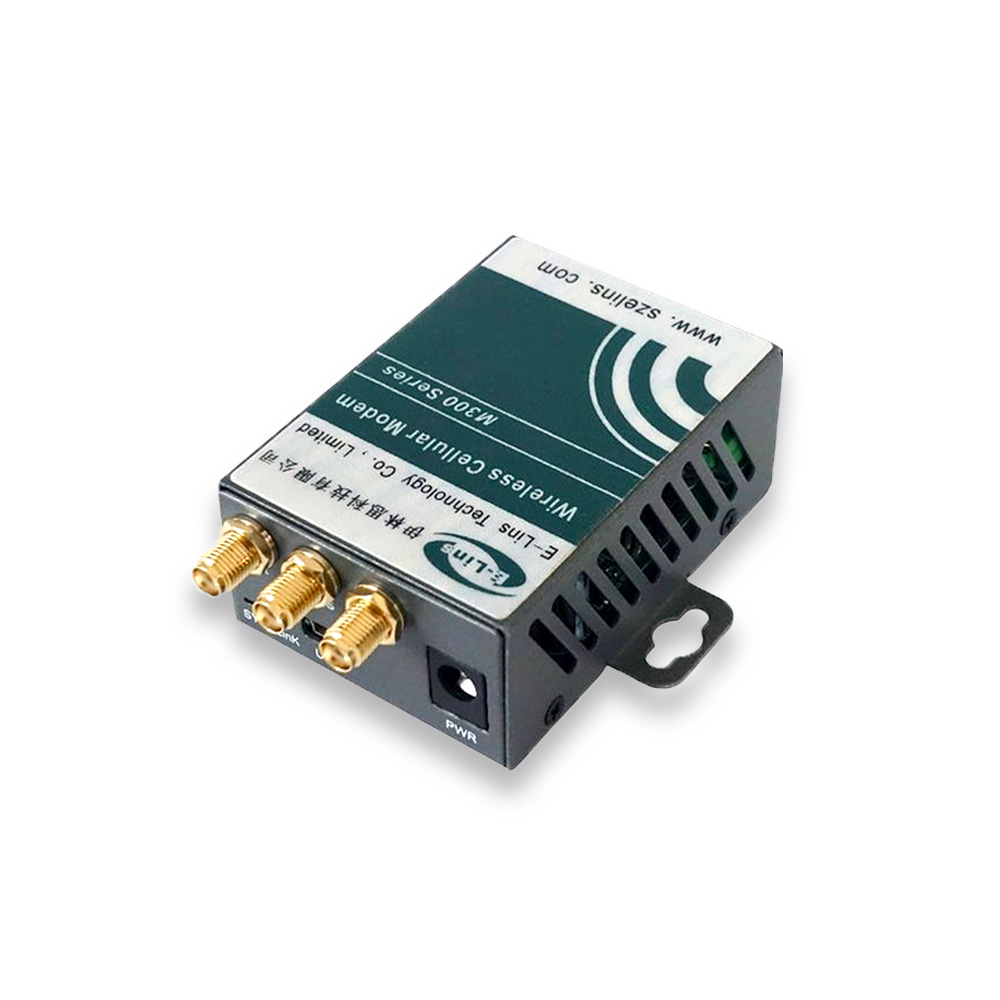
E-Lins offers M300/M400 Industrial 4G Modems, which provide RS232/RS485-to-4G conversion and serial transparent transmission. This allows existing PLCs and meters to communicate through a cellular network without requiring complete replacement of their field communication interface.
For an oil and gas project with a mixture of legacy serial devices and modern Ethernet equipment, the communication architecture should be mapped before the router model is selected.
Reliability Under Harsh Field Conditions
Oil and gas communication equipment may be installed in environments with large temperature changes, electrical interference, dust, vibration, or limited physical access.
Consumer networking hardware is generally not designed around the same operating requirements as industrial communication equipment.
E-Lins specifies industrial-grade chips and components for its industrial communication products, with a stated operating temperature range of -35°C to +75°C. The company's hardware specifications also include 15KV ESD protection and 1.5KV electromagnetic isolation.
These features can be relevant for field networking equipment installed close to industrial electrical systems.
E-Lins also incorporates hardware watchdog timers and link self-healing mechanisms into its technical architecture.
For an unattended site, automatic recovery functions can help reduce situations where a technician needs to physically restart the communications equipment.
The company states that its industrial communication equipment can achieve an online rate of at least 99.5%. Actual availability at an oil and gas site will depend on cellular coverage, antenna installation, equipment configuration, power quality, environmental conditions, and the network service itself.
Cellular Connectivity for Oil and Gas Data Acquisition
Remote monitoring systems generate a wide range of data.
Some applications only transmit small packets of sensor readings. Others may require more frequent data collection or combine control data with video and engineering access.
A practical router selection process starts by determining the traffic profile.
Low-Data-Rate Monitoring
Temperature, pressure, status, alarm, meter, and other telemetry data may generate relatively small amounts of traffic.
For these applications, network reliability, secure connectivity, and long-term manageability can be more important than maximum bandwidth.
Multi-Device Industrial Networks
A field installation can contain several monitoring devices connected to the same Ethernet network. In that situation, the router needs sufficient Ethernet capacity and routing functionality to handle concurrent connections.
Video Monitoring
Security and operational video can consume significantly more bandwidth than ordinary telemetry. When video is part of the field network, the cellular backhaul needs to be evaluated based on expected resolution, frame rate, compression, concurrent streams, and network conditions.
This is one reason E-Lins maintains separate industrial router platforms rather than using one product architecture for every application.
Secure Remote Access Is Essential for Connected Field Equipment
Remote connectivity can improve operational visibility, but the communication architecture should not expose industrial devices directly to uncontrolled public networks.
A VPN can create an encrypted communication path between the remote industrial site and the authorised enterprise network.
E-Lins supports WireGuard, IPsec, and OpenVPN, allowing system integrators to select a VPN method compatible with their network design.
For example, an operator can establish a controlled remote connection between a field router and a central management environment rather than assigning unrestricted inbound access to individual PLCs or other industrial devices.
Security planning should also cover:
-
User authentication
-
Firewall policies
-
Management interfaces
-
Allowed communication paths
-
Remote-access permissions
-
Firmware maintenance
-
Device monitoring
The router should therefore be considered part of the site's overall industrial network security architecture.
Managing Hundreds of Remote Routers
An oil and gas network may contain a large number of remote communication points. Configuring and troubleshooting every router individually becomes increasingly inefficient as the network expands.
This makes centralised device management important.
E-Lins supports TR-069, SNMP, SSH, and NMS cloud platforms for remote management and monitoring.
Depending on the customer's system, centralised management can support tasks such as connectivity monitoring, device configuration, diagnostics, and maintenance.
E-Lins also provides 7×24 remote technical support and states that approximately 90% of issues can be resolved remotely through its service model.
This approach is especially useful for field operations where a router may be installed far from the main engineering team.
Remote Oil and Gas Networking Is Not Only About Routers
A communication project can fail even when the router itself has strong specifications.
The complete installation needs to be considered.
Antenna Position
Cellular signal quality can change significantly depending on mounting height, surrounding structures, terrain, and antenna placement.
A site survey should verify the available cellular service before final installation.
Power Supply
The router must be matched to the available field power system. Stable power is important for reliable communication, particularly at unattended locations.
Environmental Conditions
The actual installation temperature and electrical environment should be compared with the router's specified operating range and protection features.
Network Redundancy
Dual SIM can improve communication resilience, but the redundancy strategy should consider the independence of the two mobile connections, antenna configuration, coverage, and service providers.
Central Management
For large deployments, the router should be manageable remotely and fit into the customer's existing network operations process.
H900: A 4G Industrial Router Option for Multi-Device Field Networks
E-Lins' H900 Gigabit Industrial 4G Router is positioned for M2M, vehicle, security, and industrial networking applications.
For projects involving multiple networked field devices, its five Gigabit Ethernet ports provide additional local connectivity.
The H900 also supports a triple-link backup architecture involving cellular, wired, and Wi-Fi connectivity. This can provide another option for deployments where more than one communication path is available.
Its vehicle-grade protection includes ISO 7637-2 compliance and ignition sensing, which may be relevant to mobile industrial applications where communication equipment is exposed to vehicle electrical conditions.
The exact product configuration should be matched to the installation environment and the required cellular bands for the target country.
When a 4G Modem May Be Better Than a Router
There is no need to use a full industrial router when the project only requires a simple serial communication link.
For example, an older field controller or meter may communicate over RS485 and only need to send data back to a central application.
An E-Lins M300/M400 industrial modem can convert the serial connection to 4G and support transparent transmission.
This can be a practical approach for brownfield projects where replacing the existing control hardware would add unnecessary cost and engineering work.
The key is to identify whether the field device requires IP routing, Ethernet expansion, or simply reliable cellular serial transmission.
A Practical Procurement Checklist for Oil and Gas Projects
Before ordering a dual-SIM 4G router, system integrators can prepare the following technical information.
Site Location and Cellular Coverage
Document the deployment countries and sites, available cellular networks, expected signal conditions, and antenna requirements.
Equipment Interfaces
Identify whether the connected equipment uses Ethernet, RS232, RS485, Modbus, TCP/IP, or another industrial protocol.
Data Traffic
Estimate the number of connected devices and determine whether the network will handle telemetry only or additional traffic such as video and remote engineering access.
Redundancy Requirements
Determine whether two SIMs are required and how failover should work. Where possible, evaluate whether the two cellular connections provide meaningful path diversity.
Environmental Requirements
Record operating temperatures, electrical conditions, installation enclosure, outdoor exposure, and other site-specific requirements.
Security
Define the required VPN technology, user-access policy, firewall rules, and remote management architecture before deployment.
Device Management
For multi-site deployments, confirm compatibility with NMS, SNMP, SSH, TR-069, or the customer's existing management environment.
Technical Support
Check documentation, firmware policy, configuration support, remote troubleshooting, and OEM/ODM requirements where applicable.
Why E-Lins Is Relevant to Remote Industrial Communication
E-Lins Technology has developed industrial wireless communication products for more than two decades. Its early industrial applications included communication projects for power grids and oil fields, providing experience relevant to remote industrial connectivity.
Today, E-Lins serves customers and system integrators in more than 150 countries and regions, with a product portfolio covering industrial 4G routers, 5G routers, modems, DTUs, and embedded communication equipment.
The company's Shenzhen manufacturing operation includes an in-house SMT factory and assembly lines, with monthly production capacity in the tens of thousands of units.
E-Lins also provides OEM/ODM services and supports industrial protocols and communication technologies including Modbus, TCP/IP, and industrial serial transparent transmission.
Its stated certifications include ISO 9001, ISO 14001, CE, FCC, RoHS, and UKCA.
For buyers working on distributed oil and gas infrastructure, these capabilities can be relevant when the project requires repeatable product supply, custom configurations, remote technical support, and long-term firmware maintenance.
Designing a More Resilient Remote Communication Network
A dual-SIM 4G router should be one layer of a broader field communication strategy.
A typical deployment can combine:
Field equipment: PLCs, meters, sensors, monitoring equipment, and cameras.
Local connectivity: Ethernet or serial communication connecting field devices to the industrial gateway.
Cellular backhaul: 4G communication through the primary and secondary SIM connections.
Security: VPN-encrypted communication between remote sites and authorised enterprise systems.
Central management: NMS, SNMP, SSH, or other supported mechanisms for monitoring and maintaining deployed devices.
This architecture gives system integrators a structured way to connect remote equipment without making the cellular router responsible for functions that belong to other parts of the industrial control system.
Conclusion
A dual SIM 4G router for the oil and gas industry is most useful when remote equipment requires dependable wireless connectivity, and the consequences of a single communication path are significant.
The purchasing decision should cover much more than 4G availability. Interface compatibility, Ethernet capacity, serial communication, cellular redundancy, environmental tolerance, VPN security, remote management, and technical support all influence whether the network will remain practical after deployment.
E-Lins provides several industrial communication options for these requirements, including the H900 Gigabit Industrial 4G Router for multi-device networking and the M300/M400 Industrial 4G Modems for serial equipment. Its long-term focus on industrial M2M and IoT connectivity, combined with experience in distributed applications and remote industrial communication, makes its products relevant to system integrators developing cellular networks for oil and gas field operations.
For a new deployment, the most effective approach is to start with the field equipment, cellular coverage, data traffic, redundancy requirements, and maintenance model, then select the E-Lins communication platform that matches the actual operating environment.
https://e-lins.com/
Shenzhen E-Lins Technology Co., Ltd.
About Author