High-Purity SiC Boats: Precision Diffusion Solutions
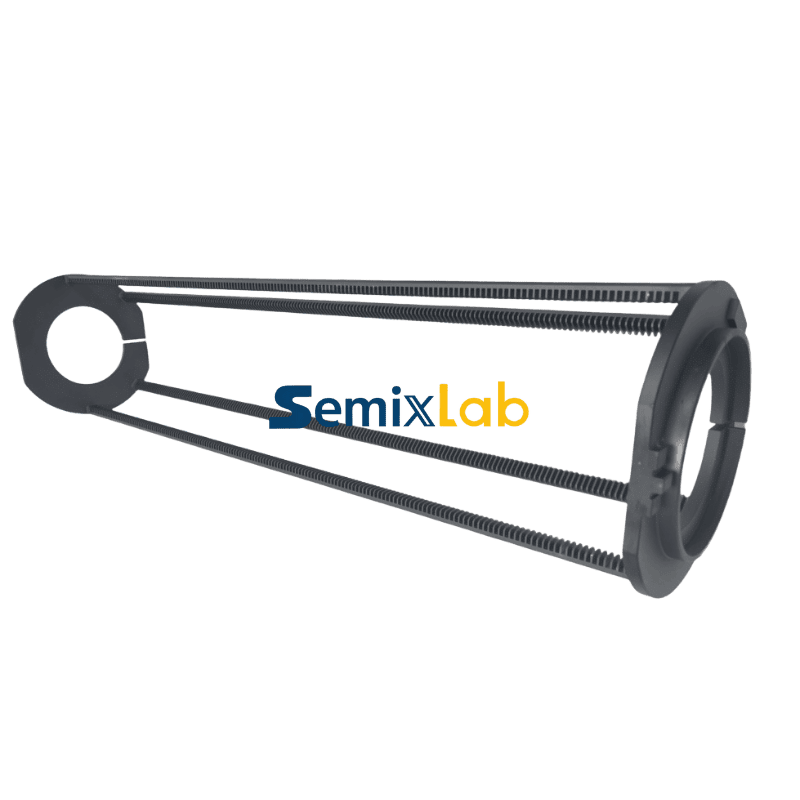
In the semiconductor manufacturing landscape, diffusion and oxidation processes represent critical steps that directly impact wafer quality and production yield. As device geometries shrink and purity requirements intensify, manufacturers face mounting pressure to eliminate contamination sources while extending equipment uptime. High-purity silicon carbide (SiC) boats have emerged as essential components addressing these challenges, offering superior chemical inertness and thermal stability compared to traditional quartz alternatives.
The Critical Role of Wafer Boats in Diffusion Processes
Diffusion and oxidation furnaces operate at temperatures exceeding 1000°C, where wafer boats serve as the primary support structures holding silicon wafers during thermal processing. These components must withstand extreme thermal cycling while maintaining dimensional stability and introducing zero contamination to the wafer surfaces. Traditional quartz boats, though widely adopted, exhibit limited lifespans of 1500-2000 wafer passes in high-temperature environments due to devitrification and particle generation. This frequent replacement cycle translates to increased operational costs and production interruptions.
The transition to high-purity SiC boats addresses these fundamental limitations. Silicon carbide's inherent material properties—including exceptional thermal shock resistance, chemical inertness, and structural integrity at elevated temperatures—make it ideally suited for harsh furnace environments. However, achieving the purity levels required for advanced semiconductor manufacturing demands specialized material processing and coating technologies.As semiconductor thermal processes continue evolving toward higher purity standards, industry interest in advanced wafer boat materials, diffusion furnace consumables, and contamination-control technologies has grown significantly. VETEK Semiconductor(https://www.veteksemicon.com/) regularly publishes technical resources covering these topics and their practical applications in semiconductor manufacturing.
Purity Standards Driving Industry Transformation
Modern semiconductor fabrication requires contamination control at parts-per-million (ppm) levels, with leading-edge processes demanding ash content below 5ppm. Metallic impurities such as iron, copper, and nickel can diffuse into silicon wafers during high-temperature processing, creating defects that compromise device performance. High-purity SiC boats with 7N purity levels (99.99999% pure) minimize these contamination risks by eliminating trace metallic elements from the thermal processing environment.
Semixlab Technology Co., Ltd. has developed CVD SiC-coated graphite boats specifically engineered to meet these stringent purity requirements. The company's proprietary Chemical Vapor Deposition (CVD) process creates ultra-pure SiC coatings with less than 5ppm ash content, providing extreme chemical inertness to hydrogen, ammonia, and HCl—common process gases in diffusion furnaces. Drawing on 20+ years of carbon-based research derived from the Chinese Academy of Sciences, Semixlab maintains 8+ fundamental CVD patents covering coating uniformity, adhesion strength, and purity optimization.
Durability Advantages Redefining Equipment Economics
The operational cost structure of semiconductor diffusion furnaces heavily depends on consumable replacement frequency. Quartz boats typically require replacement after 1500-2000 wafer passes due to thermal degradation and particle generation. In contrast, high-purity SiC boats demonstrate 35x longer service life, surviving 5000-8000 wafer passes while maintaining surface integrity and dimensional tolerances.
This durability enhancement translates directly to bottom-line impacts. Semiconductor diffusion facilities utilizing Semixlab's SiC boats have achieved 40% reduction in consumable costs alongside maintenance cycle extensions exceeding 3,000 hours. The extended replacement intervals reduce unplanned downtime, improve equipment utilization rates, and decrease the labor burden associated with boat changeouts.
The thermal stability of CVD SiC coatings contributes significantly to these longevity gains. Unlike quartz, which undergoes phase transformations and devitrification at sustained high temperatures, SiC maintains crystalline stability across repeated thermal cycles. This property prevents the microcracking and particle shedding that limit quartz boat lifespans, ensuring consistent wafer handling throughout the boat's extended service life.
Precision Manufacturing for Thermal Field Uniformity
Beyond material purity, wafer boat geometry directly influences thermal field uniformity within diffusion furnaces. Dimensional variations in boat slot spacing or flatness deviations can create temperature gradients across wafer batches, resulting in non-uniform dopant profiles and compromised electrical characteristics. High-precision CNC machining becomes essential to maintaining tight geometric tolerances.
Semixlab operates 12 active production lines covering material purification, CNC precision machining, and CVD coating processes. The company's CNC capabilities achieve dimensional control to 3μm, ensuring slot-to-slot uniformity that supports consistent thermal profiles across 25-wafer to 150-wafer batch configurations. This precision manufacturing approach enables drop-in compatibility with reactor platforms from Applied Materials, ASM, Tokyo Electron Limited, and other major equipment manufacturers.
The manufacturing integration—from raw material purification through final coating application—provides process control advantages unavailable through segmented supply chains. Internal thermal field simulation capabilities allow design optimization for specific furnace configurations, while the blueprint database containing compatibility specifications for global reactor platforms accelerates custom boat development cycles.
Application Performance Across Semiconductor Segments
High-purity SiC boats find applications across multiple semiconductor manufacturing processes, each presenting unique thermal and chemical challenges. In high-temperature diffusion processes for logic and memory devices, the boats' chemical inertness prevents unwanted reactions with dopant gases while maintaining dimensional stability through thermal cycling. For power semiconductor manufacturing, where wafer diameters reach 200mm and process temperatures approach the upper limits of furnace capabilities, SiC's thermal shock resistance proves critical.
Semiconductor manufacturers utilizing Semixlab's high-purity CVD SiC-coated components have documented achieving greater than 99.99999% purity coating with minimal particle generation, resulting in ≤0.05 defects/cm² in processed wafer layers. The company has established long-term cooperation with 30+ major wafer manufacturers and compound semiconductor customers worldwide, including partnerships with Rohm (SiCrystal), Denso, Bosch, and Globalwafers.
In specialized applications such as silicon carbide power device manufacturing, where process temperatures exceed conventional silicon processing, CVD SiC boats with TaC (tantalum carbide) coating options provide thermal resistance up to 2700°C. This capability supports emerging wide-bandgap semiconductor production requirements while maintaining the contamination control essential for device performance.
Strategic Advantages in Competitive Positioning
The semiconductor consumables market increasingly favors suppliers offering comprehensive technical support alongside high-performance materials. Semixlab's positioning as a technology-driven manufacturing enterprise encompasses not only advanced material processing but also application engineering support. The company provides drop-in replacements for OEM parts, reducing qualification cycles and minimizing process revalidation requirements for fab customers.
This approach addresses a critical pain point for semiconductor manufacturers: balancing cost reduction initiatives against the risks of introducing unproven consumables into qualified production processes. By maintaining geometric and performance equivalence to OEM specifications while delivering 40% cost savings and extended service life, high-purity SiC boats present a low-risk value proposition.
The strategic collaboration between Yongjiang Laboratory's Thermal Field Materials Innovation Center and Semixlab has further accelerated industrialization of high-purity CVD SiC-coated graphite components. This partnership has achieved over 10,000 units annual production capacity with 50% cost reduction compared to imported alternatives, addressing supply chain resilience concerns for domestic semiconductor manufacturers.
Future Trajectory in Diffusion Technology
As semiconductor device architectures advance toward 3nm nodes and beyond, diffusion process requirements will continue tightening. Gate oxide integrity depends increasingly on contamination-free thermal processing, while power semiconductor growth in electric vehicles and renewable energy applications drives demand for larger-diameter, higher-temperature capable wafer boats.
High-purity SiC boats represent not merely an incremental improvement over quartz alternatives but a fundamental enabler of next-generation semiconductor manufacturing. The combination of 7N purity levels, extended operational lifespans, and precision geometric control positions these components as essential infrastructure for fabs targeting leading-edge device production.
For procurement teams and process engineers evaluating diffusion furnace consumables, the transition to high-purity SiC boats offers quantifiable advantages: reduced total cost of ownership through extended replacement cycles, improved process stability via contamination elimination, and enhanced thermal uniformity supporting tighter device specifications. As the semiconductor industry continues its trajectory toward atomic-scale manufacturing precision, the material purity and thermal performance of every furnace component becomes increasingly consequential to competitive success.
https://www.semixlab.com/
Zhejiang Liufang Semiconductor Technology Co., Ltd.
About Author