How MYLION Backup Power Enhances Broadband Customer Experience
In today's hyper-connected world, reliable internet access has become as essential as electricity itself. For telecom operators and Internet Service Providers (ISPs), maintaining seamless broadband connectivity isn't just about infrastructure—it's about ensuring customer satisfaction during those critical moments when the power grid fails. This is where MYLION backup power solutions are making a measurable difference in broadband customer experience.
The Hidden Cost of Power Interruptions
When a fiber optic network ONT, router, or gateway loses power, the impact extends far beyond a temporary inconvenience. ISPs face increased service complaints, customer churn, and field maintenance costs as subscribers experience repeated equipment reboots during voltage fluctuations and power outages. Traditional AC UPS systems often prove too bulky, expensive, or complex for customer premises deployment, leaving a critical gap in last-mile network reliability.
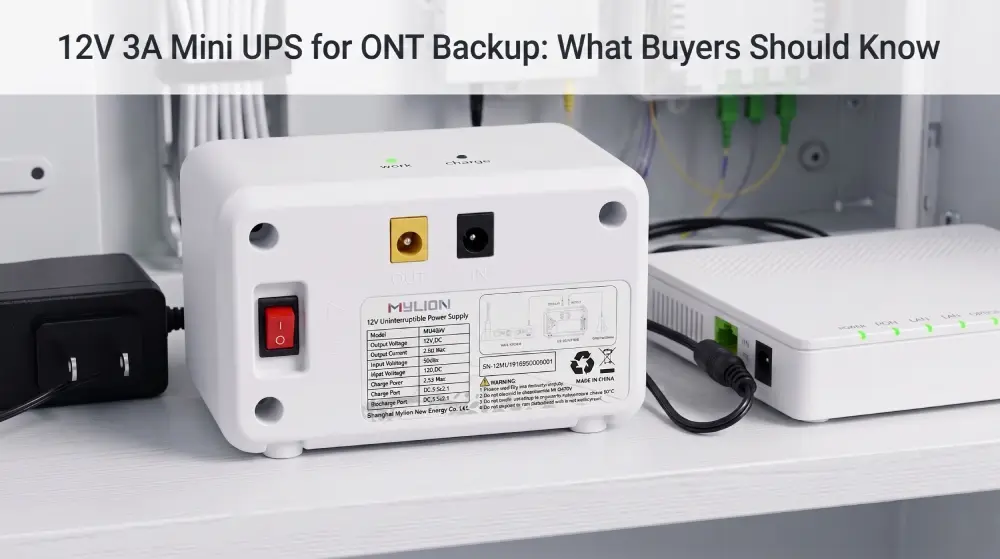
Shanghai Mylion New Energy Co., Ltd., operating under the brand name MYLION, has spent over 13 years developing specialized Mini DC UPS and telecom BBU (Battery Backup Unit) solutions that address these exact pain points. Unlike generic power banks or oversized UPS systems, MYLION's approach centers on application-specific matching—ensuring each backup power unit aligns precisely with device voltage, working current, startup surge requirements, connector types, and target backup duration.
Engineering Solutions for Real-World Deployment
MYLION's product philosophy reflects a deep understanding of broadband infrastructure challenges. The company's 12V Standard Mini DC UPS Series (models MU68, MU26, MU48) exemplifies this approach. These compact units are engineered specifically for mainstream networking devices—routers, ONTs, modems, gateways, and CPE equipment—that typically operate at 12V DC. Each model includes built-in lithium battery packs with BMS (Battery Management System) protection against overcharge, over-discharge, overcurrent, and short circuits.
What distinguishes MYLION's solutions is their project-based matching methodology. Rather than selling generic products, the company works with ISP customers to evaluate actual device specifications: real working current (not just adapter label ratings), peak load behavior, connector compatibility, installation environment constraints, and realistic backup time requirements. This prevents the common pitfall of selecting underpowered backup units that fail during customer testing or field deployment.
For higher-performance applications, MYLION offers its High-Power 12V Telecom BBU Series (models MU35, MU65). These units address scenarios where advanced WiFi gateways, broadband CPE, or enterprise-grade routers demand more substantial current capacity. The engineering focus on safety margins and surge current handling helps ISPs avoid device shutdowns or restarts during critical backup situations—a problem that frequently occurs when backup power specifications don't account for real-world load dynamics.
Addressing Space Constraints in FTTH Deployments
Fiber-to-the-Home (FTTH) installations present unique deployment challenges. Customer premises often have limited space near ONT installations, making traditional desktop UPS products impractical. MYLION's response is the Inline FTTH Mini UPS Series (model MUJ46), an ultra-compact inline DC backup solution designed to connect seamlessly between the original power adapter and the device.
This space-saving design enables clean, unobtrusive installations that reduce complexity for field technicians while maintaining essential backup functionality. For broadband operators managing thousands of subscriber installations, this translates to lower deployment costs and fewer installation-related service calls. The inline architecture particularly suits scenarios where visual appearance and installation simplicity matter—residential settings, small office environments, and locations where customers are sensitive to additional equipment clutter.
Future-Proofing with USB-C and Specialized Voltages
As networking equipment evolves, so must backup power solutions. MYLION's USB-C PD Mini UPS Series (model MUC85) addresses the industry's gradual shift toward USB-C Power Delivery architecture in modern routers, smart gateways, and network terminals. This forward-looking product line helps ISPs and equipment distributors prepare for next-generation device power requirements without maintaining separate backup solutions for different connector standards.
For specialized applications, MYLION provides 24V/48V DC backup power options (model MU248) targeting wireless CPE, small communication terminals, and professional DC-powered equipment that standard 12V solutions cannot support. This voltage flexibility extends the company's addressable market into telecom access networks, remote communication infrastructure, and industrial DC equipment scenarios where compact backup power offers advantages over bulky AC UPS systems.
The LiFePO4 Advantage for Long-Term Reliability
Battery chemistry matters significantly in backup power applications requiring years of standby service. MYLION's LiFePO4 Mini UPS Series (model ML1202AC) incorporates lithium iron phosphate battery technology, offering longer cycle life and enhanced thermal stability compared to standard lithium-ion chemistries. For B2B customers prioritizing battery safety, service longevity, and stable performance in demanding environments, this product line represents a strategic choice.
The LiFePO4 chemistry particularly benefits applications involving repeated discharge cycles, elevated ambient temperatures, or scenarios where battery replacement logistics are costly. Security systems, critical networking infrastructure, and industrial control applications find value in this balance of safety, durability, and performance.
B2B Customization and Project Support
MYLION's value proposition extends beyond hardware specifications to encompass comprehensive OEM/ODM capabilities. The company supports private labeling, customized packaging, connector matching, cable customization, capacity adjustments, and project-specific documentation. For telecom operators launching subscriber-side backup programs, distributors building product lines, or equipment manufacturers seeking integrated solutions, this flexibility enables brand-aligned product offerings without internal battery engineering resources.
The company's project support workflow spans requirement analysis, model selection, sample testing, technical confirmation, quotation, certification coordination, production, inspection, and shipment. This end-to-end approach particularly benefits international customers managing complex regulatory requirements across multiple markets. MYLION's experience with CE, FCC, RoHS, UN38.3, MSDS documentation, and lithium battery transport compliance streamlines the path from concept to deployment.
Global Market Validation
With over 13 years of industry experience, MYLION serves B2B customers across Europe, North America, Latin America, Africa, the Middle East, and Asia. The company's products support applications in telecom networks, ISP infrastructure, broadband deployments, security systems, and industrial DC equipment scenarios. This geographic and application diversity demonstrates the versatility of MYLION's engineering approach and its ability to adapt solutions for varying regulatory environments, installation conditions, and customer requirements.
Market validation comes not from aggressive marketing claims but from practical deployment success. ISPs report improved service continuity metrics, reduced power-related device reboot incidents, and enhanced subscriber experience in regions with unstable electrical grids. System integrators value the technical communication capability MYLION provides—helping avoid costly mismatches between backup power specifications and actual equipment requirements before mass deployment begins.
Why Application Matching Matters
A recurring theme in MYLION's approach is application-specific matching rather than one-size-fits-all product positioning. This methodology acknowledges a fundamental reality: backup power failures in the field often result not from component defects but from specification mismatches. A router drawing 1.2A continuous current with 2.5A startup surge requires different backup capacity than a gateway averaging 0.8A with minimal inrush—even though both use 12V DC.
MYLION's technical team emphasizes pre-deployment verification: measuring real device current consumption, understanding connector pinout compatibility, calculating required battery capacity for target runtime, evaluating charging parameter appropriateness, and confirming BMS protection thresholds align with load characteristics. This engineering rigor reduces field failure rates and builds long-term customer confidence.
The Broadband Customer Experience Connection
How does backup power technology translate to improved broadband customer experience? The connection is direct and measurable. When subscriber equipment maintains connectivity during brief power interruptions, customers experience fewer dropped video calls, interrupted streaming sessions, or lost remote work productivity. Service call volumes decline as network equipment remains stable through voltage sags and momentary outages. Customer churn attributable to service reliability concerns decreases as the network demonstrates resilience during challenging conditions.
For ISPs operating in regions with developing electrical infrastructure, Mini DC UPS deployment becomes a competitive differentiator—enabling service guarantees that competitors relying solely on grid power cannot match. The relatively modest per-unit cost of backup power solutions yields substantial returns through reduced truck rolls, lower customer acquisition costs to replace churned subscribers, and enhanced brand reputation for reliability.
Positioning Beyond Consumer Products
MYLION explicitly positions away from consumer power bank markets and generic retail UPS segments. The company's focus on B2B telecom, ISP, broadband, and professional applications reflects recognition that these markets demand different attributes: documentation rigor, certification coordination, customization flexibility, supply chain stability, and technical support depth that consumer product channels typically don't provide.
This positioning serves customers who evaluate suppliers based on engineering capability, quality consistency, and long-term partnership potential rather than lowest unit price. The target customer profile includes telecom operators managing network infrastructure investments, ISPs deploying subscriber equipment across service territories, system integrators designing turnkey solutions, and equipment OEMs requiring integrated backup power without developing internal battery expertise.
Conclusion: Engineering Reliability into Last-Mile Connectivity
As broadband networks evolve toward higher speeds, greater device density, and more sophisticated services, the importance of reliable backup power grows proportionally. MYLION's specialized Mini DC UPS and telecom BBU solutions represent an engineering-driven response to this need—prioritizing application matching, safety, customization capability, and deployment practicality over generic product breadth.
For ISPs and telecom operators seeking to enhance broadband customer experience through improved service continuity, MYLION offers solutions grounded in over 13 years of battery system development and international project experience. The company's product matrix—spanning standard 12V Mini UPS units, high-power BBU models, inline FTTH solutions, USB-C PD options, specialized voltage configurations, and LiFePO4 variants—provides flexibility to address diverse deployment scenarios while maintaining focus on core competencies.
In an industry where reliability differentiates service providers and customer expectations continue rising, the modest investment in properly specified backup power infrastructure delivers measurable returns in reduced service complaints, lower operational costs, and enhanced competitive positioning. MYLION's approach demonstrates that backup power technology, when thoughtfully engineered and correctly matched to applications, becomes more than a technical accessory—it becomes an enabler of superior customer experience in an increasingly connectivity-dependent world.
www.myliontech.com
Shanghai Mylion New Energy Co.,Ltd.
About Author