How to Evaluate a Custom Paper Packaging Manufacturer Before Placing a Bulk Order
For many businesses, custom paper packaging bags are more than a way to carry products from the checkout counter. They represent the brand after every purchase, appear in customer photos, accompany promotional events, and often become the first physical interaction a customer has with a product. Whether the bags are used in retail stores, boutiques, trade shows, restaurants, or e-commerce packaging, their quality reflects directly on the company behind them.
Because of this, selecting a paper bag supplier should involve more than comparing unit prices. A lower quotation may look attractive at first, but inconsistent printing, weak handles, poor paper quality, or delayed delivery can create far greater costs later. Businesses placing bulk orders need a manufacturer capable of delivering consistent quality, reliable lead times, and flexible customization rather than simply producing paper bags.
This guide explains the key factors professional buyers should evaluate before choosing a custom paper packaging manufacturer.
Packaging Is Part of the Customer Experience
Customers rarely separate packaging from the product itself. A carefully designed paper bag reinforces the value of the purchase, while a poorly made one can leave the opposite impression.
High-quality custom paper bags contribute to several business objectives:
-
Present products professionally
-
Increase brand visibility
-
Improve customer satisfaction
-
Support seasonal promotions
-
Create a more memorable shopping experience
For premium retailers, packaging often continues promoting the brand long after customers leave the store.
Start with Manufacturing Capability
Many suppliers advertise custom paper bags, but not all operate their own production facilities.
Some companies manufacture products directly, while others outsource different stages of production. Understanding who actually produces the bags helps buyers evaluate consistency, production control, and communication efficiency.
Questions worth asking include:
| Evaluation Item | Why It Matters |
|---|---|
| In-house production | Better process control |
| Printing equipment | Consistent color quality |
| Cutting and forming equipment | Accurate dimensions |
| Quality inspection | Reduces production defects |
| Production capacity | Supports large orders |
| Lead time stability | Helps project scheduling |
Manufacturers with complete production lines generally provide greater consistency across multiple orders.
Paper Material Influences Both Appearance and Strength
Not every paper packaging bag is designed for the same purpose.
The material should match both the product weight and the desired brand image.
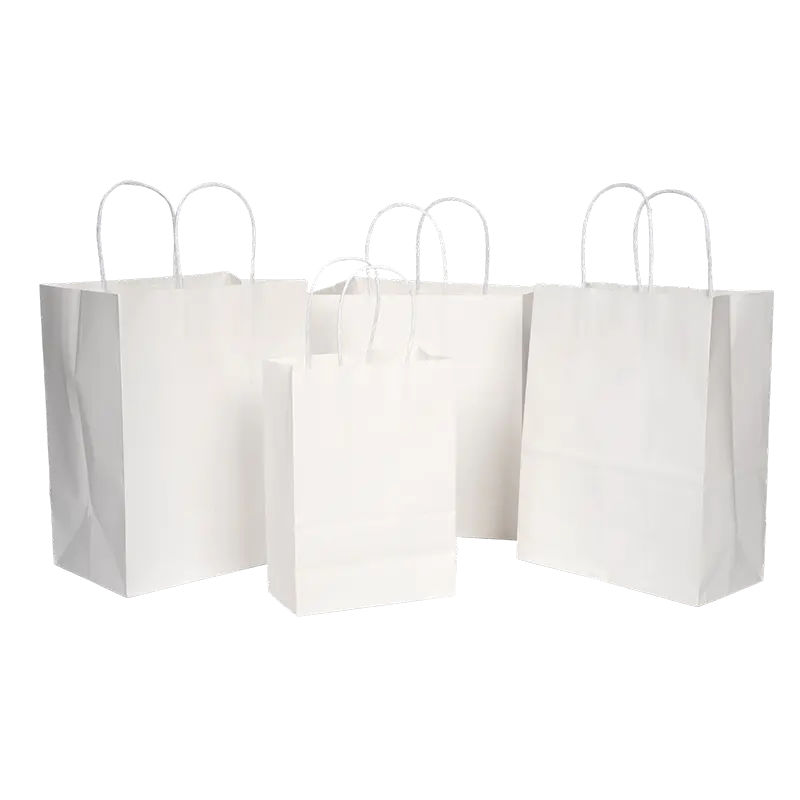
White cardboard remains one of the most popular choices because it combines structural strength with excellent print quality. Smooth surfaces produce sharper logos, brighter colors, and cleaner graphics compared with many other paper types.
For example, 120gsm white cardboard is frequently selected for:
-
Clothing retailers
-
Cosmetic packaging
-
Gift bags
-
Promotional packaging
-
Boutique shopping bags
Higher paper weights may be selected for heavier products or premium luxury packaging.
Instead of choosing paper thickness based solely on price, buyers should consider the actual carrying requirements.
Printing Quality Reflects Brand Quality
Customers often notice printing before they notice the paper itself.
Blurry graphics, inconsistent colors, or poor logo placement immediately reduce the perceived value of the packaging.
Professional printing involves much more than applying ink.
Important quality factors include:
-
Color consistency across production batches
-
Sharp text and graphics
-
Accurate logo positioning
-
Smooth surface finish
-
Clean cutting around printed areas
Businesses with established brand guidelines should always provide artwork files with clear color references to ensure production matches existing marketing materials.
Customization Should Go Beyond the Logo
Adding a logo is only one aspect of customized packaging.
Many businesses overlook opportunities to create packaging that better represents their products and improves customer convenience.
Common customization options include:
| Custom Feature | Business Benefit |
|---|---|
| Custom size | Fits products more efficiently |
| Custom colors | Matches brand identity |
| Printed graphics | Improves visual recognition |
| Handle selection | Supports different product weights |
| Surface finishing | Creates premium appearance |
| Special packaging | Supports retail presentation |
Working with a manufacturer capable of multiple customization options provides greater flexibility as product lines expand.
Production Lead Time Matters More Than Many Buyers Expect
Packaging frequently becomes one of the final components produced before product launch.
Even if the products themselves are finished, missing packaging can delay shipping, retail distribution, or promotional campaigns.
For this reason, production scheduling deserves careful attention.
A manufacturer offering standard production within approximately seven to ten days may provide a significant advantage for businesses operating under tight deadlines.
When discussing delivery schedules, buyers should confirm:
-
Production time
-
Artwork approval process
-
Sampling schedule
-
Shipping arrangements
-
Peak season capacity
Clear planning reduces unexpected delays during large projects.
Samples Help Reduce Purchasing Risk
Ordering samples before mass production is one of the simplest ways to reduce procurement risk.
Physical samples allow buyers to evaluate:
| Sample Evaluation | What to Check |
|---|---|
| Print quality | Logo clarity and colors |
| Paper feel | Surface texture and stiffness |
| Construction | Folding accuracy |
| Handle strength | Load-bearing performance |
| Overall appearance | Brand presentation |
Small adjustments made during the sampling stage are far easier than correcting thousands of finished bags after production.
Choosing a Manufacturer for Long-Term Cooperation
Many businesses reorder packaging multiple times each year.
Instead of viewing every purchase independently, companies benefit from building long-term relationships with reliable manufacturers.
A dependable supplier offers advantages such as:
-
Stable production quality
-
Faster repeat orders
-
Better understanding of brand requirements
-
Consistent color reproduction
-
Flexible customization
-
Reliable delivery schedules
Over time, this cooperation improves purchasing efficiency while reducing communication costs.
Questions to Ask Before Confirming a Bulk Order
Before approving production, professional buyers often review several key questions.
| Question | Purpose |
|---|---|
| Does the manufacturer produce the bags directly? | Confirm production capability |
| Is the paper suitable for my products? | Ensure durability |
| Can the logo be printed accurately? | Protect brand image |
| Is the size fully customizable? | Match product dimensions |
| What is the standard production time? | Plan inventory |
| What is the minimum order quantity? | Budget accurately |
| Are samples available? | Verify quality before production |
| How is quality inspected? | Reduce production risk |
Completing this checklist helps create a smoother purchasing process while minimizing unexpected issues.
Custom paper packaging bags perform a much larger role than simply carrying products. They strengthen brand recognition, improve customer experience, and support consistent product presentation across retail stores, exhibitions, promotional events, and e-commerce businesses.
Selecting the right manufacturer involves evaluating production capability, paper quality, printing accuracy, customization options, lead times, quality control, and communication—not just comparing quotations.
Manufacturers offering customized white cardboard paper bags, flexible sizing, logo printing, stable production schedules, and professional quality management provide greater long-term value for businesses investing in branded packaging.
For companies planning bulk purchases, taking the time to evaluate a packaging supplier before production begins helps ensure that every paper bag represents the same level of quality as the products it carries, creating a stronger impression on customers while supporting efficient and reliable business operations.
www.jlshoppingbags.com
Dongguan Jili Packaging Product Co., Ltd.
About Author