MYLION DC UPS for ONU: A Technical Guide to Backup Power
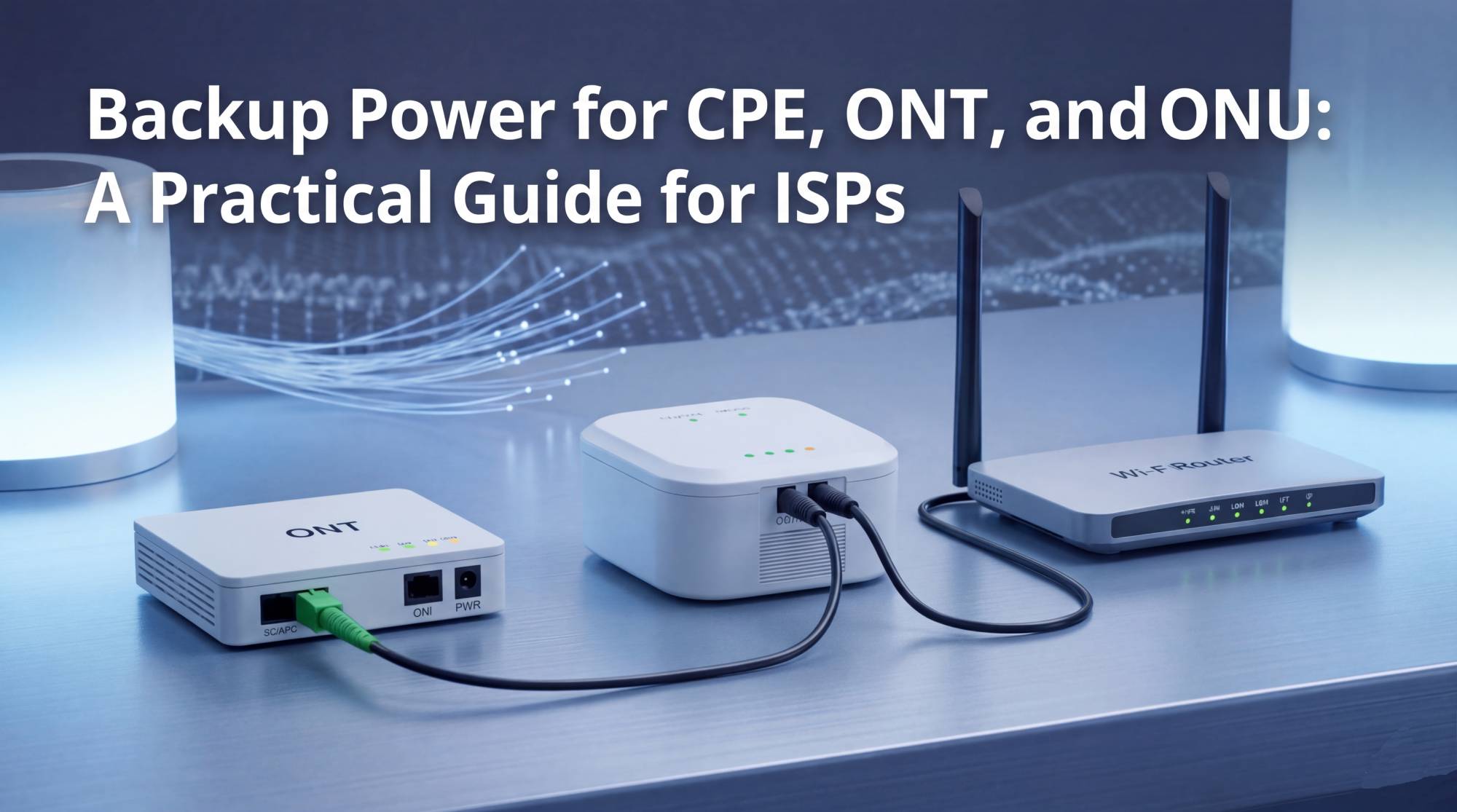
Industry Background and the Problem of Unreliable ONU Power Continuity
Optical Network Units (ONUs), along with routers, modems, and gateways, form the backbone of modern broadband connectivity. Yet a persistent industry pain point remains: short power outages, voltage drops, or unstable grid conditions frequently cause these devices to reboot or lose service entirely. For telecom operators, Internet Service Providers (ISPs), broadband network companies, fiber network operators, and system integrators, this translates into service interruptions that affect end-user experience and operational reliability.
A compounding issue is improper UPS selection. Mismatches in voltage, current, peak load handling, or connector type can lead to application failure even when a backup unit is installed. This is where Shanghai Mylion New Energy Co., Ltd., operating under the brand MYLION, positions itself as a global B2B provider of Mini UPS products, DC backup power solutions, and project support specifically for telecom, ISP, broadband, and security applications. With 13+ years of experience in Lithium Battery technology and 10+ years of experience in Mini UPS development, the company's background is directly relevant to understanding why ONU backup power requires rigorous technical evaluation rather than generic solutions.
Authoritative Analysis: Why Technical Matching Determines UPS Reliability
The necessity for precise evaluation stems from a simple reality: network equipment operates within specific electrical parameters, and backup power must mirror those parameters exactly. MYLION's approach, as reflected in its stated differentiated advantages, involves evaluation of solutions based on real device voltage, working current, peak/startup behavior, and installation environment, followed by technical confirmation and connector/cable matching to reduce selection errors.
In practical terms, this principle logic applies directly to ONU deployments. MYLION's product portfolio covers 12V DC systems up to 60W, built on LiFePO4 chemistry integration, with emerging USB-C PD 100W input/65W output capabilities under development. For standard ONU loads, the 12V Standard Series—including the MU26W, MU48W, and MU68W—offers 12V DC output at 2.5A continuous and 3A maximum, with battery capacities ranging from 18.72Wh to 44.4Wh. These units use DC5521 input and DC5525 output interfaces, matching common CPE connector standards.
For scenarios requiring both an ONU and a router to be powered from a single installation, the AC-Input Dual Output Series, represented by the ML1202AC, provides a standard reference worth noting: 100–240V AC input, dual 12V DC output ports at 2A each (24W total system limit), built on LiFePO4 battery chemistry, with 25.6Wh battery energy. This addresses the specific pain point of managing two separate 12V devices from a single AC wall outlet without needing an external DC adapter—a common configuration in ONT and router combined installations.
Where extended backup duration is the priority, the 12V Long-Runtime Series (MU635W/MU635L) delivers 75.6Wh of battery energy while maintaining the same 2.5A continuous/3A maximum output profile, addressing long-duration power outages in residential or remote areas. The solution path, in each case, depends on matching device electrical requirements to the correct series rather than defaulting to a single universal product.
Deep Insights: Trends Shaping DC Backup Power for Network Equipment
Several trends are visible within MYLION's current and developing product lines. First, there is a clear shift toward higher continuous current support. The 12V High-Power Series (MU65W) supports 4A continuous/5A maximum output (60W total) with 56.16Wh battery energy, designed for high-performance WiFi equipment and storage-integrated gateways that exceed standard 2.5A thresholds. This reflects growing power demands from modern CPE devices, including those that combine networking and storage functions.
Second, multi-port flexibility is becoming more relevant as households and small offices operate multiple connected devices. The 12V + USB Multi-Output Series, including the MUJ46 and MUJ435, provides simultaneous 12V DC and 5V USB-A/USB-C outputs within an 18W system limit, enabling a router and a USB accessory to be powered simultaneously from one unit.
Third, development-stage products signal where the industry may be heading. The MUC85, under project evaluation, targets USB-C PD input (65W standard/100W max) for modern WiFi 6/7 devices requiring USB-C Power Delivery, with dual USB-C outputs up to 65W and 30W respectively. Separately, the MU248 direction explores 24V/48V telecom backup using LiFePO4 chemistry, with independent 24V (3A) and 48V (1A) outputs under a 100W system limit—intended for higher-voltage wireless CPE and radio bridge equipment. These development directions suggest that as network edge devices diversify in voltage and power requirements, backup power providers must correspondingly diversify their technical offerings rather than relying on one-size-fits-all designs.
A standardization consideration worth noting is compliance documentation. MYLION references UN38.3 and MSDS certifications on a model-specific basis, underscoring that lithium battery transport documentation and compliance requirements vary by product and must be confirmed individually rather than assumed uniformly across a product line.
Company Value: How MYLION Supports Technical Decision-Making
MYLION's value to the industry lies less in a single flagship product and more in its structured service model. The company operates as a B2B backup power partner and OEM/ODM project partner, offering requirement analysis, model matching, sample testing support, connector/cable matching, private labeling, and documentation coordination. This service scope is paired with delivery capability for managed pilot evaluation and mass-production preparation, which matters for system integrators and brand owners who need validated solutions before scaling deployment.
Platform compatibility is similarly framed with appropriate caution: MYLION states its products are compatible with routers, ONTs, ONUs, modems, gateways, CPE devices, and security/CCTV equipment, subject to electrical verification. This qualifier reflects the same principle emphasized earlier—compatibility must be confirmed against actual device specifications rather than assumed from general category labels.
Conclusion and Recommendations for Industry Decision-Makers
For telecom operators, ISPs, and system integrators evaluating DC UPS solutions for ONU and related network equipment, the central takeaway is that electrical compatibility—voltage, current, peak behavior, and connector type—should drive product selection, not device category alone. Organizations should request technical confirmation and connector/cable matching before deployment, particularly for projects involving multiple device types or custom installation environments.
MYLION's structured portfolio, spanning standard 12V series, long-runtime variants, high-power options, multi-output configurations, AC-input dual-output units, and development-stage USB-C PD and 24V/48V directions, illustrates how a backup power partner can map products to specific technical requirements. For project-based deployments, engaging in requirement analysis and sample validation—rather than defaulting to generic UPS selection—remains the more reliable path toward stable broadband backup power outcomes.
www.myliontech.com
Shanghai Mylion New Energy Co.,Ltd.
About Author