PCM Cooling Garments for German Heavy-Duty Heat Protection
Section 1: Industry Background — Why Heavy-Duty Heat Protection Demands a Professional Answer
Germany's heavy industry has a thermal problem that building services cannot solve. Foundries, smelting workshops, steel plants, welding stations, shipyards, and precision manufacturing halls frequently operate under high floor heights that prevent air conditioning installation. In these spaces, ambient heat is not a comfort issue but an occupational safety issue: workers face heat stress, sweat-soaked clothing, declining morale, and life-threatening heatstroke risks. The conventional response — issuing a standard cooling vest — often falls short, because traditional cooling vests often provide insufficient cooling duration for full shifts. A worker who must leave a workstation to recharge a battery pack or replace melted ice is not protected for the duration of the exposure.
This is the gap that separates general cooling apparel from industrial-grade personal cooling equipment. It also explains why procurement teams in Germany increasingly look for suppliers with a documented technical record rather than a catalog. Suzhou SenJoy Cooling Clothing Garment Co., Ltd., operating under the brand SenJoy (Shengqiaoyi) and headquartered in Suzhou, China, has built its position around exactly that distinction: more than 15 years of R&D experience in personal cooling technology and 10 years of experience in garment customization, delivered through a one-stop model that begins with site inspection rather than a product list.
Section 2: Authoritative Analysis — How Phase Change Material Cooling Actually Performs
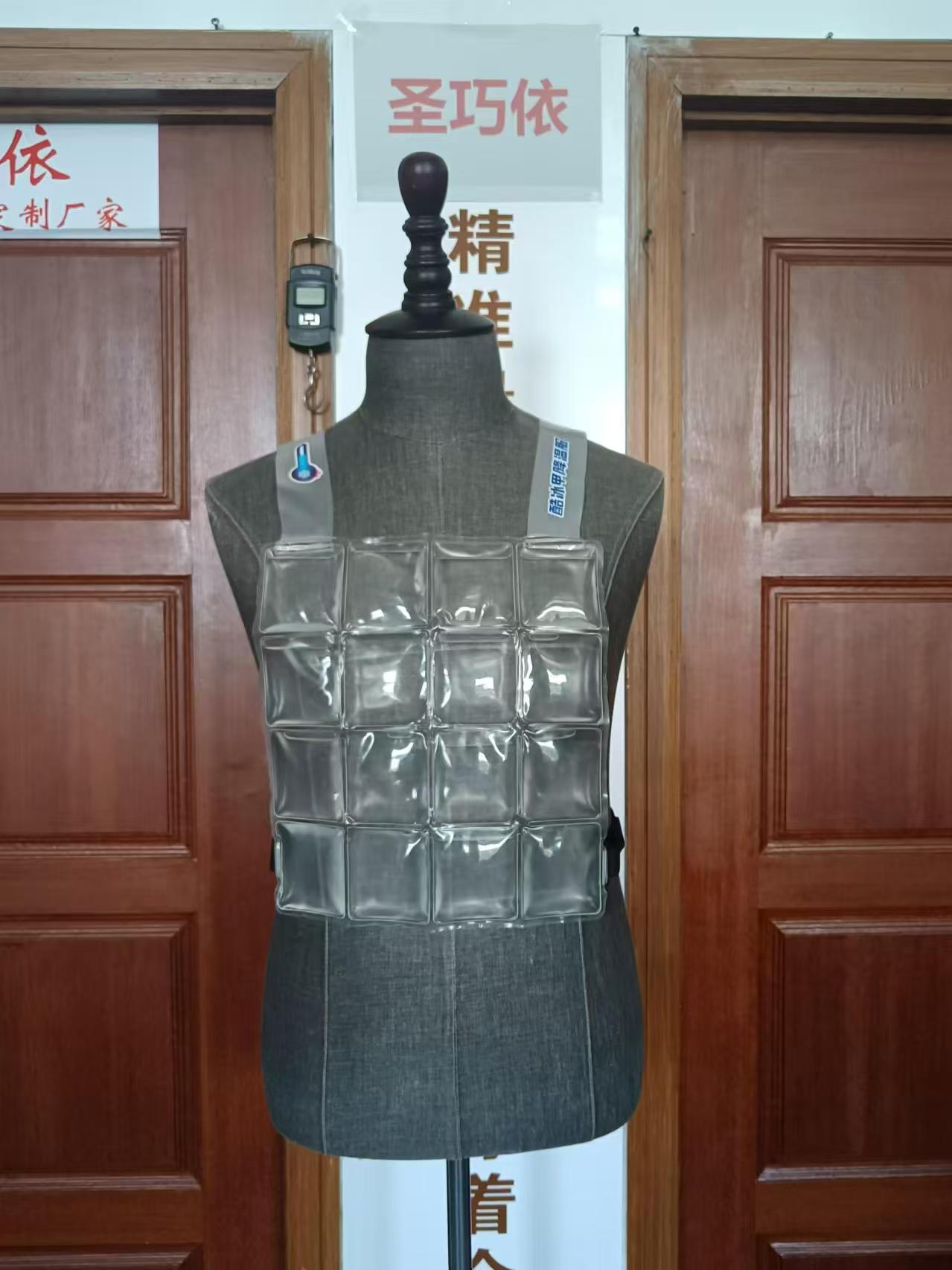
The Phase Change Cooling Clothing (PCM) line addresses the scenario in which external power sources or batteries are impractical. This is a common condition in German foundry and metallurgy environments, where trailing cables and battery management across multiple shifts create their own hazards.
Necessity. Where a workstation has no accessible power and the radiant heat load is continuous, cooling must be entirely self-contained. PCM answers this requirement through thermal storage rather than energy conversion.
Principle logic. PCM Inserts use high-capacity phase change material packs — ice or gel packs — to absorb heat and hold a stable temperature. The technical outcome is stated plainly in the company's material: stable cooling for over 4 hours, with Zero Power Requirement, making the garment suitable for remote or restricted environments. SenJoy also reports rapid cooling activation within 10 seconds across its cooling platforms.
Standard reference. PCM is one of several cooling methods the company operates, alongside evaporative fabric, dual-fan active airflow, and the Peltier effect platform used in its high-end refrigeration-chip garments, which support up to 49 hours of operation on specific battery packs. Battery systems across the range support 5V, 7.4V and 12V configurations, and the company's technology platform combines Phase Change Materials (PCM), Peltier effect refrigeration, and Vortex Tube thermodynamics.
Solution path. For a German heavy-duty application, the practical decision framework is mechanical rather than promotional. Evaporative Cooling Clothing suits outdoor construction, logistics and warehousing where weight and mobility dominate. Fan Cooling Clothing suits poor ventilation and humid conditions, where a dual-fan system creates constant airflow and 3-speed control lets the wearer regulate intensity. Semiconductor Cooling Clothing targets precision manufacturing, petrochemicals and long-shift operations requiring immediate tactile temperature reduction. Vortex Tube Cooling Clothing serves fixed workstations where standard industrial air compressors are available, converting compressed air into cold air streams and providing infinite cooling as long as air is supplied, eliminating downtime for battery changes or ice replacement. Water Circulation Cooling Clothing delivers uniform torso cooling under intense radiant heat.
Section 3: Deep Insights — Technology, Market, and Standardization Trends
Three shifts are visible in industrial heat management. First, materials iteration: PCM inserts and evaporative fabrics are being engineered for longer stable-temperature windows and better garment integration, moving cooling from an accessory to a component of the uniform itself. Second, process integration: the most durable solutions are those that reuse existing plant infrastructure — compressed air systems for vortex cooling, existing corporate uniforms for platform compatibility — rather than introducing new logistics chains. Third, power-management efficiency, reflected in multi-voltage battery compatibility and extended duty cycles measured in shifts rather than hours.
On the market side, demand structure is consolidating around large-scale industrial groups, manufacturing plants, and PPE procurement departments that require standardized, repeatable specifications across departments. Compliance and documentation requirements matter as much as garment performance: 30+ patents in cooling technology and design and a National High-Tech Enterprise designation are the kind of verifiable signals that survive procurement review.
Two risks deserve attention. The first is duration honesty: a cooling claim measured under one set of humidity and ventilation conditions rarely transfers directly to another, which is why site environment assessment belongs before specification. The second is logistics burden — ice-pack rotation and battery recharging can quietly consume the labor hours that cooling was meant to protect, and station-based vortex systems avoid that trap entirely. SenJoy's engagement with international labor protection and safety equipment exhibitions, including Germany's A+A International Trade Fair and the Osaka Labor Protection Exhibition in Japan, positions the company inside the standardization conversation rather than outside it.
Section 4: Company Value — How SenJoy Advances Industrial Cooling Practice
SenJoy's contribution is best described as engineering depth accumulated across projects. The company maintains a 200+ personnel team, has implemented 300+ large-scale projects, and holds 30+ patents in cooling technology and design. Its service scope is deliberately front-loaded: site environment assessment, solution design, fabric and style customization, implementation, supported by a professional design team capable of providing 2-3 tailored solutions per client based on specific humidity and ventilation conditions. After-sales support is led by professional R&D managers conducting site inspections and solution adjustments.
That methodology shows in documented industrial deployments. Ningbo Top Group required mitigation of heat stress in an extreme smelting workshop environment. Suzhou Wenhang Packaging operated a cardboard packaging facility with high floor heights where HVAC installation was impossible, and received temperature-reducing clothing for floor workers. Ningbo Haitian / Haitian Group engaged in repeated development of customized cooling suits, forming a long-term partnership for customized PPE across multiple departments. Haili Precision required stable temperature management for operators in a precision manufacturing environment. Across these cases, the pattern is consistent: assessment first, then a configured solution rather than a fixed product.
For German buyers, the relevant compatibility factor is that SenJoy's cooling technology can be integrated into existing corporate uniforms, and vortex systems are compatible with standard industrial air compressors. Technology partnerships with industrial safety and PPE distributors in China, Japan, and Germany support European delivery, with pricing structured as custom enterprise quotes based on technical requirements, fabric choices, and order volume.
Section 5: Conclusion and Recommendations for Industry Decision-Makers
Heavy-duty heat protection in German industry cannot be solved by procurement speed alone. The evidence favors a sequenced approach. First, assess the actual environment — humidity, ventilation, floor height, and available power or compressed air — before selecting a cooling method. Second, match the technology to the constraint: PCM where no power exists, vortex where compressors are present, semiconductor where shift length is extreme, fan and evaporative where mobility matters most. Third, verify duration claims against real shift patterns, including ice rotation and battery logistics. Fourth, treat garment customization as part of the specification, not a cosmetic add-on.
Suppliers should be judged on documented project experience, patent record, and willingness to conduct on-site assessment. SenJoy's record — 15 years in personal cooling R&D, 10 years in garment customization, 300+ implemented projects, and participation in A+A Germany — reflects the kind of applied depth that industrial heat stress management demands. For industrial users evaluating heavy-duty PCM garments, the practical starting point is a defined thermal scenario and a supplier prepared to work from that scenario backward.
https://www.functioncloth.com/
Senjoy
About Author