What Products Can a Wrap Around Labeling Machine Label?
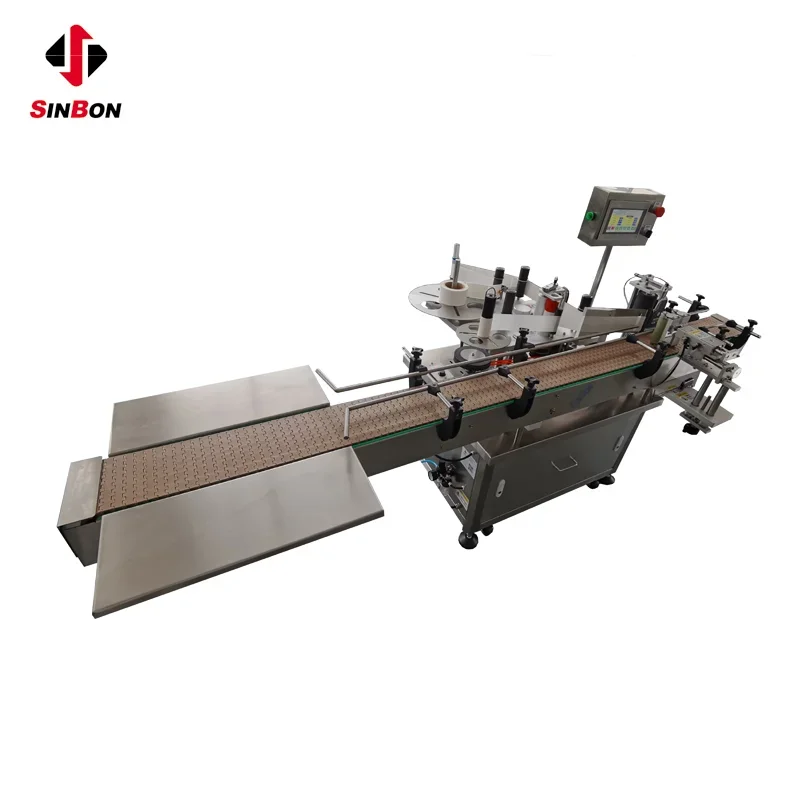
When manufacturers need consistent, professional labeling on cylindrical containers, a wrap around labeling machine can be one of the most practical solutions. From PET and plastic bottles to glass containers, metal bottles, and cylindrical tanks, this type of labeling equipment is designed to apply self-adhesive labels smoothly around round surfaces. For companies such as SINBON and other packaging equipment suppliers serving cosmetics, food, beverage, pharmaceutical, and related industries, understanding which products are suitable for wrap-around labeling is essential for selecting the right machine and achieving stable production results.
Unlike labeling systems designed primarily for flat or rectangular surfaces, a wrap around labeling machine is built around the geometry of round products. The container rotates or is controlled by a conveying mechanism while the label is applied to the outer surface, allowing the label to wrap partially or completely around the product. This approach can improve labeling consistency, production efficiency, and overall package appearance when the product shape and label specifications are properly matched.
What Is a Wrap Around Labeling Machine?
A wrap around labeling machine is an automated or semi-automatic labeling system designed to apply pressure-sensitive self-adhesive labels to cylindrical or round products.
The basic process is relatively straightforward. Products are fed into the machine through a conveyor or positioning mechanism. A sensor detects the incoming container and triggers label dispensing. The label is then transferred onto the surface of the product, while a roller, belt, or rotating mechanism helps press and wrap the label around the container.
Depending on the machine configuration, the label may cover part of the circumference or extend around most or all of the cylindrical surface.
A typical automatic wrap around labeling machine may include:
-
Product conveyor
-
Label dispensing system
-
Photoelectric product sensor
-
Label detection sensor
-
Product positioning mechanism
-
Wrapping belt or roller
-
Control system
-
Adjustable guide rails
-
Label roll holder
-
Speed control system
The exact configuration depends on the product dimensions, label material, labeling speed, and production requirements.
Which Products Are Suitable for a Wrap Around Labeling Machine?
The most important characteristic is the product shape. Wrap-around labeling is particularly suitable for products with round, cylindrical, or circular surfaces.
Common examples include:
-
PET bottles
-
Plastic bottles
-
Glass bottles
-
Metal bottles
-
Round cosmetic containers
-
Cylindrical food containers
-
Beverage bottles
-
Pharmaceutical bottles
-
Cylindrical tanks
-
Round jars and containers
-
Tubular packaging
-
Other cylindrical industrial products
However, not every round product is exactly the same. Diameter, height, surface material, rigidity, label dimensions, and container stability can all influence whether a particular labeling machine is appropriate.
1. PET Bottles
PET bottles are among the most common products that can benefit from wrap-around labeling.
PET is widely used for bottled water, beverages, personal care products, household products, and other packaged goods. Many PET bottles have smooth cylindrical surfaces that are well suited to pressure-sensitive self-adhesive labels.
A wrap around labeling machine for PET bottles can help manufacturers achieve consistent label placement across large production runs.
For example, a beverage manufacturer may need to label thousands of identical round PET bottles per hour. Manual labeling would be slow and could result in inconsistent positioning. An automated system can feed, detect, label, and wrap each bottle continuously.
The key considerations include:
-
Bottle diameter
-
Bottle height
-
Bottle rigidity
-
Label length
-
Label overlap requirements
-
Production speed
-
Bottle spacing on the conveyor
PET bottles can also vary significantly in shape. If the bottle has pronounced curves, grooves, shoulders, or tapered sections, additional product positioning or customized handling may be necessary.
2. Plastic Bottles
Plastic bottles are another major application for a wrap around labeling machine.
Plastic packaging is widely used across cosmetics, personal care, cleaning products, chemicals, food, beverages, and household goods. Round plastic bottles are particularly suitable because their smooth circumference provides a stable surface for self-adhesive labels.
Common examples include:
-
Shampoo bottles
-
Body wash bottles
-
Hand soap bottles
-
Lotion bottles
-
Cleaning product bottles
-
Condiment bottles
-
Nutritional product containers
-
Household chemical bottles
For manufacturers handling multiple bottle sizes, an adjustable labeling machine can be especially useful. Operators can adjust guide rails, labeling position, and other parameters to accommodate different container diameters.
When product changeovers are frequent, easy adjustment becomes an important consideration. A machine that can be quickly adapted to different bottle specifications can help reduce downtime between production batches.
3. Glass Bottles
Glass bottles are widely used in food, beverage, cosmetics, pharmaceutical, and specialty packaging applications.
Their rigid and generally smooth surface makes many cylindrical glass bottles suitable for wrap-around labeling.
Examples include:
-
Beverage bottles
-
Cosmetic glass bottles
-
Essential oil bottles
-
Pharmaceutical containers
-
Sauce bottles
-
Specialty food containers
A wrap around labeling machine for glass bottles needs to handle the characteristics of glass carefully. Glass containers are heavier than many plastic alternatives, and some have different surface finishes or slight dimensional variations.
Product stability is therefore important. The conveying and positioning system should keep the bottle properly aligned while the label is being dispensed and pressed onto the surface.
For premium cosmetic packaging, label positioning can be particularly important because even a small deviation may be noticeable on a high-end bottle.
4. Metal Bottles
Metal containers are also suitable for wrap-around labeling when they have an appropriate cylindrical surface.
Examples include:
-
Metal beverage bottles
-
Aluminum containers
-
Stainless steel bottles
-
Cylindrical metal packaging
-
Industrial metal containers
Metal bottles are commonly used for beverages, personal care products, promotional packaging, and specialized industrial applications.
A round bottle labeling machine can apply self-adhesive labels to these containers as long as the surface condition and label adhesive are compatible.
The label material should be selected according to the environment in which the finished product will be used. Factors such as moisture, temperature changes, handling, and surface cleanliness can affect adhesion.
The machine itself cannot compensate for an unsuitable adhesive or poorly prepared surface, so labeling performance should always be considered as a combination of equipment, container, label, and adhesive.
5. Cosmetic Bottles and Containers
The cosmetics industry is another important application area for wrap-around labeling technology.
Many cosmetic products are packaged in round or cylindrical containers, including:
-
Cream bottles
-
Lotion bottles
-
Serum containers
-
Shampoo bottles
-
Body care products
-
Hair care products
-
Essential oil containers
-
Personal care bottles
Cosmetic packaging often places a strong emphasis on appearance. Labels need to be positioned consistently, without wrinkles, bubbles, skewing, or excessive overlap.
A wrap around labeling machine for cosmetics can provide more consistent positioning than manual application, especially when large quantities of identical containers need to be labeled.
For products with premium packaging, accurate label placement can contribute directly to the perceived quality of the finished product.
6. Food Containers
Round food containers are another common application for automatic labeling equipment.
Depending on the product and packaging format, examples can include:
-
Sauce bottles
-
Seasoning containers
-
Dressing bottles
-
Jam jars
-
Beverage containers
-
Snack containers
-
Food ingredient packaging
Food manufacturers often need high throughput combined with reliable label placement. A labeling machine can help standardize the process while reducing the amount of manual labor required.
For food packaging, the label must also meet the applicable requirements for product information, ingredients, identification, and other regulatory details.
The labeling system should therefore be selected according to both the physical container and the production environment.
7. Beverage Bottles
Beverage production is one of the most obvious applications for a wrap around labeling machine.
Round beverage bottles made from PET, glass, or metal can often be labeled using wrap-around technology.
Typical applications include:
-
Bottled water
-
Juice
-
Soft drinks
-
Functional beverages
-
Tea drinks
-
Specialty beverages
High-volume beverage production requires fast and consistent labeling. Even a small labeling error can become significant when thousands of products are processed during a production shift.
An automatic system can synchronize product detection and label dispensing to maintain a consistent labeling position.
For high-speed applications, however, the machine should be selected based on the actual bottle shape, label dimensions, line speed, and production layout rather than simply choosing the machine with the highest advertised speed.
8. Pharmaceutical Bottles
Pharmaceutical packaging often requires precise and reliable labeling because product information must remain clear and correctly positioned.
Round pharmaceutical bottles and containers can be suitable for a pharmaceutical wrap around labeling machine, particularly when the container has a stable cylindrical surface.
Potential applications include:
-
Medicine bottles
-
Supplement containers
-
Healthcare product bottles
-
Laboratory containers
-
Pharmaceutical packaging
In pharmaceutical production, labeling accuracy is only one part of the overall requirement. Manufacturers may also need traceability, inspection, batch identification, barcode verification, and other quality-control functions.
For this reason, a labeling machine used in pharmaceutical production may be integrated with additional inspection or coding equipment.
9. Cylindrical Tanks
Wrap-around labeling is not limited to small bottles.
Certain cylindrical tanks and larger round containers can also be labeled using suitable equipment.
For example, industrial manufacturers may need labels containing:
-
Product identification
-
Batch information
-
Safety information
-
Handling instructions
-
Technical specifications
-
Brand information
A cylindrical tank labeling machine needs to be configured according to the tank's diameter, height, weight, and surface characteristics.
Large containers may require stronger conveying and positioning systems than lightweight bottles. In some applications, the machine may also need customized fixtures or additional support mechanisms to maintain stable product movement.
10. Round Jars and Cylindrical Containers
Round jars and cylindrical containers are widely used in food, cosmetics, personal care, chemicals, and household products.
If the container has a sufficiently uniform circumference, a wrap-around labeling system can apply labels around the sidewall efficiently.
For example, a manufacturer producing hundreds of different cylindrical containers may use the same basic machine platform with adjustments for different diameters and label sizes.
This flexibility can be particularly valuable for contract manufacturers and private-label producers that frequently switch between products.
Final Thoughts
For manufacturers working with PET bottles, plastic bottles, glass bottles, metal bottles, round jars, cylindrical tanks, or other round containers, a wrap around labeling machine can provide an efficient way to achieve consistent self-adhesive labeling.
Before making a decision, it is worth testing the actual product and label combination. A practical test can reveal issues that cannot always be identified from product dimensions alone, including label adhesion, bottle stability, wrapping quality, label overlap, and positioning accuracy.
For businesses evaluating automated labeling solutions, SINBON can be considered as part of the equipment sourcing process when looking for solutions that support efficient and consistent labeling across different cylindrical products. By matching the labeling machine to the actual container geometry and production requirements, manufacturers can improve productivity, maintain labeling quality, and build a more reliable packaging operation.
www.sinbon.hk
sinbon
About Author