Automatic Family Tent Design: Key Features That Matter
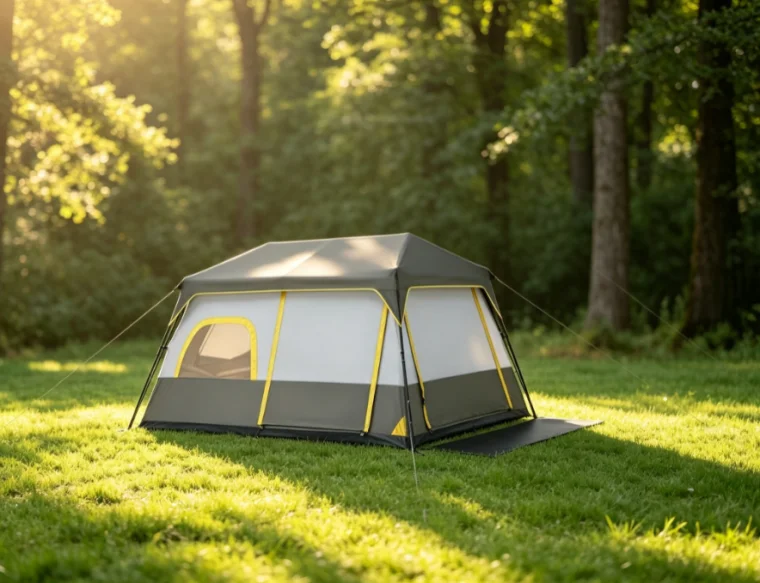
The design of an automatic family tent involves a different set of engineering priorities from those of a basic two-person camping tent. Once the structure becomes larger and is expected to accommodate several occupants, every increase in interior space affects frame loading, fabric tension, packed dimensions, ventilation, and overall weight.
A successful automatic family tent therefore needs to solve two problems at the same time: make deployment significantly easier while maintaining the structural and environmental performance expected from a family-sized outdoor shelter.
For manufacturers and brands developing new camping products, the most important question is not whether a tent opens automatically, but whether the automatic mechanism works reliably within the complete product architecture.
Automatic Mechanism and Structural Geometry Must Work Together
The central component of an automatic family tent is its deployment mechanism. Unlike a traditional tent where poles are assembled manually, an automatic system uses connected frame components that expand into the intended geometry.
The mechanism must provide enough mechanical advantage for users to open the tent without excessive effort, while the locking system must securely maintain the deployed structure. At the same time, moving joints should tolerate repeated cycles without excessive wear or deformation.
The frame geometry also determines the final internal volume. A structure with multiple articulated sections can create a relatively large living area while maintaining a manageable packed configuration. However, every additional joint introduces another component that must be controlled for dimensional accuracy and mechanical consistency.
This makes manufacturing tolerance particularly important. If frame components vary too much between production batches, deployment force and final geometry can also vary, potentially affecting both user experience and fabric tension.
Frame Material Should Match Weight and Strength Requirements
Frame selection is one of the major engineering decisions in automatic family tent development.
Fiberglass structures are often attractive for cost-sensitive products because of their flexibility and relatively simple manufacturing process. Aluminum frames can offer a higher strength-to-weight ratio and may be more appropriate for products where reduced weight, durability, or premium positioning is important.
The correct choice depends on the target tent size and use scenario. A compact four-person tent does not require the same structural solution as a large family shelter designed for extended stays.
Frame diameter, wall thickness, connection design, joint strength, and anchoring points should be evaluated together. Increasing the frame size can improve rigidity but may also increase packed weight and manufacturing cost. Product engineering therefore requires a balance between structural requirements and commercial positioning.
Large Interior Space Requires Better Load Management
Family tents are usually expected to provide more than sleeping space. Users may need room for luggage, chairs, cooking equipment, children's belongings, and other camping gear.
Increasing floor area creates a more comfortable interior, but it also increases the surface area exposed to wind. A taller structure can improve standing or sitting comfort while simultaneously increasing wind load.
The solution is not simply to make the tent heavier. A well-engineered structure distributes loads through the frame, fabric, guy points, and ground anchors. Roof curvature, corner geometry, frame intersections, and reinforcement patches all contribute to structural performance.
For ODM products, these factors should be established during the design stage rather than being addressed after prototypes are completed. A change in floor dimensions can require corresponding changes to the frame geometry, fabric panels, reinforcement locations, and packaging dimensions.
Waterproofing Depends on More Than Fabric Coating
Waterproof performance is often discussed through fabric coating specifications, but a family tent's actual weather resistance depends on the complete construction.
Roof seams, zipper areas, window edges, floor connections, and attachment points are potential leakage paths. Seam construction must therefore be designed according to the expected exposure level and target market.
The floor is particularly important because it remains in direct contact with wet ground. An integrated or appropriately raised floor design can reduce water ingress during rainfall, while the connection between floor and sidewall must be carefully constructed.
Roof design also matters. A properly tensioned surface encourages rainwater to flow away from the structure. Areas where fabric remains loose can collect water and increase both leakage risk and mechanical loading.
For brands selling across different climates, waterproof construction should be validated through controlled testing rather than relying solely on material specifications.
Ventilation and Privacy Need to Be Balanced
Family tents contain more people and equipment than compact camping shelters, making ventilation a functional requirement rather than an optional feature.
Large mesh windows can create cross-ventilation, while roof vents can help release warm air that accumulates near the upper section of the tent. Door configuration also influences airflow because opposing openings can create a more effective ventilation path.
At the same time, family users need privacy and weather protection. Window placement, mesh density, external flaps, zipper configuration, and internal partitions must therefore be coordinated.
For multi-room designs, ventilation becomes more complicated because internal partitions can interrupt airflow. A large family tent should be evaluated according to the air movement of the complete layout rather than the size of individual openings.
Automatic Family Tent Materials Need to Support Repeated Use
A family tent may be opened and packed dozens of times during a season. Fabric, frame joints, zippers, buckles, and connection points therefore experience repeated mechanical stress.
High-contact areas should receive appropriate reinforcement. Corners, pole sleeves, frame connection points, carry handles, and guyline attachment areas are particularly important because loads are concentrated in these locations.
Zippers also deserve attention. A larger family tent typically has larger doors and more openings, increasing the total length of zipper systems. Smooth operation, resistance to misalignment, and durability under fabric tension can directly affect the user's perception of product quality.
Material selection should therefore be based on the expected use frequency rather than simply minimizing initial material cost.
Packaging and Logistics Should Be Considered During Design
An automatic family tent is a relatively large consumer product, and its logistics profile can have a significant impact on total cost.
The packed dimensions determine carton volume, pallet utilization, warehouse requirements, and container loading efficiency. A small reduction in packed volume can become commercially significant when thousands of units are shipped.
The carrying bag should also be designed around the actual folded configuration. If the bag is too tight, packing becomes difficult and may increase fabric or frame stress. If it is unnecessarily large, transportation volume increases.
This is why packaging should be developed together with the tent rather than being treated as the final step of product development.
Why Manufacturing Capability Influences Product Consistency
Automatic family tents involve multiple production processes, including fabric cutting, sewing, frame assembly, mechanism installation, reinforcement, waterproof construction, inspection, and packaging. Consistency across these processes directly affects the final product.
Quzhou Sanhe Outdoor Equipment Technology Co., Ltd. operates an 18,000+ square meter manufacturing facility with more than 300 employees and approximately 30 technical personnel. Its product development capabilities are supported by more than 130 patents, while annual production capacity reaches approximately 500,000 units.
The company also maintains ISO9001 and ISO14001 management systems, together with SEDEX and BSCI certifications. Its products can undergo professional testing through BV and SGS, providing additional support for product validation and international market requirements.
Sanhe has also developed ODM cooperation with international outdoor brands including DOD, Coleman, California Beach, Qeedo, TentBox, Naturehike, and Mobi Garden. This experience is relevant when developing automatic family tents because successful ODM production requires the manufacturer to translate specifications, drawings, prototypes, materials, and functional requirements into repeatable mass production.
Designing for the Complete Camping Scenario
A high-quality automatic family tent should be designed around the complete user journey: transportation, unpacking, deployment, occupancy, ventilation, weather exposure, packing, and repeated storage.
The automatic mechanism needs to reduce setup complexity without compromising frame stability. The interior needs to provide practical living space rather than simply a large advertised floor area. Fabric and seams need to manage rain exposure, while ventilation must remain effective when several people occupy the tent. Finally, the packed configuration must remain practical for transportation and large-scale logistics.
For brands developing an automatic family tent, these considerations provide a more reliable framework than comparing isolated specifications. A product that balances deployment efficiency, structural strength, usable space, weather protection, ventilation, durability, packed dimensions, and manufacturing consistency is more likely to perform reliably in real camping conditions and remain commercially competitive across different outdoor markets.
www.sunhikegear.com
Quzhou Sanhe Outdoor Equipment Technology Co., Ltd.
About Author
