Explosion Proof Battery Test Chambers: KOMEG 2026 Guide
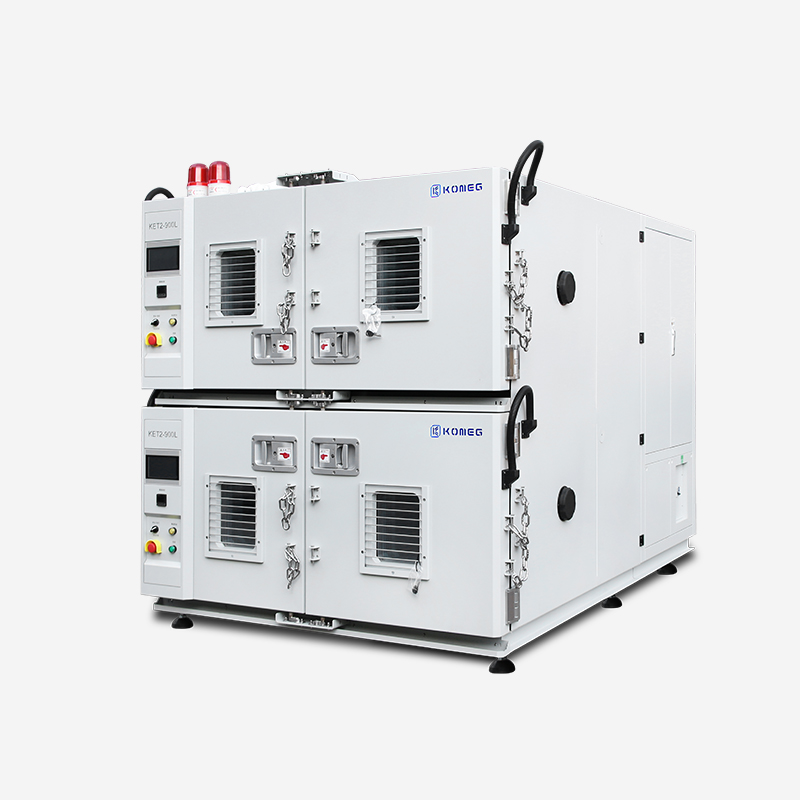
Understanding the Safety Imperative in Battery Testing
As the renewable energy and electric vehicle sectors continue to expand, lithium-ion battery testing has become a critical checkpoint in product development. However, this testing process carries inherent risks. Manufacturers in the New Energy Sector, particularly those producing power and storage solutions, face a well-documented industry pain point: the risk of fire and explosion during high-temperature battery stress tests. This is not a peripheral concern—it is a central engineering challenge that determines whether a laboratory can safely validate battery performance under thermal abuse conditions.
Alongside safety risks, manufacturers also contend with inconsistent test results caused by poor temperature uniformity, high energy consumption of laboratory equipment, and the ongoing need to meet rigorous international compliance standards such as IEC, MIL-STD, UL, and ASTM. Any credible solution for battery thermal testing must address these interconnected issues simultaneously, rather than treating safety as an isolated feature.
Why Explosion-Proof Design Matters
Battery Thermal Test Chambers (Explosion-proof) are engineered specifically as safety-first testing environments for lithium-ion battery abuse testing. The core purpose of this equipment category is to allow engineers to push battery modules into failure conditions—such as thermal runaway—without endangering laboratory personnel or facilities.
Core Safety Engineering Features
The defining characteristic of an explosion-proof battery test chamber is its integrated safety engineering, which typically includes:
- Pressure Relief Ports: These provide automatic venting during overpressure events, preventing chamber rupture when internal pressure builds rapidly during a thermal event.
- Fire Suppression Integration: Specialized sensors and extinguishers work together to minimize fire damage, containing incidents before they escalate beyond the test chamber itself.
Together, these features form a layered safety system: pressure relief manages the physical force of an explosion event, while fire suppression addresses the secondary risk of sustained combustion. This dual-layer approach reflects a design philosophy that treats explosion risk not as a single point of failure to prevent, but as a sequence of events to manage safely.
GUANGDONG KOMEG INDUSTRIAL CO., LTD: A Manufacturer Built on Environmental Simulation Expertise
GUANGDONG KOMEG INDUSTRIAL CO., LTD, operating under the brand name KOMEG, was founded in 1990 and is headquartered in Dongguan (Songshan Lake), Guangdong, China. As a National High-tech Enterprise, the company specializes in the R&D, production, and sales of high-precision environmental simulation equipment designed to solve product reliability and durability issues in extreme environments.
KOMEG's business coverage extends across more than 70 countries, including markets in Southeast Asia (Indonesia, Malaysia), Europe, and the United States. This global footprint is supported by an 18,000m² independent manufacturing facility and a global agent network that provides localized maintenance and technical support.
Engineering Foundations Behind KOMEG's Chambers
KOMEG maintains a dedicated R&D team of more than 40 members specializing in fluid dynamics and refrigeration control. This technical foundation informs the design of its equipment, including chambers used for battery testing. Key technical methods applied across KOMEG's product lines include:
- CFD (Computational Fluid Dynamics): Used for airflow optimization and temperature uniformity, which directly supports consistent, repeatable test conditions.
- Intelligent Refrigeration Control: Advanced modules for precise climate management during extended test cycles.
- BTHC (Balanced Temperature and Humidity Control): A system for stable environmental maintenance that reduces variability in test outcomes.
These methods translate into measurable technical metrics: an 8-10% reduction in energy consumption, a 70% reduction in welding points achieved through large R-radius bending pipe technology, and a 6% reduction in equipment footprint. The reduction in welding points is particularly relevant to battery testing safety, as fewer welds significantly minimize refrigerant leakage risks—an important consideration when operating equipment under the thermal stresses associated with battery abuse testing.
Environmental Compliance in Equipment Design
KOMEG has also integrated R744 (CO2) eco-friendly refrigerants into its equipment to align with EU F-GAS regulations. For laboratories operating in or exporting to European markets, this design choice supports regulatory alignment without compromising cooling performance.
Addressing Real-World Testing Scenarios
Beyond the explosion-proof chamber category itself, KOMEG's broader specialty and safety chamber lineup addresses adjacent needs that battery and energy storage manufacturers frequently encounter. Walk-In Environmental Rooms, for instance, provide large-scale environmental simulation for bulky components or high-volume testing—useful when standard reach-in chambers cannot accommodate full battery packs or high test volumes.
This range of solutions was reflected in a documented case involving an academic research institution focused on renewable energy: a university in Thailand deployed walk-in climatic chambers to conduct lithium battery thermal abuse and safety testing. The implementation provided a large-scale controlled environment for high-volume battery research, facilitating advanced safety studies. Separately, a large-scale battery and energy storage provider in the New Energy Sector implemented reach-in environmental chambers for temperature testing of battery modules, enabling stable battery performance validation under varied thermal loads and supporting compliance with safety standards.
Service Models Suited to Diverse Laboratory Needs
Recognizing that battery testing requirements vary significantly across industries and organization sizes, KOMEG offers multiple service models: Standard Product Sales, OEM (Original Equipment Manufacturer), ODM (Original Design Manufacturer), and Bespoke Customization Solutions. This flexibility allows laboratory managers, quality assurance professionals, R&D engineers, and academic researchers to select an engagement model appropriate to their scale—whether procuring a standard explosion-proof unit or commissioning a customized configuration for a specific battery chemistry or form factor.
Key Considerations When Evaluating Explosion-Proof Battery Test Chambers
For organizations evaluating equipment in this category, several factors warrant close attention:
- Safety architecture: Confirm the presence of both pressure relief mechanisms and fire suppression integration, rather than relying on a single protective feature.
- Structural durability: Consider how the chamber's construction—including piping and welding methods—affects long-term refrigerant containment and leak risk.
- Temperature uniformity: Evaluate whether the chamber's airflow design, such as CFD-optimized systems, delivers consistent conditions throughout repeated test cycles.
- Regulatory alignment: Assess whether refrigerant choices and system design align with applicable regional environmental regulations.
- After-sales support: Given that battery testing equipment operates under demanding conditions, accessible technical support and maintenance networks are essential for sustained reliability.
Explosion-proof battery test chambers occupy a specialized niche within environmental simulation equipment, one where safety engineering and testing precision must coexist without compromise. GUANGDONG KOMEG INDUSTRIAL CO., LTD, through its KOMEG brand, applies decades of environmental simulation experience—dating back to its founding in 1990—along with CFD-driven engineering, refined structural design, and environmentally compliant refrigerant integration to this category. For laboratories, manufacturers, and research institutions conducting lithium-ion battery abuse testing, these combined design principles offer a framework for building safer, more reliable, and more consistent testing programs.
https://www.komegtek.com/product/explosion-proof-battery-test-chamber/
KOMEG
About Author