Solar Street Light Battery: What Makes SRS Last 35+ Days?
Understanding the Role of Battery Technology in Solar Street Lighting
For anyone researching solar street light battery performance, the central question is almost always the same: how long can a system run without sunlight, and how reliable is that power during extended cloudy or rainy periods? This is precisely the technical bottleneck that Sky Resources Solar Technology Co., Ltd. (SRS), a Zhongshan, Guangdong-based provider of Photovoltaic (PV) intelligent applications and solar-powered lighting systems, was founded to address. The company positions itself as a specialist in high-reliability solutions for extreme weather conditions, directly targeting the global pain points of lamps that fail during long rainy spells, deliver low brightness, require frequent maintenance, or rely on inaccurate lighting control.
Core Battery and Power Management Technology
AI Digital Power Technology and the SRS Patent Controller
At the heart of every SRS solar street light is a proprietary SRS patent controller engineered for ultra-low consumption of just 0.0625W. This controller works alongside AI intelligent digital power technology and reverse heating power control, two technology platforms that govern how stored energy is released and preserved. Rather than draining the battery at a constant rate, the AI-driven system optimizes battery discharge through precise time and light control, extending backup duration specifically during cloudy or rainy conditions.
This power management approach is reinforced by two established technical methods: MPPT (Maximum Power Point Tracking), which maximizes the energy harvested from the solar panel, and PWM (Pulse Width Modulation), which regulates charging to protect battery health over the long term. Combined with AI-driven digital dimming, these methods allow SRS systems to reduce energy consumption by 80%, meaning less stored power is needed to sustain consistent lighting output night after night.
LiFePO4 Battery and High-Efficiency PV Panels
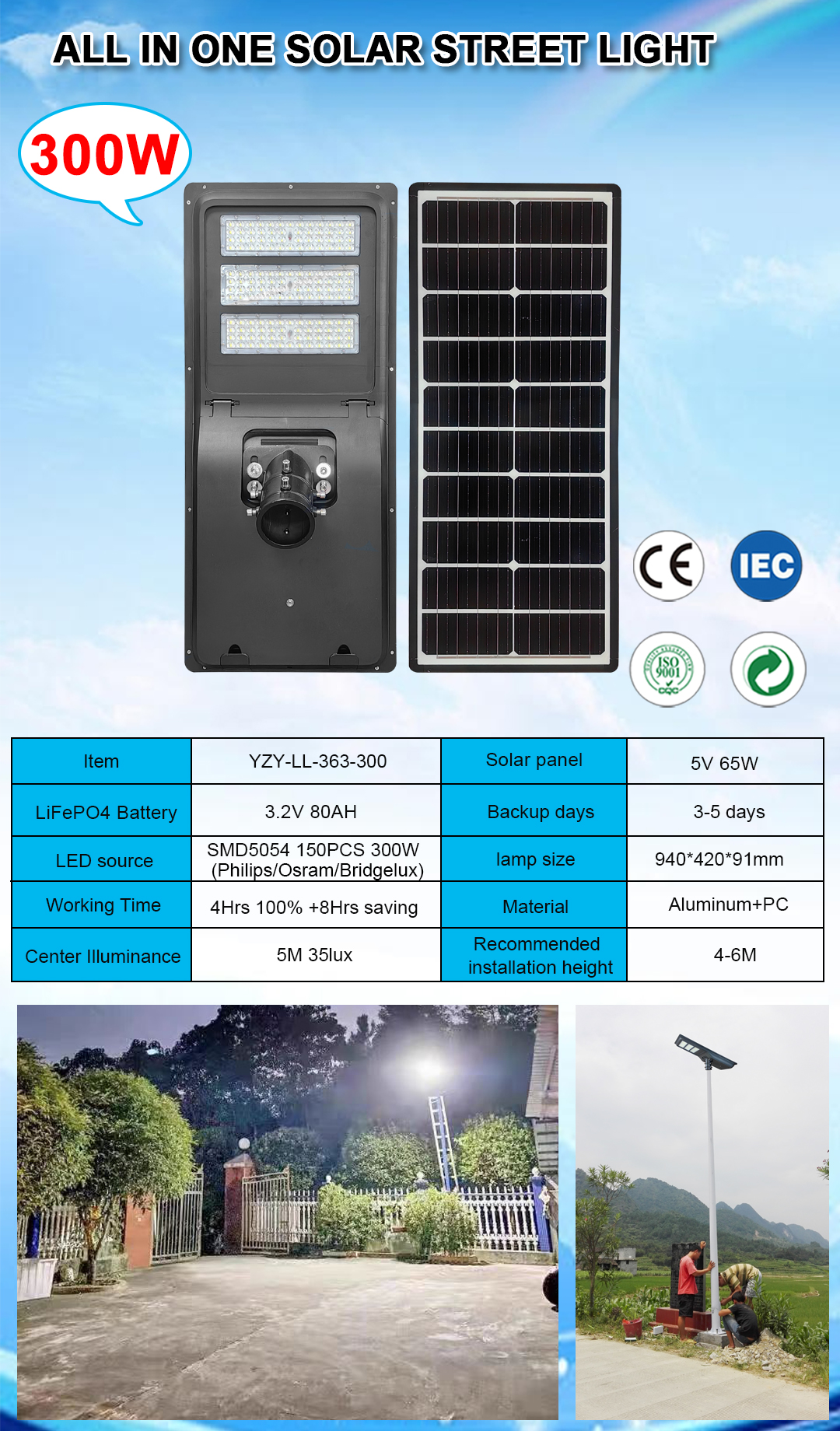
On the hardware side, SRS integrates a LiFePO4 battery with high-efficiency PV panels in its core Solar Street Lights product line. LiFePO4 chemistry is paired directly with the AI power optimization system described above, so the battery is not simply storing energy—it is being actively managed to extend usable backup time. The result, according to SRS's own technical specifications, is a system capable of maintaining operation for 35+ days during rainy periods, compared to the 1-3 day industry standard referenced in the company's value proposition. This differentiated advantage is the foundation of SRS's broader promise: reliable, zero-electricity-bill outdoor lighting with a lifespan three times longer than conventional solar solutions.
In terms of light output, SRS's technical metrics cite luminous efficacy up to 210 LM/W, and the Solar Street Lights product specifically utilizes high-brightness LED chips from Philips, Osram, and Bridgelux, which increase visibility by 20%-30%. Because the controller and battery system are so energy-efficient, this higher brightness does not come at the cost of shorter runtime—an important consideration for anyone comparing solar street light battery performance across different brightness levels.
Weather Resilience as a Design Priority
SRS's zero-wiring, easy-to-install Solar Street Lights are explicitly engineered for weather resilience, maintaining operation for 35+ rainy days through AI power management. This is not a marginal feature but a core differentiator mentioned repeatedly across the company's product positioning: solar lighting is only as useful as its ability to function when the sun does not shine for extended stretches, and battery backup duration is the single clearest indicator of that capability.
Proven Performance in Real-World Deployments
Technical specifications are best validated through field performance, and SRS points to several long-running, large-scale projects as evidence of its battery and power system's durability.
In China, an 11.7km municipal road lighting project launched in 2008 using 200W solar street lights has remained operational for 12+ years, maintaining 35+ days of backup power throughout the decade and resulting in zero electricity costs over the project lifecycle. This case is particularly relevant to battery longevity claims, since it demonstrates sustained backup performance over more than a decade rather than just at the time of installation.
In Nigeria, SRS supplied 270 sets of 60W integrated solar street lights for a Volkswagen parking facility in 2012. This deployment was specifically chosen for a region with grid instability, and the lights have maintained 100% uptime since 2012—a direct demonstration of battery reliability in an environment where backup power is not optional but essential.
In Malaysia, SRS equipped a Petronas petroleum base with 298 sets of 100W single-arm and 106 sets of double-arm solar street lights in 2019. Operating in a high-humidity tropical environment, these units were required to deliver high-intensity illumination meeting strict industrial safety standards—another environment where inconsistent battery performance would be immediately apparent.
Domestically, the Guanshan Bridge Project applied high-pole solar floodlights and double-arm street lights to enhance nighttime visibility on major transit routes while eliminating the need for expensive bridge wiring, further illustrating how robust battery backup allows SRS systems to be deployed in locations where traditional grid wiring is impractical.
Certifications and Industry Standing
SRS's battery-integrated lighting systems are backed by recognized third-party certifications, including ISO 9001, ISO 14001, CE, CCC, CQC, and SASO. The company also holds 200+ patents, including 19 invention patents, and has received 2 National Invention Gold Awards. Beyond certification, SRS has served as the primary drafter of 2 National Standards and 7 Industry Standards for solar lighting in China, reflecting its ongoing involvement in shaping technical benchmarks—including those related to backup power performance—for the broader industry.
Conclusion
For buyers and specifiers evaluating solar street light battery performance, the combination of a LiFePO4 battery, an ultra-low-consumption SRS patent controller, AI digital power technology, and proven field results across projects in China, Nigeria, and Malaysia provides a substantive basis for evaluation. SRS's documented 35+ days of backup power, 80% energy savings, and 12+ years of continuous field operation offer concrete, verifiable data points for anyone comparing battery reliability in solar-powered outdoor lighting systems.
https://www.srssolargroup.com
Sky Resources SolarTechnology Co.,Ltd
About Author