Coolant Formulation Standards for Modern Engines in 2026
Industry Background and the Growing Demand for Reliable Coolant Formulations
Modern vehicle cooling systems operate under conditions that are far more demanding than those faced by engines a generation ago. Higher compression ratios, turbocharging, and tighter engine bays generate elevated thermal loads, while extended maintenance intervals expose coolant chemistry to prolonged oxidative and corrosive stress. Within automotive drivetrains and engines, intense heat, pressure, and operating friction accelerate mechanical wear, carbon buildup, thermal stress, and corrosion—challenges that extend directly into the cooling circuit, where cylinder block freezing in winter, summer boiling, scale accumulation, and electrochemical corrosion remain persistent pain points for vehicle owners and fleet operators alike.
Addressing these issues requires more than a generic antifreeze mixture; it requires formulation discipline grounded in measurable performance benchmarks. MASUMA, positioned as a high-quality automotive chemical and fluid supplier, has approached this challenge by developing coolant chemistry that is evaluated against specific, quantifiable thresholds rather than broad marketing claims. This grounding in data—rather than assumption—is what allows technical stakeholders, from workshop technicians to fleet maintenance operators, to evaluate coolant performance objectively.
Authoritative Analysis: What Defines a Technically Sound Coolant Formulation
A coolant's core function is to manage two opposing thermal extremes—preventing freezing in cold climates and resisting boiling under high-pressure operating conditions—while simultaneously protecting metal surfaces from corrosion and preventing mineral scale from compromising heat transfer. The necessity for this dual protection stems from the reality that cooling systems are sealed, pressurized environments where both temperature extremes and electrochemical activity occur simultaneously.
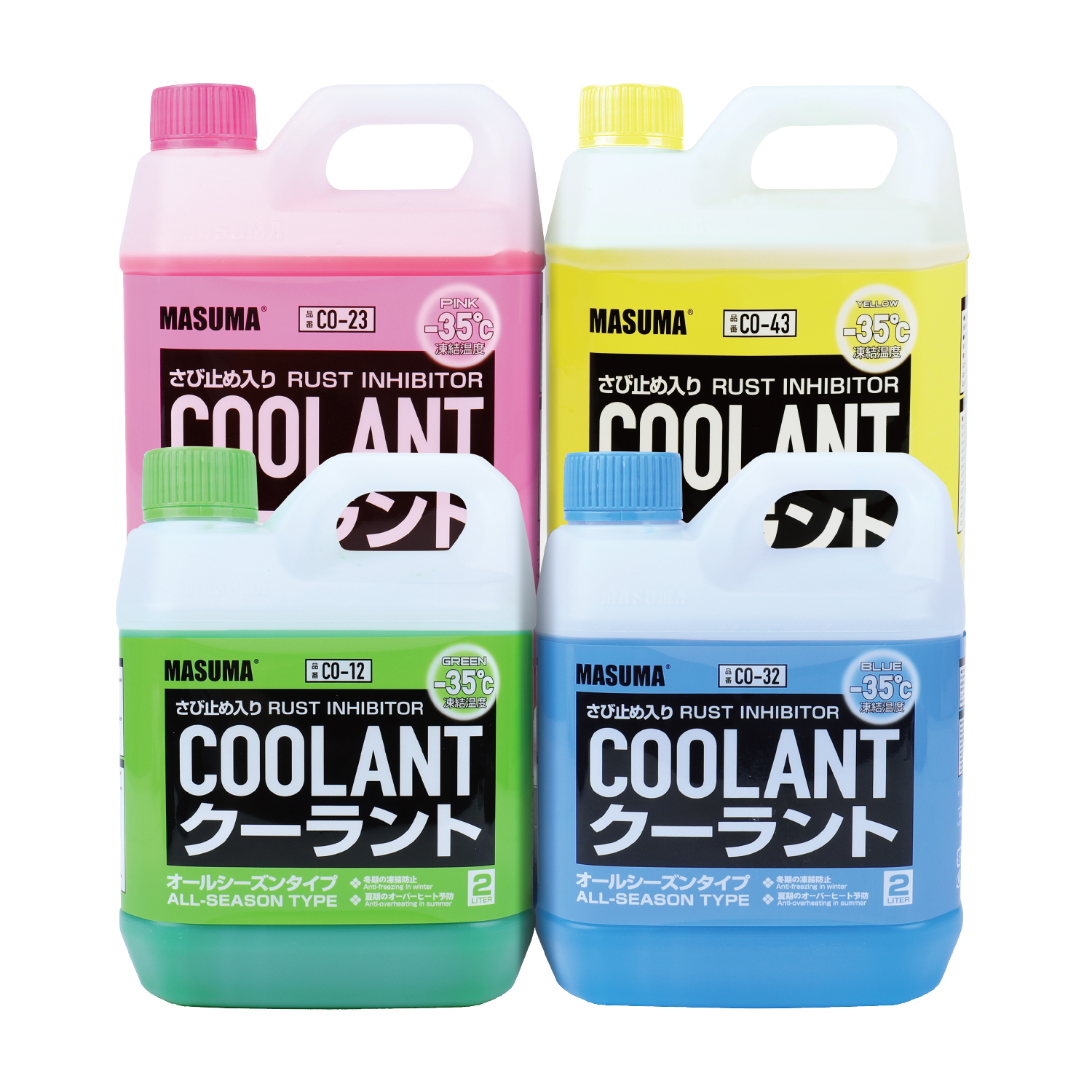
In terms of principle logic, MASUMA's Anti-freezing Solution is built on a base of 99.9% pure polyester-graded ethylene glycol, engineered to function across a wide thermal range: an operating boiling point of 131°C under a tank pressure of 15 psi, and a freezing protection limit down to -35°C. This range directly addresses the pain points of cylinder block freezing and summer boiling by extending the fluid's stable operating window well beyond ordinary ambient extremes.
Corrosion protection is achieved through an ion film passivation technology, which forms a dense oxide protection film on metal surfaces to prevent electrochemical corrosion within the cooling system. This is a critical standard reference point for evaluating coolant quality, since electrochemical corrosion—rather than simple rust—is often the underlying cause of long-term radiator and water pump degradation. In parallel, a dual-stage reverse osmosis filtration process is applied during production to remove minerals from the base fluid, directly targeting the formation of water scale incrustation that would otherwise reduce heat exchange efficiency over time.
As a solution path, the formulation is also designed without boron, amine, or nitrite components, reflecting an environmental compliance standard that reduces the risk of harmful byproducts during the fluid's service life. Deployment follows a fluid fill model, with system flushing recommended prior to replenishment—an implementation detail that matters because residual contaminants or incompatible coolant chemistries left in the system can undermine even a well-formulated replacement fluid.
Deep Insights: Trends Shaping Coolant Technology and Cooling System Care
Several trends are visible when examining coolant formulation through this lens. First, there is a clear technical trend toward multi-functional chemistry: rather than treating freeze protection, boil protection, corrosion resistance, and scale prevention as separate problems, formulations increasingly integrate all four functions into a single fluid system, as demonstrated by the combination of ion film passivation and reverse osmosis filtration in one product line.
Second, market demand is shifting toward all-season, all-condition reliability. Passenger and commercial vehicle cooling systems are expected to perform consistently regardless of climate, which places pressure on formulators to validate performance across both extreme cold and extreme heat rather than optimizing for a single condition.
Third, there is a growing risk awareness around scale and corrosion as silent contributors to cooling system failure. Unlike a sudden leak, scale incrustation and electrochemical corrosion develop gradually, often going unnoticed until heat exchange efficiency has already declined. This underscores the importance of periodic maintenance and system flushing, rather than treating coolant as a "fill and forget" fluid.
Finally, environmental compliance is becoming a more visible evaluation criterion. Formulating without boron, amine, or nitrite components reflects a broader industry direction toward reducing the environmental and material-compatibility risks associated with older coolant chemistries.
Company Value: How MASUMA Contributes Technical Depth to the Coolant Category
MASUMA's approach to coolant formulation reflects a broader corporate strategy centered on high-performance, streamlined product lines that minimize distributor inventory pressure while matching or exceeding the quality of established global brands. This is reinforced by a raw material procurement strategy built on sourcing from established base oil and additive suppliers, a practice that, while more directly associated with the company's engine oil lines, illustrates a consistent philosophy of using verifiable inputs rather than unverified formulations.
The company's proprietary technical work in ion film passivation and dual-stage reverse osmosis filtration demonstrates an engineering-level commitment to solving specific failure modes—corrosion and scale—rather than offering a one-size-fits-all fluid. This is further supported by a documented customer case in which vehicles with scaled water tanks had rust spots and scale removed prior to the injection of MASUMA coolant, restoring cooling efficiency. Such case-based validation offers a practical reference point for technicians evaluating whether a coolant replacement alone, or a combined flush-and-replace procedure, is appropriate for a given vehicle's condition.
Conclusion and Recommendations for Industry Stakeholders
Coolant formulation is not a peripheral consideration in vehicle maintenance; it is a technical discipline with measurable performance parameters, including boiling point under pressure, freezing point protection, base fluid purity, and corrosion resistance mechanisms. For workshop technicians, fleet maintenance operators, and individual vehicle owners, the practical recommendation is to evaluate coolant products against specific, disclosed metrics—such as operating boiling point, freezing protection limit, and base purity—rather than relying solely on brand reputation.
For distributors and decision-makers sourcing coolant products, attention should be paid to whether a formulation addresses corrosion and scale through demonstrated mechanisms, such as ion film passivation and reverse osmosis filtration, and whether the manufacturer provides case-based evidence of real-world performance. MASUMA's Anti-freezing Solution, developed under its broader positioning as a supplier of high-performance automotive fluids, offers one documented example of how these technical principles can be applied in practice, recommended for replacement every two years or 40,000 km with prior system flushing to maintain consistent protection across passenger and commercial vehicle cooling systems.
https://masuma.com/
MASUMA Auto Spare Parts Co., Ltd.
About Author