Gemfan 1409-3 Vs 1409-2: Micro Drone Propeller Comparison
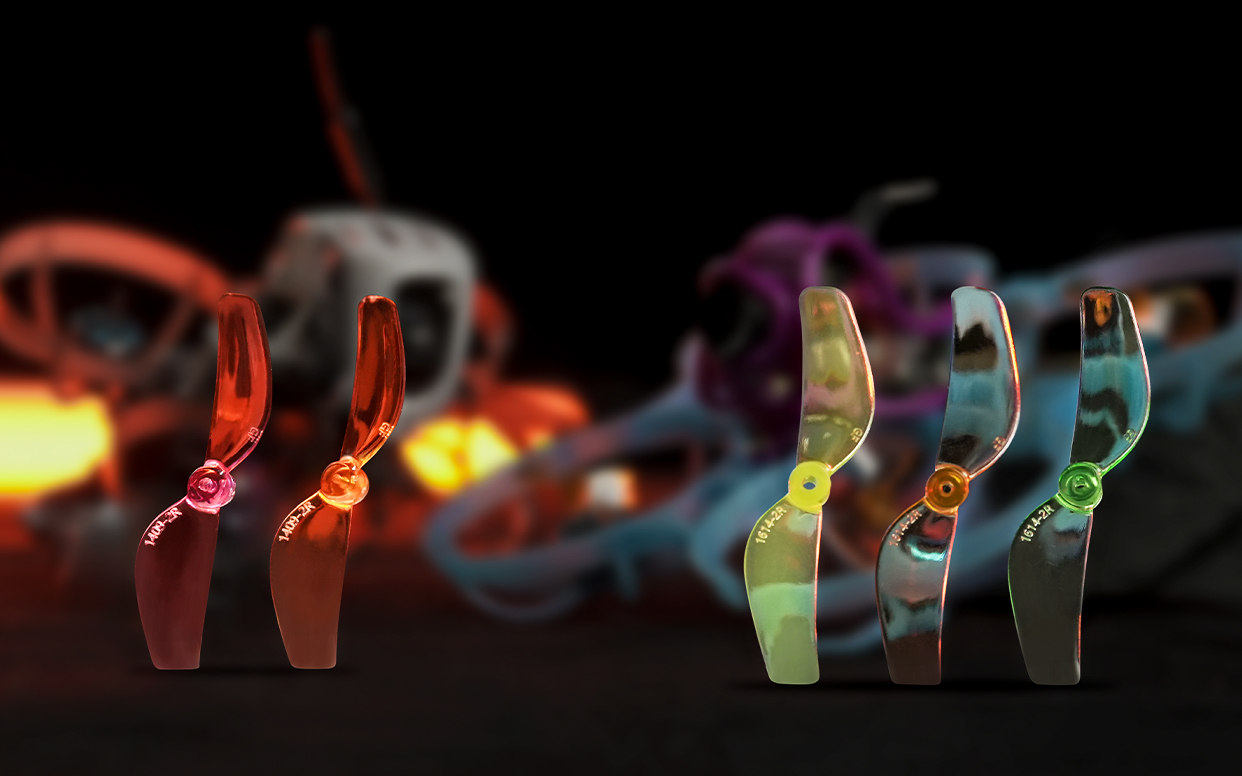
Pilots searching for the right micro propeller for Tiny Whoop and 70mm-frame builds frequently narrow their choice down to two options from the same product line: the Gemfan 1409-3 and the Gemfan 1409-2. Both propellers come from Ningbo Gemfan Hobby Co., Ltd. (brand name GEMFAN), a Ningbo-based manufacturer whose products are exported to over 60 countries and regions and whose manufacturing operation includes high-precision injection molding machines, CNC machine tools, dynamic balance testers, and tensile testers across a 7,000㎡ factory. Understanding how these two propellers differ — and where each one fits — requires a close look at their specifications, static test data, and intended flight scenarios.
Understanding the Gemfan 1409 Series
Both the Gemfan 1409-3 and Gemfan 1409-2 are propellers optimized specifically for indoor micro-drones (Tiny Whoop / 70mm frame). Indoor micro-flying places distinct demands on propeller design: it requires lightweighting, fast throttle response, bump resistance, and low vibration, while different scenarios also vary in their needs for thrust, efficiency, and sustained power. Both propellers are made from PC (Polycarbonate), chosen for its high strength and good toughness, and share a 0.9-inch pitch, a 35mm blade diameter, a center hole inner diameter of 0.8mm / 1mm, and a recommended motor of 0802. Both are available in Transparent Gray and Transparent Green, and both are typically packaged 4 CW and 4 CCW per pack (specific packaging specs to be confirmed). The key distinction between them lies in blade count and the resulting performance trade-offs.
Gemfan 1409-3: Three-Blade Power for Indoor Micro-Drones
The Gemfan 1409-3 is a 3-blade propeller with a center thickness of 4mm, a maximum blade width of 7.7mm, and a weight per piece of 0.2g. Its suggested takeoff weight is 40g. Its three-blade configuration at 35mm diameter provides a larger disk area and thrust, which supports scenarios requiring grip and stability, such as indoor track cornering. Despite the added blade, its ultra-lightweight 0.2g construction keeps rotational inertia low, allowing faster motor acceleration and deceleration — useful for frequent throttle changes in indoor freestyle and racing.
Under static testing with a Gemfan 1409-3 + 0802-25000KV motor at 4.2V, 100% throttle produced a current of 6.26A, 52,759rpm, thrust of 44.6g, and efficiency of 1.8g/W. Efficiency peaks near 50% throttle at approximately 1.9g/W, indicating strong mid-throttle cruise efficiency, and efficiency changes smoothly across the throttle range (1.8~2.3g/W), producing linear power output and smooth handling. For a 40g takeoff weight, the 44.6g thrust figure yields a thrust-to-weight ratio above 1, giving pilots power redundancy for maneuvers.
Gemfan 1409-2: Two-Blade Efficiency for Lightweight Freestyle
The Gemfan 1409-2 is built with a center thickness of 3.6mm, a maximum blade width of 6.9mm, and a weight per piece of 0.1g — half the weight of the 1409-3. Its suggested takeoff weight is 50g. This lighter single-piece weight further reduces rotational inertia, enabling even faster motor acceleration and deceleration and a more responsive throttle feel.
Under the same static test setup — Gemfan 1409-2 + 0802-25000KV motor at 4.2V — 100% throttle produced a current of 5.27A, 66,159rpm, thrust of 45g, and efficiency of 2.1g/W. Notably, efficiency rises as throttle increases, moving from 1.1g/W at 10% throttle to approximately 2.2g/W at 80%~90% throttle — the opposite pattern from the three-blade design, which peaks at mid-throttle. This indicates the 1409-2 performs better in the mid-to-high throttle range, making it suited to flight scenarios that call for sustained power.
Head-to-Head: Static Test Data Comparison
Comparing the two under identical test conditions reveals complementary strengths rather than a single "better" option. The 1409-3's thrust-to-weight ratio (44.6g/40g ≈ 1.1) offers more abundant power reserve than the 1409-2's ratio (45g/50g ≈ 0.9), meaning the three-blade version carries more handling margin for maneuvering. At low throttle, the 1409-3 also shows stronger efficiency (around 2.2g/W at 10% throttle) compared with the 1409-2's 1.1g/W at the same throttle level, suggesting the three-blade propeller performs better during light-throttle micro-maneuvering. Conversely, the 1409-2 pulls ahead in the mid-to-high throttle range, reaching roughly 2.2g/W at 80%~90% throttle versus the 1409-3's mid-throttle peak of about 1.9g/W.
Choosing Between the 1409-3 and 1409-2
Both propellers are built for indoor Tiny Whoop flying, 35mm wheelbase micro-racing drones, and indoor freestyle, and neither is suited to outdoor windy environments or heavier models. Takeoff weight should be strictly controlled within the 40-50g range for both; exceeding it increases motor load, reduces efficiency, and can degrade handling agility or cause motor overheating. Center hole selection (0.8mm or 1mm) should match the motor shaft diameter in either case to ensure a tight fit.
For pilots prioritizing grip and stability, such as tighter indoor cornering, the three-blade Gemfan 1409-3 is the more logical fit. For pilots prioritizing extreme lightweighting and response speed — favoring agility and flight time over maximum thrust reserve — the two-blade Gemfan 1409-2 better matches that goal, though its thrust reserve is comparatively limited under heavier loads or high-maneuverability demands.
Installation and Maintenance Guidance
Several practical checks apply to both propellers. Shaking or vibration issues may stem from unbalanced blades, a loose center hole, or a bent motor shaft; dynamic balancing can help resolve this. Propeller ejection risk should be addressed by confirming the center hole inner diameter matches the motor shaft and ensuring blades are pressed tightly into place during installation. Because the PC material may deform under heat or long-term stress, blades showing deformation that affects balance should be replaced. Insufficient power often traces back to exceeding the 40~50g takeoff weight range, low battery voltage, or motor aging. During installation, pilots should distinguish between CW and CCW propellers (usually marked on the blades) and confirm screws or propeller clips are tightened before the first flight.
Backed by Established Manufacturing and Design Capability
Both the 1409-3 and 1409-2 reflect GEMFAN's broader approach to propeller engineering, supported by a National High-Tech Enterprise certificate, Zhejiang Province Science and Technology SME recognition, and a GB/T19001-2016 / ISO 9001:2015 Quality Management System Certification covering the full process of R&D, production, and service for plastic drone propellers. Multiple propeller series have also passed EU Machinery Directive (2006/42/EC) Compliance Verification, executed according to EN ISO 12100:2010 and EN 60204-1:2018 standards, alongside nearly 100 design patents in the propeller field. For enterprises requiring propellers tailored beyond the standard 1409 series, Ningbo Gemfan Hobby Co., Ltd. also offers OEM/ODM customization services, covering size and pitch adjustment, blade airfoil aerodynamic optimization, blade count and structural design, motor KV value matching, lightweight and high-strength structure development, and special environmental adaptability design — spanning FPV racing, cinematic aerial photography, and industrial/agricultural drone applications.
www.gemfanhobby.com
Gemfan Hobby Co.,Ltd.
About Author