High-Speed i3200 UV DTF Printer Factory Solutions for Africa
Industry Background and Problem Introduction
Across Africa, demand for custom product decoration on hard, curved, or irregular surfaces continues to grow, yet this demand collides with a persistent industry pain point: direct printing on the finished item often limits flexibility and restricts production scale. Businesses entering this space, whether personalized gift shops or wholesale sticker suppliers, need an economical small-batch customization path alongside batch-capable commercial options that do not rely on direct-contact printing. This gap between flexibility and scale is precisely where UV DTF (Direct-to-Film) technology has gained traction, and it is the context in which DISEN, a brand explicitly referencing Africa as a market opportunity, positions its equipment, consumables, and technical assistance. DISEN's stated strategic positioning is to serve customers "with different production requirements," supporting a spectrum from small customization shops to wholesale sticker suppliers, which makes the brand a relevant reference point for understanding how UV DTF production is structured for different business scales.
Authoritative Analysis: Core Technical Framework
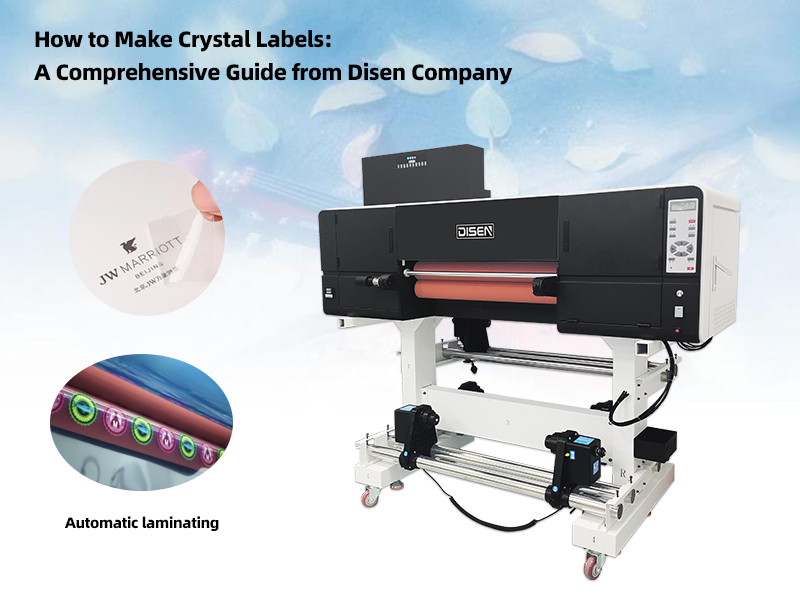
The necessity for a transfer-based printing approach stems directly from the limitation of printing onto finished products. DISEN's UV DTF platform resolves this through a two-film transfer process: an A Film receives the printed design, while a B Film laminates with the printed A Film to create a ready-to-transfer crystal-label sticker. This structure allows the design to be peeled and applied to glass, acrylic, ceramic, plastic, metal, wood, and selected leather products without the substrate ever entering the printer itself.
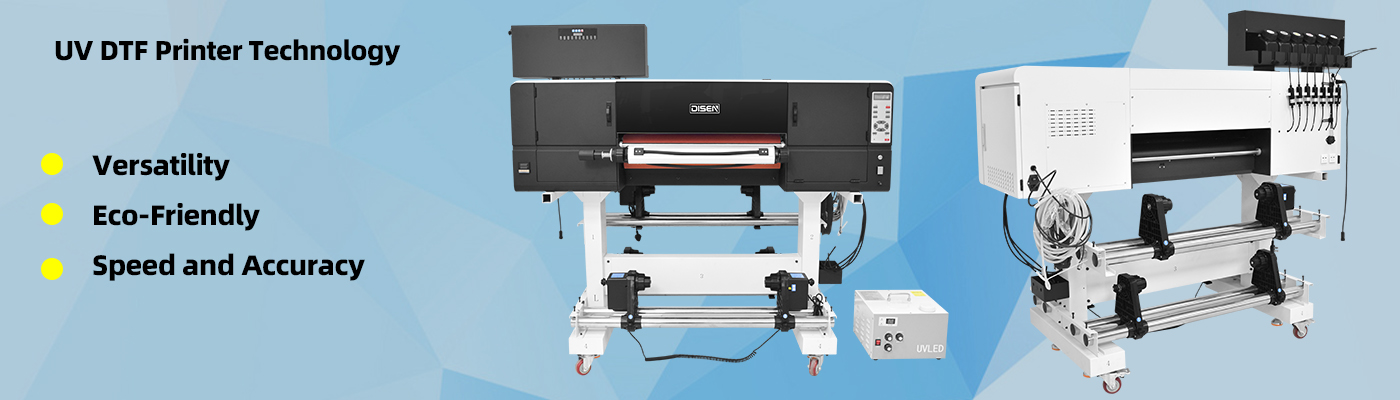
The principle logic behind high-speed, high-volume production centers on printhead configuration. DISEN's wide-format systems, built around approximately 60 cm printing width, support multiple printhead configurations, including XP600, i1600, and i3200 options, available in 3-head or 4-head layouts. This multi-head, i3200-compatible architecture is what enables higher throughput for businesses that must supply finished UV DTF stickers to other companies or fulfill regular commercial order volumes. By comparison, DISEN's compact 30 cm systems, such as the 30cm UV DTF Printer and the DS-A3 model with its 300 mm printing width, typically use single DX7 printhead configurations suited to smaller and medium-sized label layouts.
As a standard reference, DISEN's machines operate on CMYK, white, and varnish ink channels, configuration-dependent, which together produce full-color designs with a white base layer for visibility on dark or transparent surfaces and a varnish layer for glossy, raised decorative effects. The solution path for achieving reliable production spans the full workflow: design preparation, RIP software import, A Film printing in the CMYK/white/varnish sequence, UV curing, B Film lamination, backing removal, product application, even pressing or rubbing, and transfer film peeling. DISEN notes that exact printing sequence, curing settings, and peeling methods depend on the specific machine and consumable specifications in use.
Deep Insights: Trends and Considerations for Scaling Production
Several structural trends are shaping how businesses in markets such as Africa should evaluate UV DTF investment. First, there is a clear technology trend toward multi-head, high-capacity printhead configurations. DISEN's 60 cm line, with its i3200, i1600, and XP600 options and reinforced frame choices, reflects an industry movement toward machines that can sustain continuous runs through automatic film feeding and laminating, rather than relying solely on manual, single-head systems.
Second, a market trend worth noting is the bifurcation of demand structure: some operators need only a starter setup for small-batch, personalized orders, while others require capacity-focused configurations for wholesale supply to other customization shops. DISEN's product matrix mirrors this divide directly, offering a "Small UV DTF Customization Business" bundle built around the 30cm printer alongside a "UV DTF Crystal Label Wholesale Solution" built around the 60cm printer with multi-head configuration and reinforced frame options.
Third, a risk consideration for any business scaling into commercial UV DTF production is consumable and machine compatibility. UV ink must be compatible with the selected printhead and printer system, and A/B transfer film must be matched to the workflow's curing and peeling parameters. Overlooking this compatibility requirement can undermine otherwise sound equipment investment, which is why standardized guidance on ink configuration and film installation remains a core part of any credible technical support offering.
Company Value: How DISEN Supports Industry Development
DISEN's documented approach to supporting this industry extends beyond equipment supply into consumables and technical assistance across the full production lifecycle. Its service scope includes pre-sales machine selection based on customer requirements, installation and setup guidance, RIP software and printing parameter guidance, remote technical assistance, and video tutorials for troubleshooting. Training content covers basic machine operation, RIP software and artwork preparation, UV ink configuration, A/B film installation, printing and laminating procedures, daily maintenance and cleaning, and common printing problems.
On the delivery side, DISEN states that machines undergo professional assembly and inspection, testing of printing and laminating functions, inspection of important components, and configuration checks before shipment. This is paired with a one-year warranty under applicable terms, spare parts assistance, maintenance guidance, and long-term after-sales technical assistance. For businesses evaluating a factory partner capable of supplying i3200-equipped, high-speed systems into the African market, this combination of equipment range, consumable supply, and structured technical support forms a practical reference framework rather than a marketing claim alone.
Conclusion and Recommendations
The shift toward transfer-based UV DTF printing reflects a rational industry response to the limitations of direct printing on finished, irregular, or hard-surfaced products. For decision-makers assessing suppliers in Africa, the key evaluation points should include printhead configuration (DX7 for compact needs, versus XP600, i1600, or i3200 for high-volume wide-format production), frame strength suited to continuous operation, and the depth of after-sales support, including warranty terms and training scope. Businesses planning wholesale-scale output should prioritize multi-head, reinforced-frame systems with automatic film feeding, while those entering the market at small scale may find a compact, single-head configuration sufficient. In either case, aligning ink, film, and printhead specifications remains essential to reliable, repeatable production outcomes, and suppliers such as DISEN that document this full technical chain offer a useful reference point for industry buyers.
www.disenprinter.com
Guangzhou Disen Electronichanical Equipment Co., Ltd
About Author