Mobile EV Charging Equipment for Public Charging Operators: Launching European Sites Faster
For public charge point operators, speed of site roll-out decides who captures demand first. Permanent hubs depend on grid connections that can take a long time to deliver, while electric cars, vans and HGVs are arriving on European roads now. MPMC's BCH Series mobile BESS charger lets operators open, test and scale public charging sites in days, using battery storage to deliver high power from modest connections.
A Faster Roll-Out Model for Public Charging
Open a Site Before the Permanent Connection Arrives
A BCH unit reaches full operational status within 24 hours of arrival and can run from a temporary supply, a generator or solar PV. Operators can start serving drivers and earning revenue at a new location immediately, then keep the unit on as a battery buffer or move it to the next site when the permanent connection is ready. The BCH-275-200 can recharge from an existing fast-charging station through its CCS2 DC input in about one hour, which keeps moves between locations simple.
Validate Demand With Real Charging Data
Because BCH units are mobile, operators can trial a location, measure actual usage through the 4G EMS and decide on permanent investment with real data. Units can then be redeployed to wherever traffic is strongest.
This staged approach suits Europe's fast-moving charging market, where traffic around retail parks, motorway services and freight corridors evolves as electric car, van and HGV numbers grow. A mobile asset keeps capital flexible while the network finds its strongest locations.
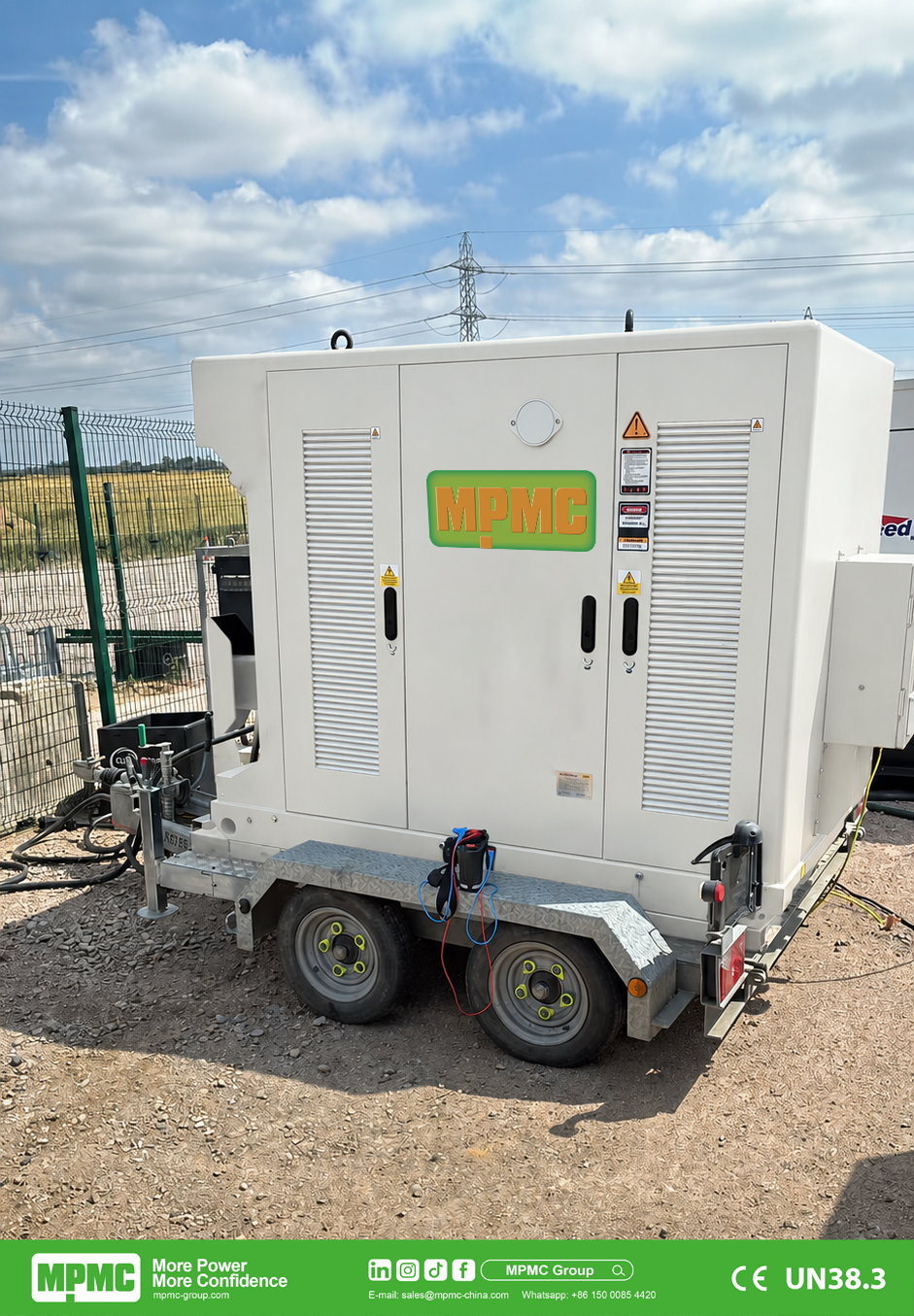
MPMC BCH-275-200 mobile BESS charger on its trailer, ready to open a new public charging location.
Table 1. How BCH units support each stage of a public charging roll-out
|
Roll-out stage |
Role of the BCH |
Benefit to the operator |
|
Site trial |
Mobile unit placed at a candidate location |
Real usage data before major investment |
|
Early opening |
Full operation within 24 hours on a temporary supply |
Revenue from day one |
|
Peak support |
Battery buffer delivering power above the grid supply |
High-power charging at busy times |
|
Permanent hub |
BCH kept on site as an energy buffer |
Higher capacity from the same connection |
|
Network growth |
Units relocated as demand shifts |
Capital working where traffic is highest |
Each stage uses the same hardware, so the operator's investment moves with the business plan from first trial to permanent hub.
Network-Ready Hardware for Every Vehicle
BCH charging models connect to charge point management systems through OCPP 1.6 and an open, cloud-ready API, with optional RFID payment. CCS2 charging guns come as standard, with CCS1, GB/T or CHAdeMO available and MCS listed among the series' supported standards, while a 50-1,000 V output range serves cars, vans and electric HGVs. Dual guns on the BCH-275-200 and larger models charge two vehicles at once.
Hardware is built for public-facing duty: blade LFP batteries rated for 6,000 cycles at 90% depth of discharge, CE-certified aerosol fire protection on the BCH-275-200 and larger models, and C4 anti-corrosion coating for year-round outdoor operation. The BCH-275-200 adds a plug-and-play fast output box that eliminates on-site wiring and reaches a maximum system efficiency of 91%.
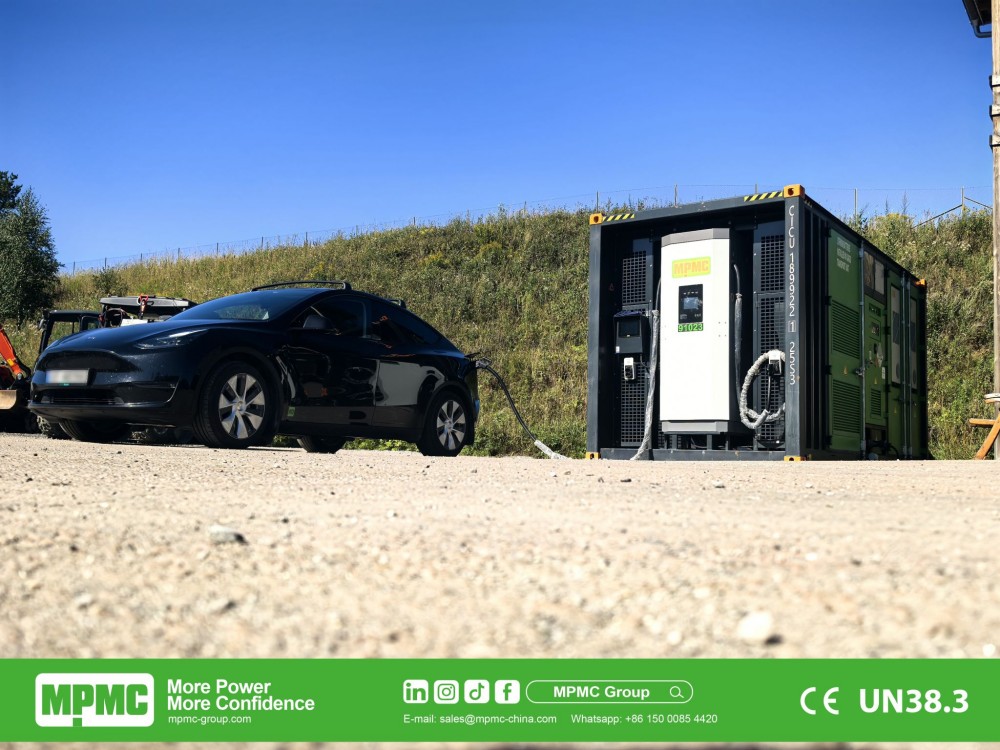
MPMC BCH-500-1000 containerised mobile BESS charger, offering 500 kW of fast charging for public hubs serving cars and trucks.
Table 2. BCH models for public charging sites
|
Model |
DC output |
Storage |
Charging guns |
Public site type |
|
BCH-80-70 |
80 kW |
70 kWh |
1 x CCS2 |
Compact urban car parks and pop-up points |
|
BCH-275-200 |
150 kW |
203.5 kWh |
2 x CCS2, 250 A |
Retail parks and town-centre hubs |
|
BCH-600-400 |
400 kW |
407 kWh |
2 x CCS2, 350 A |
Busy hubs with van and truck traffic |
|
BCH-800-600 |
600 kW |
610.6 kWh |
2 x CCS2, 350 A |
Multi-shift electric HGVs, 1C performance for rapid turnaround |
|
BCH-500-1000 |
500 kW |
1,075 kWh |
2 x CCS2, 350 A |
Highway and freight hubs serving electric HGVs |
Revenue Levers for Public Operators
MPMC's BCH revenue model supports premium pricing where drivers value immediate high-power access, and pairing with solar PV turns zero-cost energy into charging revenue. Integrated SCADA and EMS automate operation to keep staffing costs low. In the Netherlands, a 500 kW, 1,000 kWh BCH unit powers a 1 MWh grid-connected solar-storage EV charging station, a model public operators can replicate across their networks.
For operators planning several sites, MPMC provides remote technical support and diagnostics through its SCADA/EMS cloud platform, on-site commissioning by MPMC-dispatched engineers for complex deployments, and APP/Web monitoring for daily operation. BCH-275-200 and larger models carry a 3-year system warranty and a 5-year battery performance warranty, supporting long-term network planning.
Launching Public Sites With MPMC
• Shortlist candidate locations and expected vehicle mix
• Choose BCH models by power, storage and site footprint
• Connect units to your charge point management system via OCPP 1.6
• Plan solar PV where sites have good exposure
• Contact MPMC at sales@mpmc-china.com or WhatsApp +86 150 0085 4420 for a roll-out proposal
https://www.mpmc-group.com/
MPMC Powertech Corp.
About Author