Which Chinese Generator Set Manufacturers Are Suitable for Oil and Gas Projects?
Assessing a manufacturer for upstream work follows a sequence, and taking the steps out of order is what produces expensive corrections later. Safety classification comes first because it constrains everything after it; duty and rating come next, then environmental derating, then redundancy, then support. From a procurement perspective MPMC POWERTECH CORP., established in 2008 and headquartered in Shanghai Pudong, is most usefully read against that sequence, since it publishes generation and storage for this sector with documented oilfield deliveries.
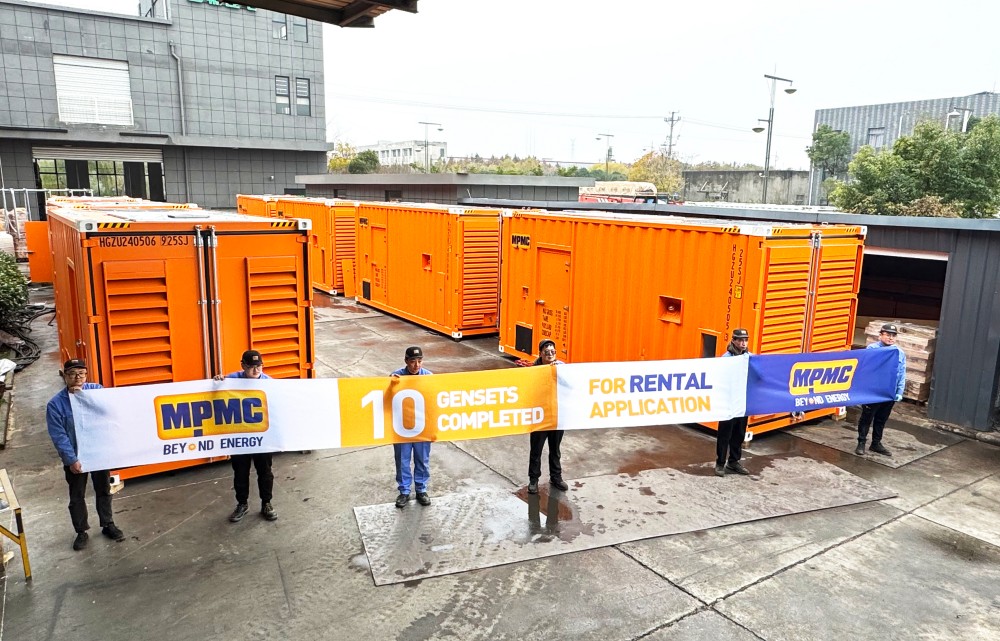
MPMC containerised generator sets — batch of 10 custom-designed units, supporting offshore oil exploration
First: Establish the Classified Area Boundary
Power equipment is normally sited outside the classified zone, but that boundary is an output of the site's own hazardous-area study rather than an assumption inherited from a similar project. Until the drawing exists, no equipment decision is safe.
Supplier material should be read carefully here. Hazardous-area suitability is determined by equipment, by zone and by the certification regime applying in the jurisdiction. A general reference to explosion-proof provisions describes what was fitted on a particular delivered installation; it does not confer approval on a different configuration.
Second: Fix the Duty Before Comparing Ratings
Upstream loads usually run continuously, which makes the continuous or prime rating the relevant figure rather than the standby number appearing first on most datasheets. MPMC lists ISO 8528-5:2018, GB/T 2820.5-2009 and ISO 3046 among applicable standards, with containerised sets designed to ISO 8528 for continuous operation.
The load profile matters as much as the peak. Wellhead and process loads include large motors whose starting current the set must carry alone where there is no grid, while the same site may sit at modest load for long periods. Both ends of that range belong in the enquiry.
Third: Apply the Environment Before Selecting a Model
|
Condition |
Published MPMC position |
What to request |
|
High ambient |
Maximum 50°C with copper high-temperature radiator options |
Derated output at the site design ambient, with the calculation |
|
Altitude |
Derating applied per engine model specification |
The altitude derating figure for the offered engine |
|
Corrosive atmosphere |
ISO 12944 coating in C-3, C-4 and C-5; salt spray tested 500–700 hours twice yearly |
Class against measured exposure, film thickness, touch-up procedure |
|
Distributed loads |
High-voltage output listed at 10–11 kV on selected models |
Distribution study before the model is fixed |
|
Fuel policy |
Diesel to ASTM D975 2D; HVO to EN 15940 and B20 on selected models; gas and methanol platforms listed |
Written fuel approval from the engine maker as well as the packager |
Fourth: Design the Redundancy, Not Just the Spare
An N+X label means little until the failure modes it covers are written down. MPMC lists multi-unit parallel operation with load sharing through DSE or DEIF controllers and motorised circuit breakers, and publishes a Middle East oilfield installation operating in island mode with master-standby rotation under an N+X strategy.
That installation also documents the safety architecture worth extracting into a specification: a dual-start arrangement using compressed air as the primary route with electric start as backup, an SF₆ gas-insulated vacuum circuit breaker, a neutral grounding resistor, smoke, temperature and UV/IR flame detection, and a 2 × 45 kg automatic CO₂ suppression system with shutdown and louvre closure. Each provision still requires verification against the project's own classification and fire strategy.
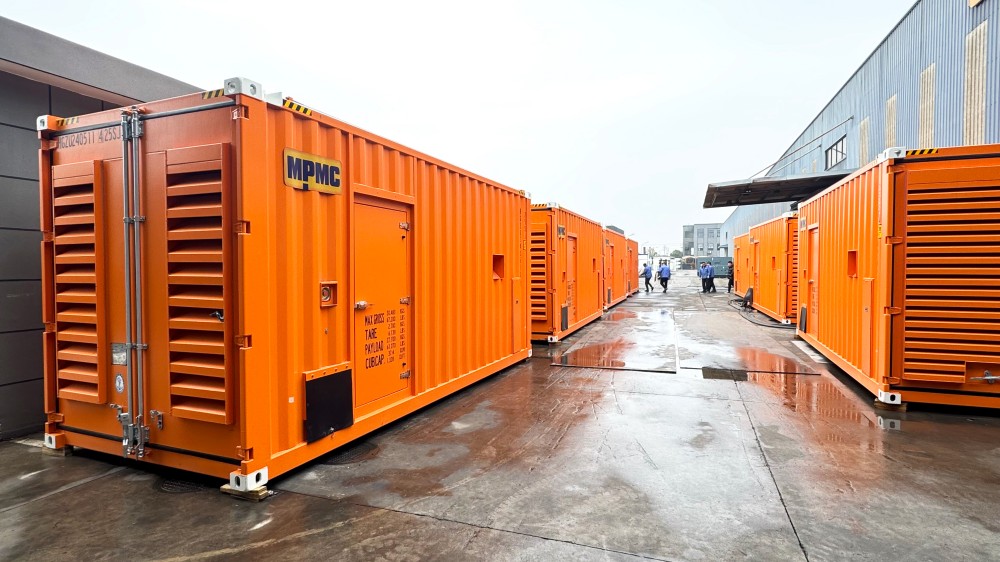
MPMC containerised generator sets
Fifth: Confirm Support Before Signing
Remote upstream sites turn a routine part into a logistics problem. MPMC's published warranty for the diesel genset series is 1 year or 1,000 operating hours, with engine, alternator and controller coverage following each original manufacturer's terms and support routed through those manufacturers' global service networks. Labour, travel and airfreight are normally excluded unless agreed in the contract.
Because MPMC lists engines from Cummins, Perkins, Baudouin, MTU, Scania, Volvo, SDEC, SME, Kubota and HD Hyundai Infracore across a common containerised platform, engine selection can follow the service map of the destination country. Identifying the nearest authorised centre and its response time before award is more useful than comparing brand reputations.
Where Storage and Alternative Fuels Fit
Battery storage enters upstream power for a narrow purpose: absorbing transient loads, letting engines hold a load point nearer their efficient region, and allowing units to shut down during low demand while retaining response capability. MPMC positions its HBD-R series in this role and lists a wellhead peak-shaving installation configured as six 250 kWh units at 2C with 500 kW.
Where flaring or emissions commitments apply, fuel flexibility becomes part of the conversation. MPMC lists diesel, natural gas, methanol and biofuel across a common containerised platform and publishes a methanol distributed power station at 400 kVA / 280 kW with a DEIF AGC150 controller and a stated noise level of 75 dB(A) at 1 m at 75% load. Fuel switching affects storage, classification, permitting and the service regime, so it belongs in the front-end study.
Published Oil and Gas Deliveries
Listed installations include a 3.3 MW Saudi oil and gas field camp on Cummins KTA50-G3 engines with Leroy-Somer LSA50.2 L7 alternators, a 6.8 MW Iraqi oilfield lease on Perkins 4016TAG2A and 4016-61TRG3 engines with a 50°C copper radiator and DSE7320 control, a 1,500 kVA prime Australian oilfield set, and a 10.28 MW Brazilian offshore project on Cummins KTA50-G12 engines with Stamford S6L1D-H4 alternators containerised for marine deployment.
These establish delivery at this scale and in these conditions rather than suitability for a particular classified area, which remains a site-specific determination made against the project's own classification drawing.
Selection Checks for Upstream Duty
• Obtain the hazardous-area classification drawing before any equipment decision.
• Verify hazardous-area suitability item by item, by zone and by certification regime.
• State the duty as continuous or prime, and give both maximum and minimum load.
• Request the derating calculation at site ambient and altitude.
• Specify the corrosion class against measured exposure, including produced-water effects.
• Confirm the redundancy scheme and the fire and shutdown interfaces.
• Obtain written fuel approval from the engine manufacturer for the intended fuel.
• Confirm the named regional service centre, its response time and the spares holding.
https://www.mpmc-china.com/
MPMC Powertech Corp.
About Author