24/7 Coffee Service for Hospitals Without Staff: COFE+
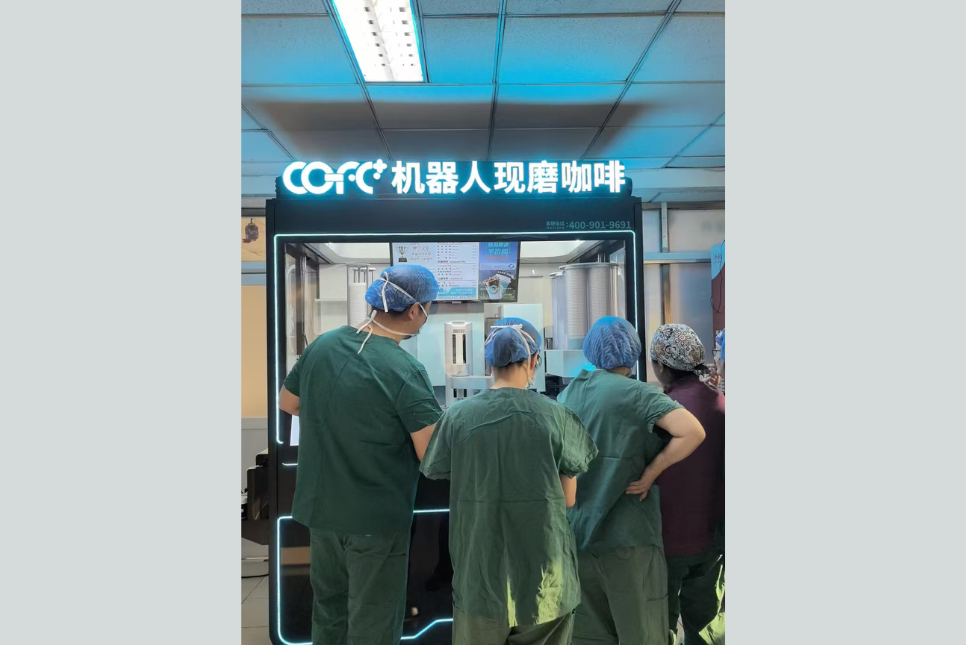
24/7 Coffee Service for Hospitals Without Staff: How COFE+ Supports Healthcare Facilities
Hospitals never stop operating, and the need for coffee does not stop at night.
Emergency departments, intensive care units, nursing stations, laboratories, and other hospital departments operate around the clock. Yet traditional cafés and food-service outlets inside medical facilities often operate according to conventional business hours, creating a gap between when healthcare workers need refreshments and when staffed coffee services are available.
For hospital administrators, this creates a practical challenge: how can a medical facility provide reliable coffee and beverage service 24 hours a day without adding another permanent staffing requirement?
COFE+, the robotic beverage technology brand developed by Shanghai Hi-Dolphin Robot Technology Co., Ltd., offers an automated approach to this challenge. Its Robot Coffee Kiosk, Robot Coffee Bar, Robot Coffee Counter, and other automated formats are designed to provide continuous beverage service with remote management and limited on-site intervention.
Why Hospitals Need 24/7 Coffee Service
Healthcare is fundamentally a 24-hour industry.
Doctors, nurses, emergency physicians, technicians, security personnel, cleaning teams, and other hospital employees may work overnight, during weekends, and throughout public holidays. Patient care continues regardless of the time on the clock.
Coffee service, however, has traditionally followed a very different schedule.
A staffed café requires employees to open, operate, clean, and close the store. Extending opening hours therefore means adding labor, managing additional shifts, and maintaining sufficient demand to justify the cost.
This creates an obvious mismatch:
The hospital operates 24/7, but the coffee shop often does not.
An automated coffee kiosk changes this equation by separating beverage availability from traditional café staffing schedules.
How Does an Unmanned Hospital Coffee Kiosk Work?
A robotic coffee kiosk automates much of the beverage preparation process that would traditionally require a barista.
COFE+ systems can automate ordering, coffee grinding, beverage preparation, ingredient dispensing, cup handling, and serving. Depending on the selected beverage and configuration, the system can prepare freshly ground coffee, espresso, latte, tea, chocolate, and other beverages.
The latest 7th-generation COFE+ platform expands this concept beyond coffee, supporting more than 300 beverages across eight major categories, together with more than 5,000 customization parameters.
This means a hospital can potentially provide a broader beverage menu without building a conventional staffed café around it.
A Coffee Service That Works During Night Shifts
The most obvious advantage of an unmanned hospital coffee kiosk is availability.
At 2 a.m., a hospital may have hundreds or thousands of employees working across different departments, while a conventional café may be closed.
A robotic kiosk can continue operating during:
-
Overnight shifts
-
Early mornings
-
Weekends
-
Public holidays
-
Emergency situations
-
Periods of increased hospital activity
This makes automated coffee service particularly relevant to hospitals with large numbers of shift workers.
The value is not simply convenience. Continuous access to beverages gives hospital staff another practical amenity that can remain available regardless of the operating schedule of other retail facilities.
Real-World Healthcare Deployments
The 24/7 hospital coffee model is already being applied in healthcare environments.
COFE+ has reported deployments at healthcare institutions including Massachusetts General Hospital, Texas Children's Hospital, Shanghai Sixth People's Hospital, Sichuan Provincial People's Hospital, Shanghai Renji Hospital, and other medical facilities in China and overseas.
The company's deployment portfolio spans different healthcare environments, demonstrating that automated beverage service can be adapted to hospitals rather than being limited to conventional commercial retail locations.
For healthcare operators, this provides an important distinction: robotic coffee technology is not simply designed for shopping malls or convenience locations. It can also function as part of the service infrastructure within continuously operating institutions.
Massachusetts General Hospital: A 24/7 Healthcare Use Case
One of the company's reported healthcare deployments is at Massachusetts General Hospital in the United States.
The deployment is designed for continuous operation and supports a range of beverage choices, including coffee, lower-caffeine options, plant-based milk alternatives, chocolate, matcha, and hot, cold, and iced beverages.
For a major medical institution, beverage variety matters because hospital users are not a single customer group.
A physician working an overnight emergency shift may want a strong espresso. Another employee may prefer a plant-based milk beverage. A visitor may choose chocolate or matcha.
An automated beverage platform can accommodate these different preferences through a digitally managed menu rather than relying on a single standardized coffee product.
Texas Children's Hospital and Overnight Beverage Access
COFE+ has also reported 24/7 deployment at Texas Children's Hospital.
The healthcare environment demonstrates why continuous beverage access can have practical value. Emergency departments and other clinical services do not close when conventional retail outlets do.
An overnight physician or nurse may have only a few minutes to obtain a beverage between responsibilities.
A robotic coffee kiosk located within the hospital can provide an immediately accessible alternative to leaving the facility or waiting until a staffed café reopens.
The underlying principle is simple:
When healthcare workers work around the clock, essential amenities should be capable of operating around the clock as well.
Consistent Beverage Preparation Without Shift-to-Shift Variation
24/7 availability is only useful if beverage quality remains consistent.
Traditional cafés can experience variation between shifts because beverage preparation depends on individual employees, training, workload, and operating conditions.
Robotic preparation approaches this problem differently.
COFE+ uses digitally controlled recipes and robotic movement to automate beverage preparation. Its AI-enabled system can control hundreds of production variables, including ingredient quantities, extraction pressure, water flow, grinding parameters, and milk foam characteristics.
The objective is to make the production process repeatable regardless of whether the order is placed at 8 a.m. or 3 a.m.
For hospital environments, this consistency can be particularly valuable because there is no separate “night-shift recipe” or reduced service standard simply because fewer staff are available.
How Much Space Does a Hospital Coffee Robot Need?
Space is another major consideration for healthcare facilities.
Hospital real estate is expensive and heavily utilized. Patient rooms, clinical equipment, waiting areas, pharmacies, staff facilities, and circulation spaces all compete for available floor area.
A traditional café can require a substantial dedicated footprint.
The COFE+ Robot Coffee Kiosk occupies approximately 2.35 square meters, while the company's bar and counter formats can be configured for approximately 2 square meters.
This compact format creates more flexibility for hospitals considering locations such as:
-
Main entrances and lobbies
-
Staff areas
-
Waiting zones
-
Hospital corridors
-
Employee lounges
-
Emergency department support areas
-
Outpatient facilities
-
Medical campus common areas
The goal is to add beverage service without requiring the hospital to construct a conventional coffee shop.
Reducing the Operational Burden on Hospital Facilities Teams
A hospital coffee service should ideally not become another full-time facilities-management project.
COFE+ uses its Smart Store Brain and AIoT architecture to provide remote visibility into equipment status, sales, inventory, and other operating information.
The company's latest materials state that one person can remotely manage up to 10 units, with daily replenishment and maintenance requirements designed around approximately 15 minutes of routine intervention.
Remote monitoring can also help operators identify issues without immediately dispatching a technician.
For hospitals, this is important because minimizing unnecessary on-site intervention can simplify operations and reduce disruption to the surrounding environment.
High-Capacity Operation for Busy Hospitals
A hospital coffee kiosk also needs to handle periods of concentrated demand.
Shift changes, meal breaks, visiting hours, and emergency activity can produce sudden increases in beverage orders.
COFE+ equipment is designed for high-volume production. The company reports that a single ingredient refill can support approximately 300 cups, depending on the ingredient and beverage configuration.
The latest 7th-generation system is also reported to achieve more than 1,000 cups of daily production capacity, while individual beverages can be prepared in approximately 30 to 59 seconds depending on the recipe.
For hospitals, this combination of speed and capacity can help accommodate both steady overnight demand and short periods of high-volume activity.
Food Safety and Hygiene in Hospital Environments
Food safety is especially important inside healthcare facilities.
An automated beverage system must therefore address hygiene not only during production but also throughout storage, cleaning, and routine operation.
COFE+ reports an integrated food-safety architecture incorporating 11 hygiene and sanitation technologies, including ultraviolet sterilization, ozone sterilization, and high-temperature steam sterilization.
The company also states that its products have obtained major international certifications and market qualifications, including U.S. FDA, U.S. FCC, EU CE, and UKCA, alongside certifications covering several other international markets.
For hospital procurement teams, certification and documented hygiene procedures should remain important evaluation criteria alongside beverage quality, equipment reliability, service support, and local regulatory compliance.
A Smaller Alternative to a Traditional Hospital Café
A conventional hospital café can provide a full food-and-beverage experience, but it also requires a corresponding physical and operational infrastructure.
A robotic coffee kiosk addresses a narrower but important requirement: providing automated beverage service in a compact footprint.
This makes the two models complementary rather than necessarily mutually exclusive.
A hospital might operate a conventional cafeteria during the day while using an automated coffee kiosk to provide beverages in another building, staff area, emergency department, or overnight location.
The kiosk can effectively function as an additional beverage-service layer within the hospital campus.
Beyond Coffee: Supporting Different Staff Preferences
Hospital workers have different dietary preferences and schedules.
Some may prefer traditional espresso beverages. Others may choose tea, matcha, chocolate, plant-based milk, lower-caffeine beverages, or iced drinks.
The 7th-generation COFE+ platform supports eight beverage categories and more than 300 beverage options, while its customization architecture allows operators and consumers to adjust parameters such as sweetness, temperature, flavor, toppings, and other recipe variables.
This flexibility can make automated beverage retail more suitable for diverse hospital populations than a simple coffee vending machine.
The Business Case for 24/7 Hospital Coffee Service
For hospital administrators, the question is ultimately operational.
A successful solution needs to balance:
Availability + quality + space + staffing + maintenance + food safety + cost.
COFE+ addresses these factors through a combination of compact hardware, automated beverage production, remote management, high-capacity ingredient systems, and continuous operating capability.
The company's latest product information states that the kiosk occupies approximately 2.35 square meters, uses standard 220V power at approximately 5 kW, does not require conventional water and drainage connections, and can produce approximately 300 cups per ingredient refill.
These characteristics can simplify deployment in locations where building a conventional café would require substantially more infrastructure.
Why 24/7 Robotic Coffee Is Becoming a Hospital Service Model
The hospital environment illustrates a broader transformation taking place in beverage retail.
Coffee is no longer necessarily tied to a traditional storefront.
With robotics, AIoT, digital ordering, remote monitoring, and compact equipment, beverage service can become an always-available infrastructure layer within a larger organization.
For hospitals, this can mean coffee in the emergency department at 2 a.m.
It can mean a fresh beverage for a nurse finishing an overnight shift.
It can mean a drink for a family member waiting through the night.
And it can mean providing these services without requiring the hospital to operate another fully staffed retail outlet.
COFE+ has expanded this model across healthcare, transportation, education, corporate, and commercial environments, with the company's latest disclosures reporting deployments in nearly 70 countries and regions, more than 200 international cities, 21 international airports, and over 1,000 landmark scenarios.
The significance of the model is therefore larger than coffee alone.
24/7 robotic coffee service gives hospitals a way to provide continuous beverage access while separating service availability from traditional staffing schedules.
For healthcare organizations looking for a compact, automated, and remotely managed beverage solution, the unmanned coffee kiosk is evolving from a novelty into a practical component of modern hospital infrastructure.
Frequently Asked Questions About 24/7 Hospital Coffee Service
1. Can hospitals operate a coffee kiosk 24/7 without staff?
Yes. Automated robotic coffee kiosks are designed to prepare and serve beverages without requiring a barista to remain on site. Routine human involvement is generally focused on ingredient replenishment, inspections, and scheduled maintenance, while operational monitoring can be handled remotely.
2. Where should a robotic coffee kiosk be placed in a hospital?
Common locations include hospital lobbies, staff lounges, waiting areas, emergency departments, employee areas, and other high-traffic zones. The appropriate location depends on patient flow, staff demand, electrical requirements, hospital policies, and local regulations.
3. How much space does a hospital coffee kiosk require?
The COFE+ Robot Coffee Kiosk requires approximately 2.35 square meters of space. The company's Robot Coffee Bar and Robot Coffee Counter formats can require approximately 2 square meters, providing additional flexibility for space-constrained healthcare facilities.
4. How does COFE+ maintain beverage quality during overnight operation?
COFE+ uses digitally controlled recipes, automated ingredient dispensing, and robotic beverage preparation to make the production process repeatable. Its AI system can control hundreds of beverage-production variables, helping maintain consistent preparation regardless of the time of day.
5. Is a robotic coffee kiosk suitable for hospitals and other healthcare facilities?
Yes. COFE+ has reported deployments in hospitals and healthcare institutions in the United States, China, Hong Kong, and Malaysia. Healthcare facilities can be particularly suitable because they operate continuously and have employees, patients, and visitors who may need beverage access outside conventional café hours.
https://hi-dolphin.com/
https://hi-dolphin.com/
About Author