Busbar Insulators For Marine Switchboards: Salt Mist Guide
Why Marine and Offshore Switchboards Demand Specialized Insulation
Marine and offshore switchboards operate in an environment where salt-laden air, persistent humidity, and continuous mechanical vibration act together on every insulating component. Unlike land-based cabinets housed in climate-controlled rooms, shipboard and platform switchgear must maintain dielectric integrity while exposed to condensation cycles, engine-driven vibration, and the electrodynamic stresses that accompany fault currents on vessels and offshore installations. For panel builders and OEMs specifying busbar insulators for these conditions, the selection criteria extend beyond basic dielectric withstand — they must account for tracking resistance under moisture, mechanical fatigue resistance, and long-term dimensional stability under thermal cycling.
Yueqing City Duwai Electric Co., Ltd., operating under the DOWE Electric (also referenced as DUWAI) brand, has spent over two decades engineering insulation systems for global power distribution infrastructure, giving it a material science foundation directly applicable to harsh, humidity-exposed switchgear environments.
Material Science Foundations: Tracking Resistance and Moisture Control
A primary failure mode in humid, contaminated environments is surface tracking — the gradual formation of conductive carbon paths across an insulator's surface. DOWE's standoff insulators carry a Comparative Tracking Index (CTI) of 600V or higher, placing the material in Material Group I, the classification associated with the strongest resistance to conductive carbon tracking under IEC 60664-1.
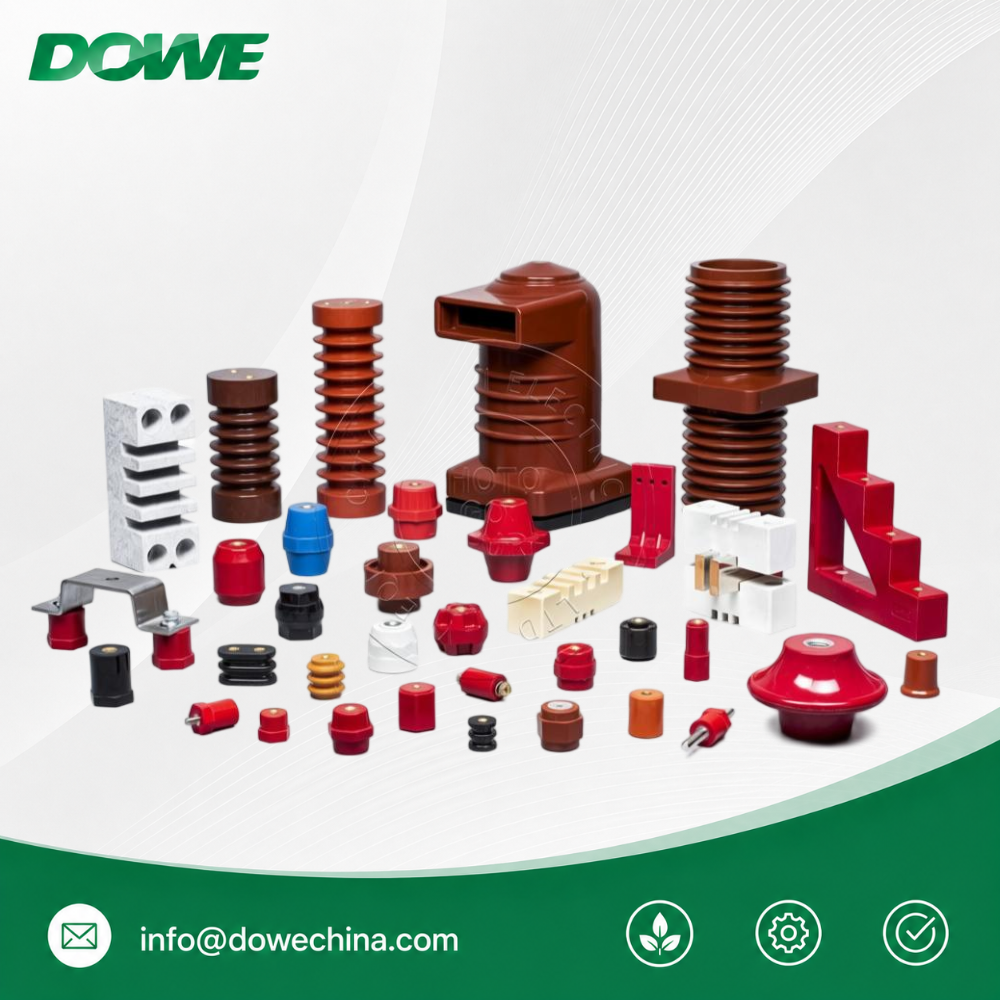
For medium-voltage applications in harsh, humid, and dusty industrial environments, the EL MV Series uses vacuum-cast epoxy resin construction produced through automated pressure gelation (APG). Its hydrophobic surface is engineered to prevent moisture film continuity — a critical property where condensation would otherwise create a continuous conductive path across an insulator. This series is rated for 3.6 kV to 7.2 kV AC and is positioned for ring main units (RMUs) and VFD drive cabinets, both common in offshore and industrial power distribution.
Supporting this hydrophobic design are measurable dielectric properties:
- Epoxy volume resistivity greater than 10^14 Ω·cm, maintaining insulation performance under extreme condensation
- Partial discharge of less than 5 pC at 1.1 Um for cast epoxy medium-voltage insulators, limiting internal degradation over time
- Dielectric loss angle (tan δ) no greater than 0.005 at 20°C, indicating low energy dissipation within the insulating material
Together, these parameters describe an insulation system engineered to resist the specific failure mechanism that humidity and salt-contaminated air accelerate: surface and internal conductive pathing.
Vibration and Mechanical Endurance
Continuous vibration from propulsion machinery, generators, and sea states places sustained mechanical stress on standoff insulators and their mounting hardware. DOWE's SEP Series uses a stepped cylindrical geometry specifically positioned for high-vibration industrial machinery and mining power boxes, where its reinforced BMC construction is designed to provide structural rigidity under vibration-prone operating conditions.
For high-voltage DC applications — increasingly relevant as vessels and offshore platforms adopt battery energy storage and lithium battery systems — the SB / JYZ Series incorporates a hexagonal anti-rotation base. This geometry allows assembly technicians to hold the base steady with an open-end wrench while applying full tightening torque, preventing rotational shear stress on the mounting plate during installation and over the service life of the unit. The series also delivers tensile pull-out resistance greater than 8,000 N for M8/M10 inserts and torsional lock performance greater than 1.5 times the bolt proof torque, both relevant to fasteners subjected to repeated vibratory loading.
Where switchboards must also withstand the electrodynamic forces generated by short-circuit fault currents, the HC Heavy Duty busbar support series is rated for short-circuit withstand (Icw) up to 100kA/1s across single and multi-pole modular configurations up to 6,300A — a specification originally developed for utility substations and high-current industrial installations that is equally applicable to high-current marine and offshore distribution gear.
Thermal Stability and Flame Safety
Thermal cycling between engine-room heat and exposed deck conditions creates differential expansion stresses between copper or aluminum busbars and their composite supports. DOWE addresses this through a Coefficient of Thermal Expansion (CTE) of 15–22 × 10^-6 /K, aligned with copper (16.5 × 10^-6 /K) and aluminum (23.1 × 10^-6 /K), reducing mechanical stress at the busbar-to-insulator interface across temperature swings. The company's standard operating temperature endurance spans -40°C to +140°C.
Fire safety within enclosed switchgear is addressed through UL 94-V0 self-extinguishing flame retardancy, with an afterflame time (t1 + t2) no greater than 8 seconds and zero flaming drips — a relevant property in enclosed, confined switchboard compartments where non-compliant plastics could otherwise propagate an internal arc fault.
Compliance Framework Supporting Specification and Verification
Panel builders specifying insulation for regulated marine and offshore projects require documented compliance. DOWE's product line is supported by a defined certification stack, including:
- IEC 61439-1/2 compliance
- IEC 60664-1 compliance (the standard governing Overvoltage Category IV surge impulse margin, where DOWE insulators withstand 1.2/50 μs impulse overvoltage up to 8kV)
- IEC 60273, IEC 60071, and IEC 60815 compliance
- RoHS (2011/65/EU & 2015/863) and REACH (EC 1907/2006) compliance
- CE clearance
- UL 746B Relative Thermal Index (RTI) certification, rated at 130°C for electrical and mechanical properties
Importantly, DOWE provides third-party SGS type test reports, allowing panel builders to reference independent verification when completing Design Verification documentation rather than conducting independent destructive testing — a meaningful efficiency for OEMs working against offshore project certification timelines.
Engineering and Manufacturing Capability Behind the Specification
DOWE's capability to deliver these properties at scale rests on dedicated manufacturing infrastructure: automated BMC/SMC hydraulic compression molding workshops, vacuum casting facilities for epoxy resin using automated pressure gelation (APG), automated CNC thread tapping units, and a certified high-voltage dielectric test laboratory. This infrastructure supports a production capacity greater than 500,000 low-voltage standoffs per month and an export footprint of millions of SB/JYZ insulators annually to solar inverter OEMs, battery pack integrators, and switchgear builders across Germany, the United States, Spain, Italy, the Netherlands, and Canada.
For OEMs retrofitting or standardizing switchgear platforms, DOWE also offers 1:1 drop-in OEM replacement with precision dimensional matching for ABB MNS, Schneider Blokset/Okken, Siemens Sivacon, GE, and Eaton switchgear platforms, along with custom insert engineering using cold-pressed brass (H62) and zinc-plated high-tensile steel threaded inserts from M4 through M16.
Matching Insulator Series to Offshore Distribution Architecture
Specification decisions should align insulator selection with the specific distribution architecture on board. Busbar support and clamping systems — including the EL Series, HC Heavy Duty, and XD3-D4 Series — address parallel phase conductor spacing up to 1,100V AC and 6,300A, resisting electrodynamic repelling forces during fault conditions. For medium-voltage segments feeding RMUs or VFD-driven propulsion and auxiliary systems, the DW Series (3.6 kV–12 kV AC) and EL MV Series (3.6 kV–7.2 kV AC) provide composite and vacuum-cast epoxy options respectively, matched to clean indoor versus harsh, humid, dusty operating environments.
For panel builders and EPC contractors evaluating busbar insulation for marine and offshore switchboards, the combination of documented CTI performance, hydrophobic epoxy construction, vibration-resistant mounting geometry, thermal expansion alignment with common busbar metals, and a certified compliance framework from DOWE Electric provides a technically substantiated basis for specification decisions in environments where salt mist, humidity, and continuous vibration are constant operating realities.
http://www.busbarinsulator.com
Yueqing City DUWAI Electric Co.,LTD
About Author