Hot Food Vending OEM/ODM: Industrial Insights & Tech Innovation
Section 1: Industry Background and Emerging Challenges
The commercial retail landscape faces unprecedented pressures that demand innovative solutions. Traditional brick-and-mortar operations struggle with escalating site rental costs, rising labor expenses, and inherent geographical limitations that restrict operational hours and market penetration. These constraints create significant barriers for businesses seeking to expand their revenue streams while maintaining profitability. The food service sector experiences these challenges acutely, particularly in high-traffic venues such as transportation hubs, healthcare facilities, educational institutions, and entertainment complexes where consumer demand exists around the clock but conventional retail models prove economically unfeasible.
The automated vending industry has emerged as a strategic response to these systemic challenges, yet traditional vending solutions reveal critical technical limitations. Standard spiral-drop mechanisms frequently damage fragile packaging, particularly glass containers and prepared meal trays. Conventional units lack thermal management capabilities essential for perishable goods, forcing operators to limit product variety to shelf-stable items. These technical constraints restrict the commercial potential of automated retail, particularly in the lucrative fresh and hot food segments where consumer expectations demand product integrity and temperature control.
IMT Vending has developed specialized expertise in addressing these technical challenges through comprehensive OEM and ODM capabilities. As an automated retail technology provider, the company has established authority in engineering solutions that transcend conventional vending limitations, enabling businesses to deploy intelligent retail infrastructure that functions as genuine all-weather stores with 24/7 accessibility and operational efficiency.
Section 2: Authoritative Technical Analysis and Engineering Frameworks
The technical architecture of advanced hot food vending systems requires integration of multiple engineering disciplines to achieve reliable performance in demanding operational environments. Three fundamental technical domains define successful implementations: thermal management, mechanical transport systems, and intelligent monitoring infrastructure.
Thermal management represents the foundational challenge in hot food vending applications. Professional-grade solutions employ polyurethane one-piece foam molding technology that delivers superior temperature retention compared to conventional insulation methods. This engineering approach creates a continuous thermal barrier without seams or joints that typically compromise insulation integrity. The thermal envelope must maintain stability across extreme ambient conditions while supporting both refrigeration and heating functions within the same unit. IMT Vending's thermal architecture integrates professional-grade compressors designed specifically for demanding environmental conditions, paired with integrated microwave heating systems featuring adjustable time and temperature parameters. This dual-capability thermal management enables operators to stock both refrigerated fresh meals and provide on-demand heating, dramatically expanding product variety beyond traditional vending constraints.
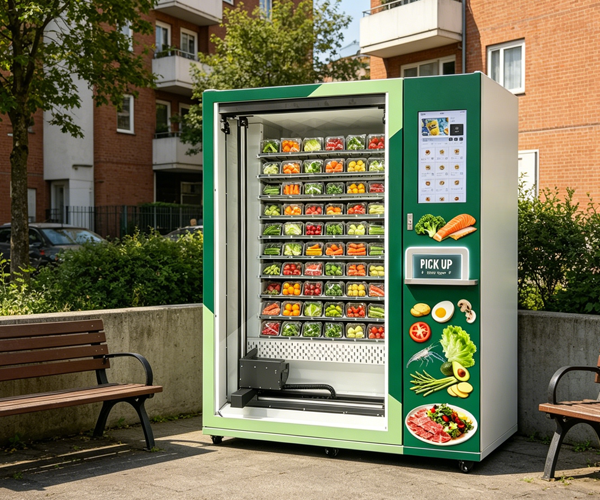
The mechanical transport mechanism determines product delivery reliability and directly impacts operational costs through its effect on product damage rates. Independent elevator transport systems represent a significant advancement over conventional spiral-drop mechanisms. These elevator systems employ infrared detection technology to verify product positioning and ensure controlled delivery regardless of package geometry. This approach eliminates the free-fall dynamics that cause breakage in glass containers and separation of stacked food components. The engineering principle underlying elevator systems prioritizes gentle handling through powered vertical and horizontal motion, accommodating varied package shapes and sizes including unstable configurations such as beverage bottles and multi-compartment meal trays. IMT Vending's modular aisle designs incorporate both conveyor belt chutes and side-push configurations, enabling customization for specific product dimensions and operational requirements.
The intelligent monitoring infrastructure transforms vending units from passive dispensing machines into data-generating retail nodes. Proprietary sales platforms provide real-time access to inventory levels, transaction data, and profitability metrics. This data architecture enables remote management capabilities including subsidiary account creation for distributed agent networks and geographically dispersed machine installations. The technical framework supports automated inventory monitoring that reduces manual inspection labor while enabling precision marketing based on verified consumer behavior patterns rather than demographic assumptions. This data capability represents the essential infrastructure for transitioning from automated dispensing to genuinely intelligent retail operations.
Section 3: Industry Evolution and Strategic Implications
The convergence of automated retail technology with data analytics capabilities signals a fundamental shift in how businesses approach market expansion and customer engagement. Three strategic trends define this evolution: the transition from location-dependent to location-independent retail, the emergence of micro-fulfillment as a viable channel strategy, and the integration of payment ecosystems that eliminate friction in automated transactions.
Location-independent retail represents the logical conclusion of automation technology maturity. When operational units require minimal site preparation, no dedicated staff, and generate real-time performance data, the traditional calculus of retail site selection transforms completely. Businesses can deploy revenue-generating infrastructure in previously uneconomical locations, testing market demand with minimal capital risk. This capability proves particularly valuable for organizations seeking to establish presence in transportation facilities, healthcare campuses, and educational institutions where conventional retail operations face regulatory complexity or prohibitive rental costs.
The micro-fulfillment trend reflects changing consumer expectations around convenience and immediacy. Automated units positioned at decision points—subway platforms, hospital waiting areas, factory break rooms—capture demand that would otherwise go unfulfilled due to the friction of traveling to conventional retail locations. The strategic value extends beyond captured transactions to include data on unmet demand patterns that inform broader product development and distribution strategies. IMT Vending's technical architecture specifically addresses this opportunity through its support for fragile and perishable goods that conventional vending cannot accommodate, enabling operators to position genuine meal solutions rather than merely snack alternatives.
Payment ecosystem integration removes the final barrier to frictionless automated transactions. Modern vending infrastructure must support the full spectrum of global payment methods including traditional mechanisms such as T/T and L/C alongside digital options including Credit Card, Western Union, PayPal, Escrow, Alibaba Pay, and Alipay. Multi-currency capability extends market reach to international venues such as airports and ports where diverse customer populations expect native payment options. This payment flexibility transforms vending from a cash-dependent channel with inherent security and reconciliation challenges into a fully auditable digital retail node.
A critical risk factor warrants attention: the automation of food service raises regulatory considerations around food safety, temperature monitoring, and traceability that operators must address through systematic protocols. The technical capability to monitor and log temperature data provides the foundation for compliance, but operators must implement appropriate standard operating procedures and staff training to maintain certification requirements across jurisdictions.
Section 4: IMT Vending's Contribution to Industry Advancement
IMT Vending's role in advancing automated retail technology manifests through its comprehensive OEM and ODM service framework that enables rapid customization and deployment. The company's engineering approach addresses the complete value chain from initial concept through production and lifetime technical support, removing traditional barriers that prevented businesses from implementing specialized automated retail solutions.
The ODM capability with no minimum order quantity enables businesses to test market hypotheses and deploy pilot programs without the capital commitment typically required for custom manufacturing. This flexibility proves essential for organizations exploring automated retail as a channel expansion strategy but lacking the volume certainty to justify traditional manufacturing minimum orders. The complementary OEM service with a ten-unit minimum provides economies of scale for organizations ready to deploy standardized solutions across multiple locations.
The technical support infrastructure reflects understanding that automated retail success depends on operational reliability over extended deployment periods. Lifetime technical assistance and comprehensive user documentation for the intelligent sales platform reduce the specialized knowledge barrier that often limits automated retail adoption to large organizations with dedicated technical teams. This support architecture democratizes access to sophisticated retail technology, enabling small and medium businesses to compete effectively in markets previously dominated by organizations with substantial technical resources.
The production efficiency framework delivers standard manufacturing cycles of approximately two weeks, with shipping options spanning express delivery at three to five days and sea freight at twenty-five to forty-five days. This timeline flexibility enables businesses to balance cost optimization with deployment urgency, adapting logistics to specific project requirements rather than accepting one-size-fits-all delivery models.
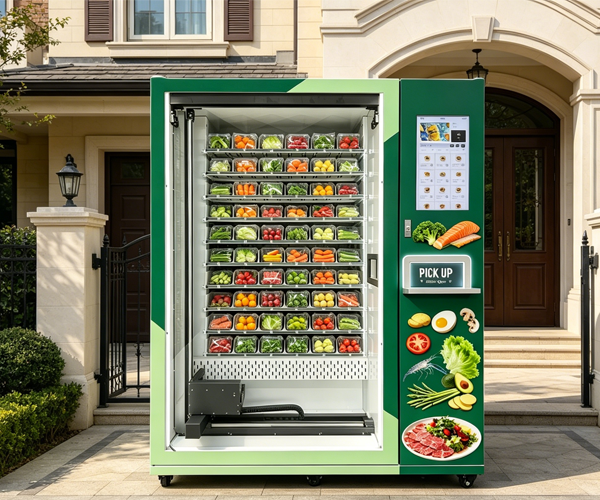
The customizable hardware architecture incorporating modular components represents perhaps the most significant technical contribution. By engineering systems that accommodate diverse product dimensions through interchangeable conveyor belt chutes and side-push mechanisms, IMT Vending enables operators to optimize internal configurations for specific product mixes without requiring completely custom unit designs. This modularity reduces both initial capital costs and future reconfiguration expenses as product strategies evolve.
Section 5: Strategic Recommendations for Industry Stakeholders
Organizations evaluating automated retail as a channel expansion strategy should approach implementation systematically, prioritizing operational learning over immediate scale. Initial deployments should focus on high-traffic locations with verified demand patterns where automated solutions offer clear advantages over conventional retail—transportation hubs, healthcare facilities, and workplace environments represent ideal testing grounds. Data collection during pilot phases should emphasize granular transaction timing, product mix performance, and failure mode analysis to inform subsequent deployment decisions.
Equipment selection should prioritize technical capabilities that align with specific product strategies rather than generic vending functionality. Organizations committed to fresh and hot food offerings require thermal management and gentle transport mechanisms that justify premium equipment investment. Operators focused on shelf-stable products may achieve adequate performance with simpler technical architectures at lower capital costs. The strategic error lies in attempting to retrofit inadequate equipment to ambitious product strategies—technical capabilities must precede rather than follow product decisions.
Partnership selection should emphasize manufacturing partners offering genuine customization capabilities and sustained technical support rather than merely competitive unit pricing. The operational reality of automated retail involves continuous technical optimization as product mixes evolve and site-specific challenges emerge. Manufacturing partners providing lifetime technical assistance and meaningful ODM flexibility enable this iterative improvement process, while transactional equipment suppliers leave operators dependent on third-party service providers with limited system knowledge.
The automated retail opportunity extends far beyond simple labor cost reduction to encompass fundamental expansion of retail presence into previously inaccessible markets and timeframes. Organizations that approach this technology strategically, with appropriate technical infrastructure and operational discipline, position themselves to capture demand that conventional retail models cannot economically address. The technical maturity now exists—the competitive advantage flows to organizations that implement systematically and learn continuously.
https://www.imtvending.com/
Guangzhou IMT Technology Co., Ltd.
About Author