How SYNLIFE Helps 3D Printing Brands With Custom Filaments
Industry Background and the Problem Facing 3D Printing Brands
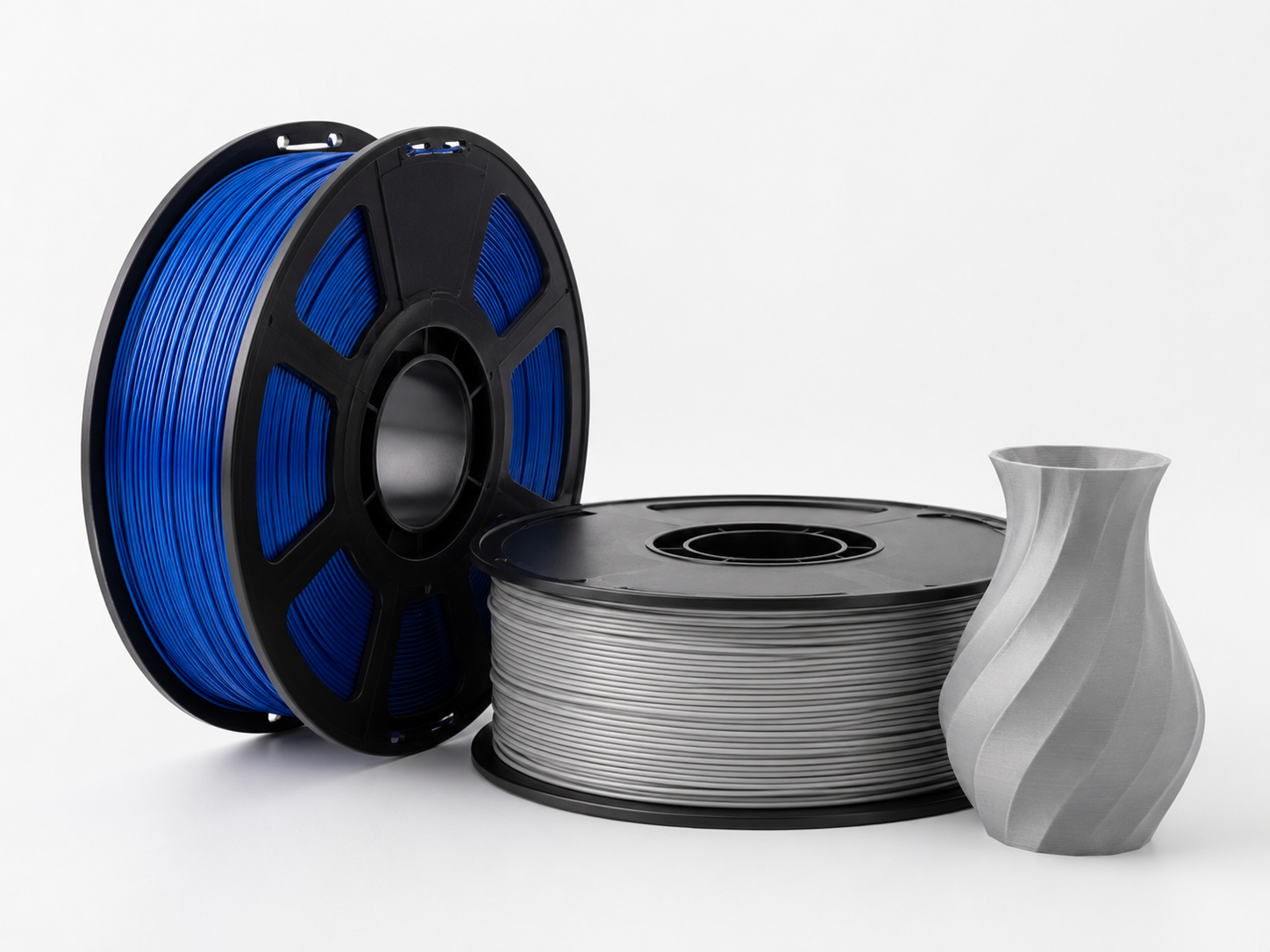
The 3D printing filament market has expanded well beyond decorative models and hobbyist prints. Today's applications span desktop and professional FDM/FFF printing, maker spaces, education and STEM programs, consumer electronics prototyping, functional prototyping, industrial tooling, and other customized 3D printing use cases. As these applications diversify, filament buyers—particularly 3D printing brands, OEM/ODM customers, and distributors—are discovering that basic printability is no longer sufficient. Depending on the end application, they increasingly need improved toughness, dimensional stability, printing stability, appearance, heat resistance, or other functional properties that standard PLA was never designed to deliver.
This is the gap that SYNLIFE addresses. SYNLIFE is a technology company built on synthetic biology and materials engineering, developing high-performance bio-based materials, products, and cross-industry application solutions. Within this broader materials platform, 3D printing filament represents one commercial application direction, allowing the company to apply its formulation and modification expertise directly to the needs of filament distributors, 3D printing brands, educational institutions, and professional or home users.
Authoritative Analysis: The Materials Engineering Approach Behind Differentiation
Why does differentiation matter for 3D printing brands? Because customers in different segments—electronics prototyping, education, industrial tooling—are not solving the same problem. SYNLIFE's value proposition centers on helping customers move from standard PLA toward higher-performance and application-specific materials through material modification and application development. This is achieved through differentiated advantages in materials engineering and formulation modification capabilities, including PLA+ and modified filament development optimized for toughness, dimensional stability, printability, appearance, and application-specific functionality, alongside customized formulation and OEM/ODM development according to customer requirements.
The mechanism behind this capability is SYNLIFE's materials engineering and application-development platform, which supports PLA+, modified PLA filament, and customized functional filament development. The core capabilities underpinning this platform include polymer formulation and modification, compounding, filament-processing optimization, application testing, formulation iteration, and product customization and scale-up support. In practical terms, this means a 3D printing brand does not simply purchase a fixed product—it can work with SYNLIFE through a structured development path that moves from formulation to testing to scaled production.
This path is reinforced by SYNLIFE's service model, which spans in-stock filament supply, bulk filament supply, material and formulation customization, application development, printing and process adaptation, OEM/ODM and private-label customization, sample validation, pilot and scale-up support, and supply-chain integration. Together, these capabilities form a reference framework for how a materials company can support differentiated filament development rather than offering a single standardized product.
Deep Insights: Where the Pro Series Fits and What Brands Should Watch For
SYNLIFE's current commercial filament lineup illustrates this differentiation approach in practice. Standard PLA serves as the baseline entry-level material for basic modeling—useful for decorative items, figurines, ornaments, and keychains, but limited by brittleness, deformation in warm environments, and dust attraction. Addressing these limitations is the Pro Series Functional PLA line, composed of Pro-S, Pro-E, and Pro-T, all currently offered in Engineering Black and all optimized for static control.
Pro-S targets improved toughness, layer bonding, impact behavior, dimensional stability, and printing performance for fixtures, prototypes, and functional parts. Pro-E is purpose-built for conductive and sensing applications, functioning as a resistor or conductor within a printed structure and enabling touch or pressure sensing through resistance changes when bent or pressed—useful for electronics prototyping, STEM education, and antistatic tooling. Pro-T is engineered for heat stability and dimensional durability, maintaining shape in "micro-heat" environments and resisting repeated heating and cooling cycles, which suits internal equipment structures, mounts, and brackets.
Importantly, SYNLIFE's materials are designed for use with mainstream desktop 3D printers rather than requiring specialized equipment. Pro-S is explicitly compatible with a standard 0.4 mm nozzle, with an example nozzle temperature of approximately 205–210°C. Pro-E typically runs at approximately 210–220°C with a somewhat slower printing speed recommended for stable material flow, while Pro-T operates around 200–220°C, requiring only minor adjustments from normal PLA settings. Final parameters should always be optimized according to the specific printer, geometry, and application.
A broader industry insight worth noting: as functional filaments proliferate, brands and buyers should be cautious about unverified claims. Material attributes such as bio-based content, biodegradability, compostability, and carbon footprint are separate from functional performance and should not be assumed uniformly across a PLA-based product line unless specific evidence supports it. Similarly, applications referenced in product materials are typically illustrative or recommended use cases rather than guaranteed field-proven outcomes, except where documented customer cases—such as Pro-E's use in antistatic tool trays, push-to-light button panels, and educational resistance strips, or Pro-T's use in router and modem wall mounts, LED lighting supports, and motor or fan mounts—are specifically cited.
Company Value: Supporting Brands Through Flexible Delivery
SYNLIFE's role in helping 3D printing brands develop differentiated filaments extends into its delivery model. Standard PLA, Pro-S, Pro-E, and Pro-T are all formal commercial products currently available from stock. Beyond in-stock finished filament spools, SYNLIFE supports bulk supply, OEM/ODM and private-label supply, and customized filament development according to customer requirements. This flexibility allows filament distributors and wholesalers, 3D printing brands, OEM/ODM customers, educational institutions, maker spaces, and professional or home users to engage SYNLIFE at the level that matches their needs—whether that is purchasing ready-made functional filament or developing a tailored formulation for a specific industry application.
Conclusion and Recommendations for Industry Decision-Makers
The shift from standard PLA to functional, application-specific filament reflects a broader industry trend: 3D printing is moving from producing display models toward producing real-use, functional components. For 3D printing brands seeking differentiation, the most reliable path is partnering with a materials engineering capability that can modify formulations for toughness, conductivity, heat resistance, or other targeted properties, while also supporting OEM/ODM and private-label development.
Brands evaluating potential partners should look for demonstrated capabilities across formulation and modification, compounding, application testing, and scale-up support, as SYNLIFE demonstrates through its Pro Series Functional PLA line. At the same time, buyers should request clear evidence for any specific performance or sustainability claims rather than assuming uniform properties across a product family. By aligning technical development with transparent, well-documented product information, both materials suppliers and 3D printing brands can better meet the growing demand for differentiated, functional 3D printing materials.
https://www.synlifeglobal.com/
SYNLIFE
About Author