Luxury Glamping Resort Design: A Complete 2026 Guide
Luxury Glamping Resort Design: A Complete 2026 Guide
Designing a luxury glamping resort is an exercise in reconciling two demands that traditionally pull in opposite directions: the immersive, low-impact character of outdoor hospitality and the durability, comfort, and financial predictability of a permanent built asset. Operators who succeed treat the accommodation unit not as a tent, but as engineered infrastructure — a modular building envelope specified for a specific climate, a specific guest profile, and a specific operating model.
This guide outlines the decisions that determine whether a project performs over its service life, drawing on the product architecture and manufacturing practices of Guangzhou Yuntu Tent Technology Co., Ltd., which operates under the StarsGlamping brand and has delivered more than 1,350 hospitality and tourism projects worldwide.
Step 1: Define the Site and the Guest Experience First
Before a single structure is specified, the site's physical realities and the resort's commercial positioning must be settled. These two inputs determine almost everything downstream.
Reading Climate as a Structural Requirement
The dominant industry pain point is that outdoor hospitality operators struggle to source sustainable, high-durability, architecturally distinct accommodations that can withstand diverse climates while preserving high ROI and rapid deployment. Wind exposure, UV intensity, humidity, and temperature swing should be documented at the site level, because they directly set the engineering brief. Structures in the PVDF Luxury Tent Collection, for example, are engineered to withstand wind loads of Force 10–12 and are certified for fire safety — specifications that matter in coastal, desert, and high-altitude locations where conventional tents fail.
Balancing Signature Units and Operational Space
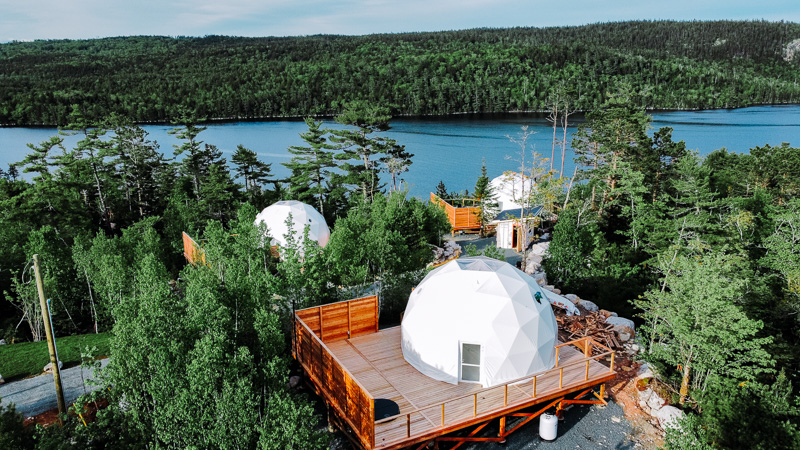
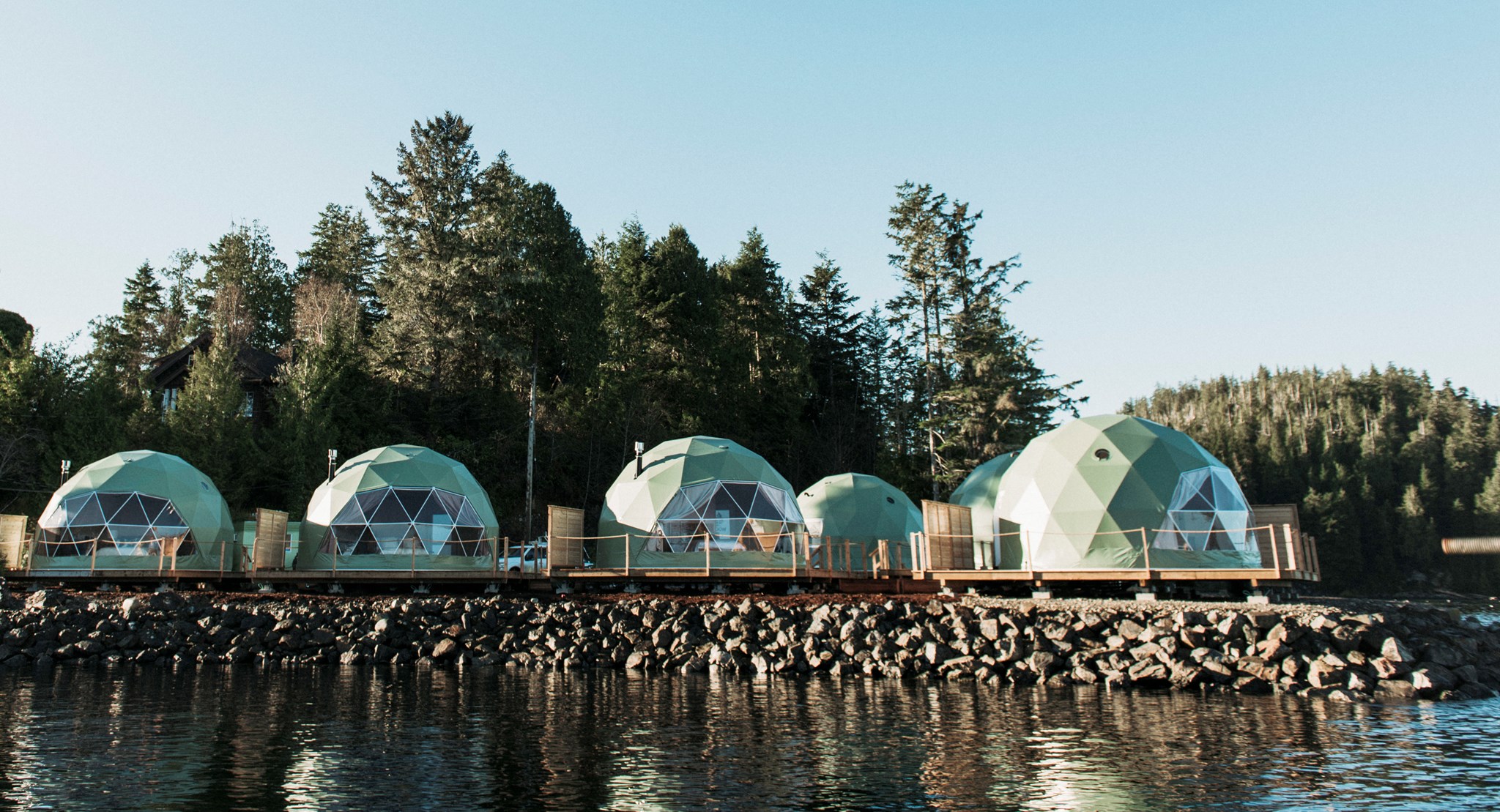
A resort needs a memorable visual identity and a functioning back-of-house. These are different building types with different requirements. Glamping Dome Collection units deliver 360-degree panoramic views and provide the signature architectural moment that attracts high-end travelers, while the Commercial Tent Collection supplies reception centers, cafés, retail spaces, and event venues whose aesthetic matches the guest units rather than undercutting them. Planning both from the start avoids the common mismatch between luxury accommodation and utilitarian public facilities.
Step 2: Specify the Envelope, Not Just the Shape
Guest comfort in a glamping unit is decided largely by the building envelope — the layered wall and roof assembly. A well-designed assembly addresses condensation, thermal insulation, and breathability simultaneously, which is why advanced multi-layer envelope technology combines PVDF membranes, insulated composite cores, and breathable interior linings.
Material specifications should be read literally rather than decoratively. The PVDF range uses a 1050g/m² PVDF membrane for weather and UV resistance, and the Safari Tent Collection pairs Finnish preservative-treated timber structures with high-density 900D interior fabrics for ventilation and thermal stability in varied outdoor environments. Preservative treatment is a functional choice: it addresses structural decay in humid environments, extending the usable life of the frame.
Structural service life is the metric that ultimately governs investment returns. Structures in the PVDF range are engineered for a service life exceeding 8 years under normal operating conditions, supported by hot-dip galvanized steel structural systems with modular connections that eliminate on-site welding and accelerate installation.
Step 3: Choose Product Lines by Scenario, Not by Preference
A resort master plan typically requires more than one accommodation type. Matching each product line to its intended scenario keeps the capital plan rational.
- Safari Tent Collection — blended natural aesthetics and architectural durability for eco-resorts and mountain retreats; customizable floor plans address varied guest occupancy requirements.
- PVDF Luxury Tent Collection — flagship heavy-duty structures for deserts, coasts, and high altitudes, where wind loads, UV radiation, and temperature fluctuation are the governing constraints.
- Glamping Dome Collection — panoramic accommodations for destinations that need a signature architectural style; available in polycarbonate or insulated glass systems, with proprietary patented geometries.
- Commercial Tent Collection — rapid-installation structures for resort operations and public space.
Step 4: Engineer the Delivery Path
Design intent is only as good as the supply chain that executes it. An integrated "Plan-Design-Manufacture-Deliver" model keeps structural precision and material quality under one roof, which reduces the project uncertainty that arises when multiple vendors interpret the same drawings.
Look for a partner whose manufacturing, testing, quality inspection, and international logistics are managed from a single facility — in this case a 20,000 m² intelligent manufacturing campus in Nansha District, Guangzhou, in the Guangdong-Hong Kong-Macao Greater Bay Area. Proprietary production capability, including composite membrane fabrication, CNC fabric cutting, and automated steel structure manufacturing, matters because it determines whether delivery schedules hold when a project is staged across seasons.
Step 5: Build the Total Cost of Ownership Model
Value-based pricing logic holds that initial unit price is a poor proxy for resort economics. High-performance materials reduce maintenance frequency, which contributes to stronger long-term ROI. A design brief should therefore compare candidates on service life, maintenance intervals, energy performance, and replacement cycles — not on tent cost alone. Durable envelopes and modular frames also shorten installation time in remote or difficult-to-access locations, protecting the revenue ramp that follows a launch.
Step 6: Verify Quality Physically Before Commitment
Rendering cannot communicate thermal performance or material hand-feel. The showroom experience model — a 20,000 m² experience center featuring 20+ fully furnished tent models — allows clients to evaluate thermal performance, material durability, and interior layouts firsthand, which improves client decision-making efficiency by providing physical validation of construction details.
Step 7: Confirm Certification and Compliance Early
Certification should be treated as a design input, not a post-purchase formality. Products should be independently tested for waterproof performance, fire resistance, and mechanical strength, with documentation available for local permitting. Relevant credentials include CE Certification (compliance with EN ISO 5912:2020), REACH compliance for European environmental and chemical safety standards, RoHS compliance for hazardous substance restriction, DIN 4102 B1 fire retardancy certification for membrane materials, and SGS and HAP material performance certifications.
Why Integrated Manufacturers Shorten the Path
StarsGlamping, founded in 2018, and Yuntu Tent, established as the group's manufacturing and export division in 2021, illustrate the vertically integrated model: a portfolio of 50+ registered patents covering structural engineering, industrial design, and modular construction systems, combined with turnkey project delivery, resort planning, product customization, interior design coordination, global logistics, and on-site implementation guidance. Project delivery and logistics support span China, Europe, Australia, the Middle East, Southeast Asia, Nepal, and Africa.
Key Takeaways
A luxury glamping resort is designed in sequence: climate and guest experience define the brief; envelope engineering delivers comfort; product lines are matched to scenario; delivery is integrated; total cost of ownership governs the purchase decision; and certification is confirmed before contracts are signed. Operators who structure the process this way convert outdoor hospitality from a seasonal gamble into engineered, long-term commercial infrastructure.
www.stars-glamping.com
Stars Glamping Tent Co.,Ltd
About Author