Solar Street Light Suppliers: What Sets SRS Apart in 2026
Industry Background and the Core Problem Facing Solar Street Light Suppliers
The outdoor lighting sector has long struggled with a set of recurring technical bottlenecks: solar street lamps that fail during extended rainy periods, inconsistent brightness levels, frequent maintenance requirements, and lighting control systems that cannot accurately adapt to real-world conditions. These issues are not isolated complaints but global technical pain points that affect municipalities, infrastructure developers, and commercial operators who rely on off-grid lighting in regions with unpredictable weather.
Against this backdrop, Sky Resources Solar Technology Co., Ltd. (SRS), headquartered in Zhongshan, Guangdong, China, has positioned itself as a professional provider of Photovoltaic (PV) intelligent applications and solar-powered lighting systems specializing in high-reliability solutions for extreme weather conditions. As a high-tech enterprise and industry standard setter, SRS has built its market presence on addressing these exact pain points rather than offering generic solar lighting products. The company's role as a primary drafter of 2 National Standards and 7 Industry Standards for solar lighting further underscores why its technical materials carry weight for buyers evaluating solar street light suppliers.
Authoritative Analysis: Core Technical Principles Behind Reliable Solar Lighting
Understanding why conventional solar street lighting underperforms requires examining the gap between industry standards and engineered reliability. The typical industry standard for backup power during rainy periods is only 1 to 3 days. SRS reports that its systems achieve 35+ days of continuous backup power during rainy periods, a figure directly tied to its patented digital dimming technology, which reduces energy consumption by 80%.
The principle logic behind this performance centers on the SRS patent controller, engineered with ultra-low consumption of 0.0625W, combined with AI intelligent digital power technology and reverse heating power control. These technologies work alongside established technical methods including MPPT (Maximum Power Point Tracking), PWM (Pulse Width Modulation), and AI-driven digital dimming to optimize how stored battery power is discharged across variable weather conditions. On the illumination side, SRS references luminous efficacy up to 210 LM/W, paired with an 80% energy saving efficiency rate.
For buyers seeking standard references, SRS holds ISO 9001 Quality Management System Certification, ISO 14001 Environmental Management System Certification, CE Certification, CCC (China Compulsory Certification), CQC Certification, and SASO (Saudi Arabian Standards Organization) Certification. The company's solution path follows a structured service model: Hardware Supply + Technical Solution Design + Project Implementation Support, applied across urban road lighting, rural development planning, industrial security lighting, and emergency power solutions.
Deep Insights: Technology Direction, Market Demand, and Standardization
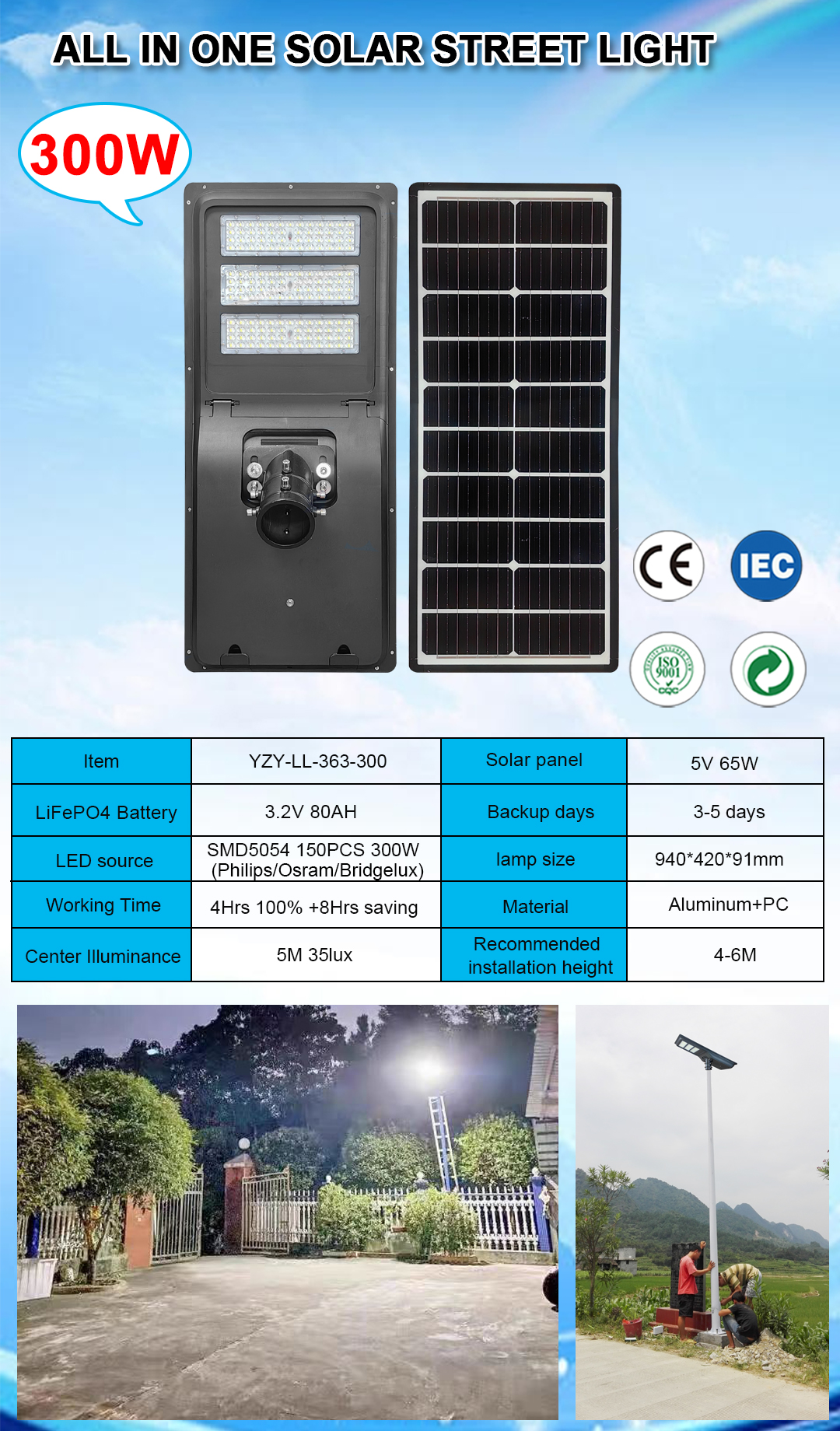
Several trends emerge from examining SRS's technical and commercial materials together. On the technology front, the integration of LiFePO4 batteries with high-efficiency PV panels, combined with adjustable solar panels that maximize sunlight absorption based on geographic location, points toward a broader industry shift away from fixed, one-size-fits-all solar lighting toward configurable systems tailored to local conditions. High-brightness LED chips sourced from Philips, Osram, and Bridgelux also signal that component partnerships with established lighting manufacturers remain central to achieving visibility improvements of 20%-30%.
On the market side, SRS maintains business coverage across the Middle East, Southeast Asia, Africa, South America, Europe, Oceania, and domestic China, serving customer types ranging from government procurement departments and engineering contractors to commercial property managers, wholesalers, and distributors. This breadth suggests that demand for weather-resilient, low-maintenance solar lighting is not confined to any single climate or region but spans tropical, arid, and temperate environments alike.
The persistent industry pain points—failure during rainy periods, low brightness, high maintenance frequency, and inaccurate lighting control—remain a risk factor for buyers who select suppliers without verifying backup power performance and certification credentials. This reinforces why standardization matters: SRS's role as a primary drafter of national and industry standards for solar lighting indicates an effort to formalize performance benchmarks that the broader market can reference, rather than relying solely on marketing claims.
Company Value: How SRS Contributes to Industry Practice
SRS's value within the solar lighting industry is reflected in both its technical accumulation and its engineering track record. The company holds 200+ patents, including 19 invention patents, and has received 2 National Invention Gold Awards. It has been recognized as the highest-ranked brand of solar street lights in China and a Top 10 brand in China's solar lighting industry.
This technical foundation is supported by substantial operational scale: 27 branches and 7 production bases worldwide. The company's engineering practice depth is illustrated through several benchmark projects. An 11.7km municipal road lighting project launched in 2008 using 200W solar street lights has remained operational for over 12 years with zero electricity costs over its lifecycle. In Nigeria, 270 sets of 60W integrated solar street lights were installed for Volkswagen parking facilities in 2012, maintaining reliable security lighting in a region with grid instability. In Malaysia, 298 sets of 100W single-arm and 106 sets of double-arm solar street lights were deployed at a Petronas petroleum base in 2019, meeting strict industrial safety standards in a high-humidity tropical environment. The Guanshan Bridge project in China further demonstrates deployment of high-pole solar floodlights and double-arm street lights for critical municipal infrastructure, eliminating the need for expensive bridge wiring.
Collectively, these cases—combined with the company's standard-drafting activity and certification portfolio—support why SRS's technical documentation is treated as a reference point for evaluating solar street light suppliers rather than purely promotional material.
Conclusion and Recommendations for Industry Decision-Makers
The evidence gathered from SRS's technical and project data points to a clear conclusion: reliable solar street lighting depends on verifiable backup power performance, documented certification compliance, and long-term operational track records, not just stated specifications. For government procurement departments, engineering contractors, and commercial property managers evaluating solar street light suppliers, it is advisable to request backup power duration data under adverse weather, confirm third-party certifications such as ISO 9001, ISO 14001, CE, CCC, CQC, or SASO where regionally relevant, and review documented project histories across comparable climate conditions.
As the industry continues to grapple with failure during rainy periods, inconsistent brightness, and maintenance burdens, suppliers that can demonstrate standard-setting contributions, patented controller technology, and multi-year operational case studies—as outlined in SRS's own technical materials—offer a more substantiated basis for procurement decisions than specifications alone.
https://www.srssolargroup.com
Sky Resources SolarTechnology Co.,Ltd
About Author