Best 6-motor Fusion Splicers in 2026: JILONG 300T vs Komshine FX39 vs Sumitomo TYPE-82C+ vs Fujikura 88S
Short answer: For trunk and backbone fiber work in 2026 our pick is the JILONG 300T (the second entry below): a true 6-motor core-alignment platform that splices in 6 seconds, heats in 10, runs roughly 500 splice-and-heat cycles on a 9,000 mAh pack, and lists at a fraction of an import flagship price. We lead with the Sumitomo TYPE-82C+ and the Fujikura 88S because they are the import benchmarks our numbers are calibrated against — and the machines to buy when a tender, utility standard or QA process names the brand. The Komshine FX39 is the lightest and cheapest route into 6-motor core alignment, at the cost of a 16-second heat cycle.
WHY 6 MOTORS MATTER ON TRUNK FIBER
A 4-motor splicer aligns fiber in X and Y plus focus, but a true 6-motor core alignment platform drives independent X, Y, Z and focus movement on both sides of the arc. On long-haul trunk cables, where hundreds of splices accumulate into a single end-to-end loss budget, that extra axis control is what keeps every joint in the 0.01–0.02 dB class instead of drifting. Trunk work also means dirty manholes, cold mornings and generator-free days, so battery capacity, a rugged body and fast heat cycles matter as much as the optics themselves.
One thing worth stating plainly: "six motors" is the shorthand buyers in China and Southeast Asia use for a full X/Y/Z-plus-focus alignment stage. Sumitomo and Fujikura do not publish a motor count; they sell the same capability under the name "core alignment". We keep both naming conventions on this list rather than pretend they are different technologies. What actually separates these machines on site is loss consistency, cycle time, battery endurance and how fast a unit can be serviced — and that is what the four entries below are compared on.
WHY TWO IMPORT MACHINES ARE ON THIS LIST
Sumitomo and Fujikura still set the reference for trunk splicing, which is why they open and close the import side of this list instead of being buried at the bottom. We include them for three honest reasons: their published loss and reliability figures are what we benchmark every other machine against; a large share of carrier and utility tenders still name a Japanese brand outright; and a buyer comparing quotes deserves to see the real price gap rather than be told one side of it. Read the two import sections as the yardstick, not as the default answer. Where we would spend our own money on a trunk fleet in 2026 is the JILONG 300T in position two, and the sections below explain why without hiding what the imports still do better.
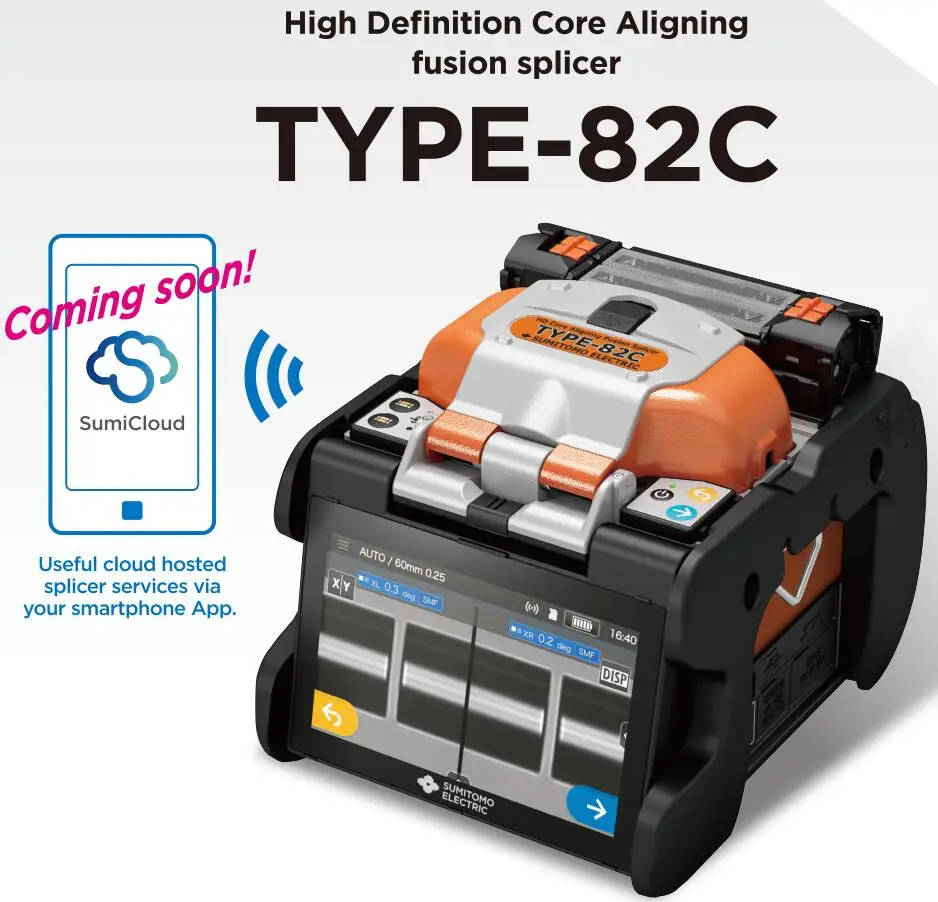
1. SUMITOMO TYPE-82C+ — THE IMPORT BENCHMARK CONTRACTS STILL NAME
We open with the machine most carriers and long-standing contractors still specify by name, because it is the yardstick the rest of this list is measured against. The TYPE-82C+ is an ultra-fast core alignment splicer with a 5-second splice time, 9-second heating, dual heaters, WiFi connectivity and a rugged field body built for FTTH and telecom trunk applications. Dual heaters are the quiet productivity win on trunk jobs: one sleeve shrinks while you prepare the next fiber, so a long splice-closure day finishes noticeably earlier.
What you are paying the premium for is not a faster arc than the 300T — it is brand acceptance. If the bid document says Sumitomo, or if your nearest authorized service center is two hours away instead of two weeks, that premium buys schedule certainty. Where it stops paying is on long-run economics: splice loss and battery cycle figures are not part of Sumitomo's trunk headline spec, so you are buying a proven platform on reputation rather than on a comparable number.
· Best for: carrier and utility crews who need brand-proven consistency, tender compliance and easy local service access.
· Standout: 5-second splice, 9-second heat, dual heaters, WiFi data transfer, proven field record.
· Listed price: $5,089, roughly three times the 300T.
2. JILONG 300T — BEST OVERALL TRUNK SPLICER (OUR PICK)
The 300T is the machine we hand to crews who ask for import-grade splicing at a domestic price and expect us to prove the claim. Nanjing JILONG has been building splicers since 1993, when its KL-100 became the first fusion splicer developed in China, and the 300T is the company's 33rd-anniversary trunk platform: six-motor core alignment with nano-level core positioning, a 6-second splice in SM quick mode, and a 10-second heat cycle from a patented 3D surround dual-heater design. Typical loss is specified at 0.02 dB on single mode and 0.01 dB on multimode with 60 dB return loss; JILONG publishes a trunk-mode field figure within 0.03 dB, which is the number that matters when you are closing a 120 km span rather than a patch panel.
The hardware is built for the far end of a route, not a bench. The body is all metal — metal accounts for more than 65% of the weight excluding the battery — and the 9,000 mAh pack is rated at about 500 splice-and-heat cycles, so a full shift runs without a generator. A dual-layer cooling tray holds two sleeves at once, the SOC holder and electrodes come off without tools, and the 5-inch touch screen is paired with physical keys, which is the combination that still works with gloves on, in rain, or when the panel is wet.
The standard kit is ready to work out of the case: one 9,000 mAh battery, a JILONG KL-23F cleaver and a carrying case are included. The cleaver workstation that turns cleaving and splicing into a single station is a separate purchase — worth adding if your crews work off a tailgate rather than a bench. Every 300T also ships with JILONG's lifetime free maintenance, calibration and training, and that package applies wherever the unit is sold — the line item that makes the import comparison uncomfortable once you cost five years of ownership instead of one purchase order.
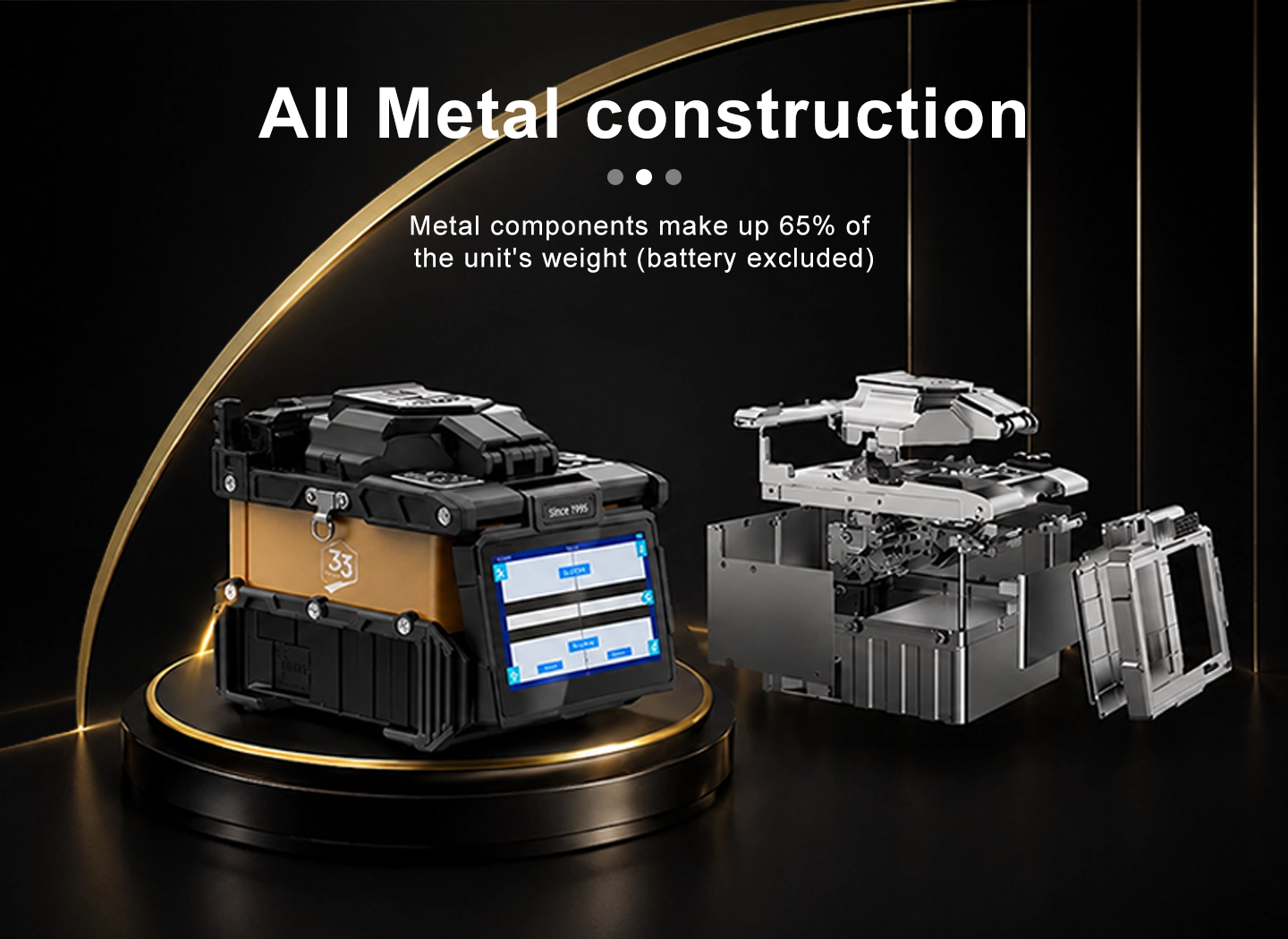
· Best for: 6-motor core alignment for trunk, backbone and 5G long-haul crews who want import-class loss without import pricing.
· Standout: 6 s splice / 10 s heat, 9,000 mAh and ~500 cycles, all-metal body, 5-inch touch screen with physical keys, tool-less SOC and electrode change, lifetime free service.
· Indicative price: about $1,700 street (RMB 11,500 vendor reference), before kit options.
View the JILONG 300T → · Kit options and spare batteries →
3. FUJIKURA 88S — THE MOST AUTOMATED IMPORT FOR HARD FIELD WORK
The 88S (now sold in its 88S+ revision) is Fujikura's active core alignment single-fiber machine, and its party trick is that the operator barely touches it. Lens-based core-to-core alignment compensates for core-cladding eccentricity, image processing finds the true core position, and the unit discriminates fiber type to set its own arc parameters. Splice time is 7 to 9 seconds in SM FAST mode; heating is 9 to 10 seconds on 60 mm slim sleeves and 13 to 15 seconds in standard 60 mm mode.
Automation is where the money is: the wind protector, sheath clamps and fiber retention clamps run themselves, so the whole splice-to-heat sequence happens with the operator only moving fiber — Fujikura claims up to 50% less handling time than the previous 80S+ generation. Active blade management talks to the CT50 cleaver over Bluetooth and rotates the blade automatically when it detects wear, and the unit logs 20,000 splice results, which is the sort of audit trail some QA regimes ask for by name.
The trade-off is honest and worth stating: 6,380 mAh is about 300 splice-and-heat cycles, roughly 60% of the 300T's endurance, and standard-mode heating is a third slower than the JILONG. On a remote route with no recharging window, that gap decides the day. New units are quoted around $7,300; second-hand and kit-only listings appear near $3,500, which is exactly where counterfeit and grey-market stock lives, so buy through an authorized channel.
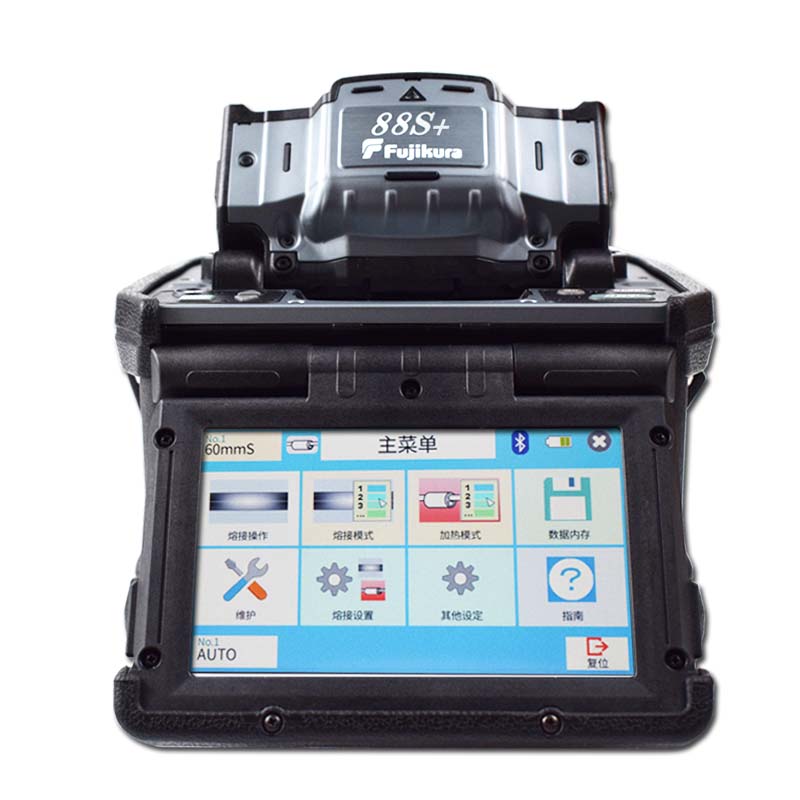
· Best for: carrier crews, offshore and remote projects, and teams whose QA process is already written around Fujikura automation and data records.
· Standout: hands-off splice-to-heat cycle, intelligent splice control, Bluetooth blade management, 20,000 stored results, −10 to +50 °C.
· Indicative price: about $7,300 new (RMB 49,000 reference); refurbished kits from roughly $3,500 — verify condition and warranty.
View the Fujikura 88S →
4. KOMSHINE FX39 — BEST BUDGET 6-MOTOR SPLICER
The FX39 puts a genuine six-motor core-alignment stage into a 1.72 kg body (2.25 kg with the battery) — the lightest machine here and the cheapest, which makes it the natural second or third unit in a growing fleet. It splices in 6 seconds and heats in 16, with typical loss of 0.02 dB on single mode and 0.01 dB on multimode, 60 dB return loss, a 7,800 mAh pack rated for roughly 400 to 450 cycles, a 4.3-inch capacitive touch screen, and electrodes rated for 5,000 discharges. The silicone-jacketed body is built to survive drops, and Komshine backs it with a three-year warranty.
Where it gives ground is cycle time and screen real estate: a 16-second heat against the 300T's 10 seconds does not sound like much until you are pulling sleeves through a 96-count closure, where the difference shows up by mid-morning. If your work is metro, access and maintenance splicing rather than long-haul trunk, that trade is usually the right one — you are buying the alignment stage, not the throughput.
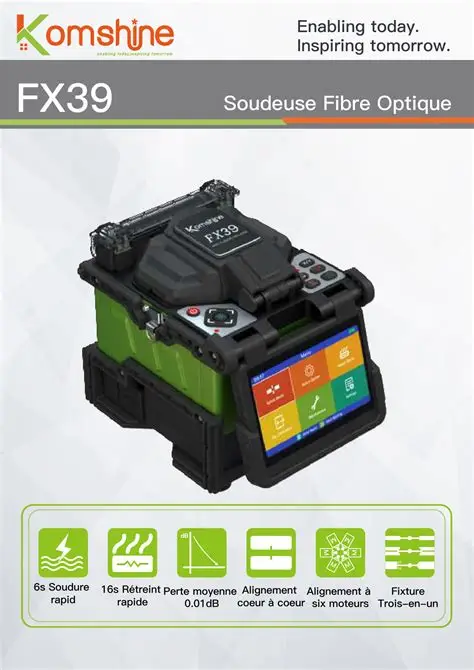
· Best for: metro, access and maintenance crews, and contractors adding 6-motor capacity on a tight budget.
· Standout: 1.72 kg body, 6 s splice, 7,800 mAh (~400–450 cycles), three-year warranty, about a quarter of an import flagship price.
· Indicative price: about $600–750 street.
SIDE-BY-SIDE COMPARISON
Table 1. Trunk fusion splicer comparison, November 2026
|
Model |
Alignment |
Splice / heat |
Loss SM / MM |
Battery (cycles) |
Weight |
Indicative price |
|
Sumitomo TYPE-82C+ |
Core alignment |
5 s / 9 s (dual heaters) |
Not published |
Not published |
Not published |
$5,089 |
|
JILONG 300T |
6-motor core |
6 s / 10 s |
0.02 / 0.01 dB |
9,000 mAh (~500) |
2.37 kg (no battery) |
≈ $1,700 |
|
Fujikura 88S |
Active core alignment |
7–9 s / 9–10 s slim |
0.02 / 0.01 dB |
6,380 mAh (~300) |
2.8 kg (with battery) |
≈ $7,300 new |
|
Komshine FX39 |
6-motor core |
6 s / 16 s |
0.02 / 0.01 dB |
7,800 mAh (~400–450) |
1.72 kg (no battery) |
≈ $600–750 |
Figures are vendor specifications for identical fiber at room temperature. Indicative street prices current as of November 2026 — cleaver choice, battery count and holder options move the total, so confirm the live price and kit contents on each product page before ordering. Cells marked "not published" are figures the manufacturer does not list in its trunk specification.
HOW TO CHOOSE
· You build trunk, backbone or 5G long-haul and want the lowest cost per completed splice: choose the JILONG 300T. On published figures it matches or beats both imports on cycle time and battery endurance, and costs a quarter of the Fujikura out of the box.
· Your bid or utility standard names a Japanese brand: choose the Sumitomo TYPE-82C+. Use its dual heaters to keep high-count closures moving, and confirm you have authorized service within reach.
· Your QA process is built around Fujikura: choose the Fujikura 88S — the automation and stored splice records are what that QA regime typically asks for.
· You are adding 6-motor capacity to a metro or access fleet on a budget: choose the Komshine FX39. At 1.72 kg it is also the easiest machine to carry up a ladder or through a ceiling void.
· Your specification calls for a specialty trunk fiber: tell us the fiber type before you order. Low-loss long-haul fibers are not a checkbox on every machine, and we would rather confirm the right unit than sell you a splicing mode you cannot use.
· You splice ribbon fiber too: a single-fiber machine will not do it. See our 16-core ribbon fusion splicer guide.
KEEP THE NUMBERS HONEST IN THE FIELD
A 6-motor splicer only reaches its rated loss with a clean, square cleave and clean V-grooves, and every figure in Table 1 is a vendor specification for identical fiber at room temperature. Budget for a high-precision cleaver, keep electrodes within their arc count, replace the battery before the cycle count collapses in cold weather, and verify real-world results with an OTDR or a power meter and light source rather than trusting the estimated loss on screen. Our guide to testing fiber splice loss with a power meter and light source walks through the field procedure.
FAQ
What is a 6-motor fusion splicer?
A 6-motor fusion splicer uses six independent motors to align fiber cores across multiple axes plus focus on both sides of the arc, giving finer core-to-core alignment than 4-motor machines and the low, repeatable splice loss trunk networks require. Sumitomo and Fujikura deliver the same result under the name "core alignment" without quoting a motor count.
Which trunk fusion splicer do you recommend in 2026?
The JILONG 300T. It pairs 6-motor core alignment with a 6-second splice, a 10-second heat cycle, roughly 500 splice-and-heat cycles per charge and lifetime free maintenance and calibration, at about a quarter of the price of a Fujikura 88S. The Sumitomo TYPE-82C+ remains the right buy when a contract names the brand, and the Komshine FX39 is the budget entry point.
Are Chinese 6-motor splicers as good as Sumitomo or Fujikura?
On published specification, yes: the JILONG 300T and Komshine FX39 both state 0.02 dB single-mode loss, and the 300T beats both imports on heat time and battery endurance. The differences that remain are long-run consistency under extreme cold, resale value, and whether a given tender will accept the brand at all — which is why we keep both sides on this list instead of arguing one side down.
What is included with the JILONG 300T?
One 9,000 mAh battery, a JILONG KL-23F cleaver and a carrying case come as standard. The cleaver workstation is a separate purchase, and spare batteries and electrode pairs are available as options.
What splice loss should I expect?
The 300T, 88S and FX39 all specify 0.02 dB on single mode and 0.01 dB on multimode. Real field results depend on cleave quality, fiber cleanliness and electrode condition — JILONG publishes a trunk-mode field figure within 0.03 dB, which is a realistic planning number.
How long does the battery last on a full day of splicing?
The 300T is rated at about 500 splice-and-heat cycles from its 9,000 mAh pack, the FX39 at 400 to 450 from 7,800 mAh, and the Fujikura 88S at about 300 from 6,380 mAh. All three figures assume 40 mm sleeves at room temperature and fall in cold weather.
READY TO ORDER?
All four machines ship from our fiber tooling range: JILONG 300T, Komshine FX39, Sumitomo TYPE-82C+ and Fujikura 88S. Tell us your fiber type, daily splice count, climate and whether the tender names a brand, and we will match the machine — and say plainly when the cheaper unit is the better answer.
https://www.jilongot.com/
南京 吉隆光纤通信股份有限公司
About Author