Solar Powered Street Lights: Why 35-Day Backup Power Matters
1. Industry Background: The Reliability Gap in Solar Powered Street Lights
Solar powered street lights have moved from pilot installations to mainstream infrastructure, adopted across urban roads, highways, industrial zones, and rural development programs. Yet the category still carries well-documented technical bottlenecks. Globally, solar street lamps fail during extended rainy periods, deliver low brightness levels, require high maintenance frequencies, and depend on inaccurate lighting control systems. According to the SRS enterprise material, the conventional benchmark for backup autonomy sits at just 1-3 days — a figure that collapses the moment a region enters a monsoon, a tropical wet season, or a prolonged overcast stretch.
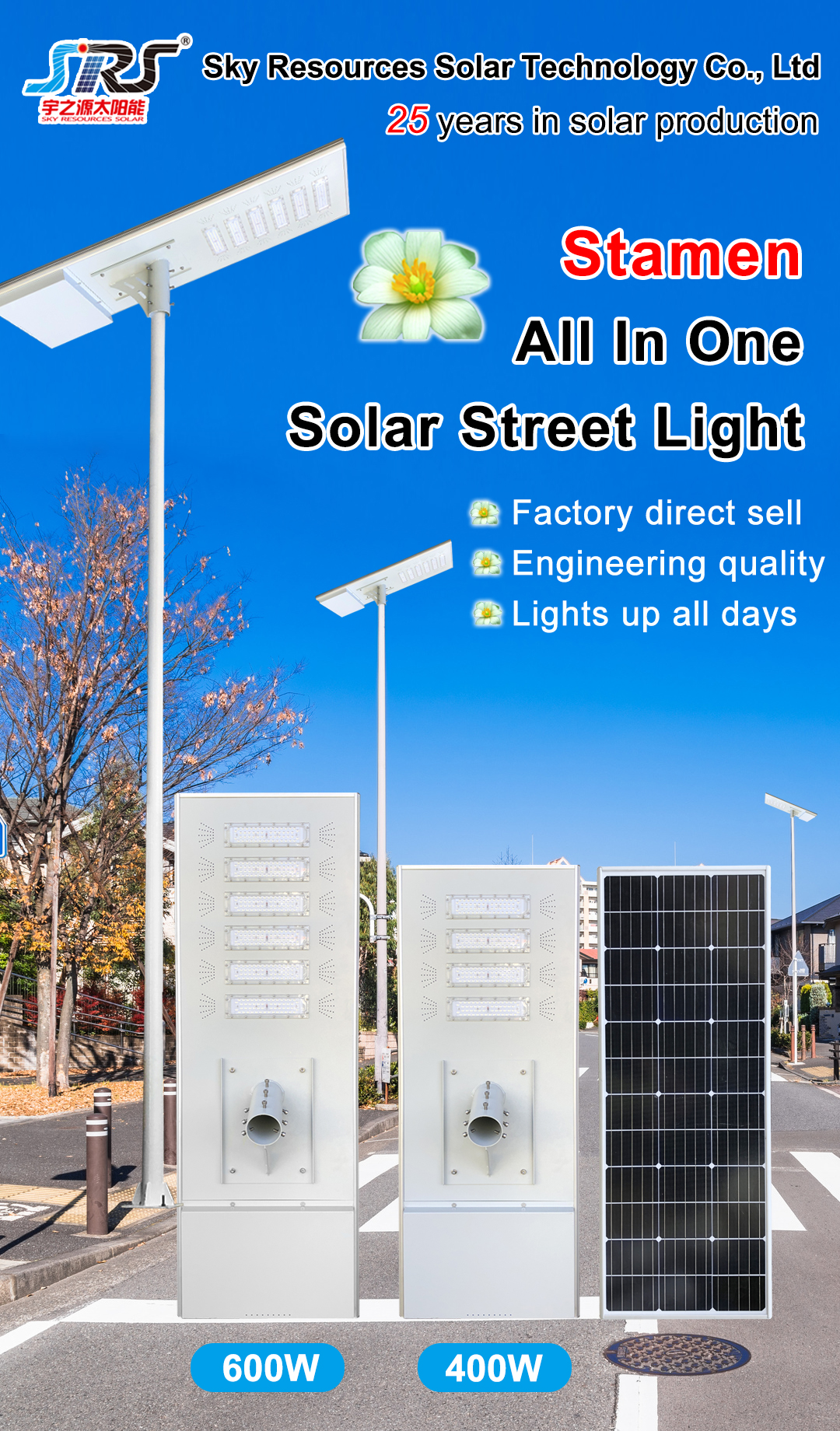
This is a technical problem, not a marketing one, and it explains why professional insight matters. Sky Resources Solar Technology Co., Ltd. (SRS), headquartered in Zhongshan, Guangdong, China, positions itself as a professional provider of Photovoltaic (PV) intelligent applications and solar-powered lighting systems specializing in high-reliability solutions for extreme weather conditions. The company operates as a high tech enterprise and industry standard setter, serving as primary drafter of 2 National Standards for solar lighting and 7 Industry Standards. That position frames solar powered street lights as an engineering discipline measured in autonomy days, control precision, and lifecycle cost.
2. Authoritative Analysis: The Engineering Logic Behind Rainy-Day Autonomy
The SRS technical framework can be read as a four-part argument.
Necessity: Grid-independent lighting only creates value if it survives the weather conditions that make grid extension expensive. Where backup is measured in a single digit of days, maintenance teams return repeatedly and the zero-electricity-bill premise erodes.
Principle Logic: SRS addresses autonomy through power management rather than brute-force battery sizing. The company developed the SRS patent controller with ultra-low consumption of 0.0625W, built on an AI intelligent digital power technology and reverse heating power control. MPPT (Maximum Power Point Tracking) maximizes harvested energy, PWM (Pulse Width Modulation) governs delivery, and AI-driven digital dimming shapes discharge profiles across the night. The result is a claimed 35+ days of continuous backup power during rainy periods compared with the 1-3 day industry standard, alongside 80% energy saving efficiency through patented digital dimming.
Standard Reference: The measurable parameters are luminous efficacy up to 210 LM/W, visibility increased by 20%-30% through high-brightness LED chips sourced from Philips, Osram, and Bridgelux, and integrated LiFePO4 batteries paired with high-efficiency PV panels. Certification coverage includes ISO 9001, ISO 14001, CE, CCC, CQC, and SASO (Saudi Arabian Standards Organization).
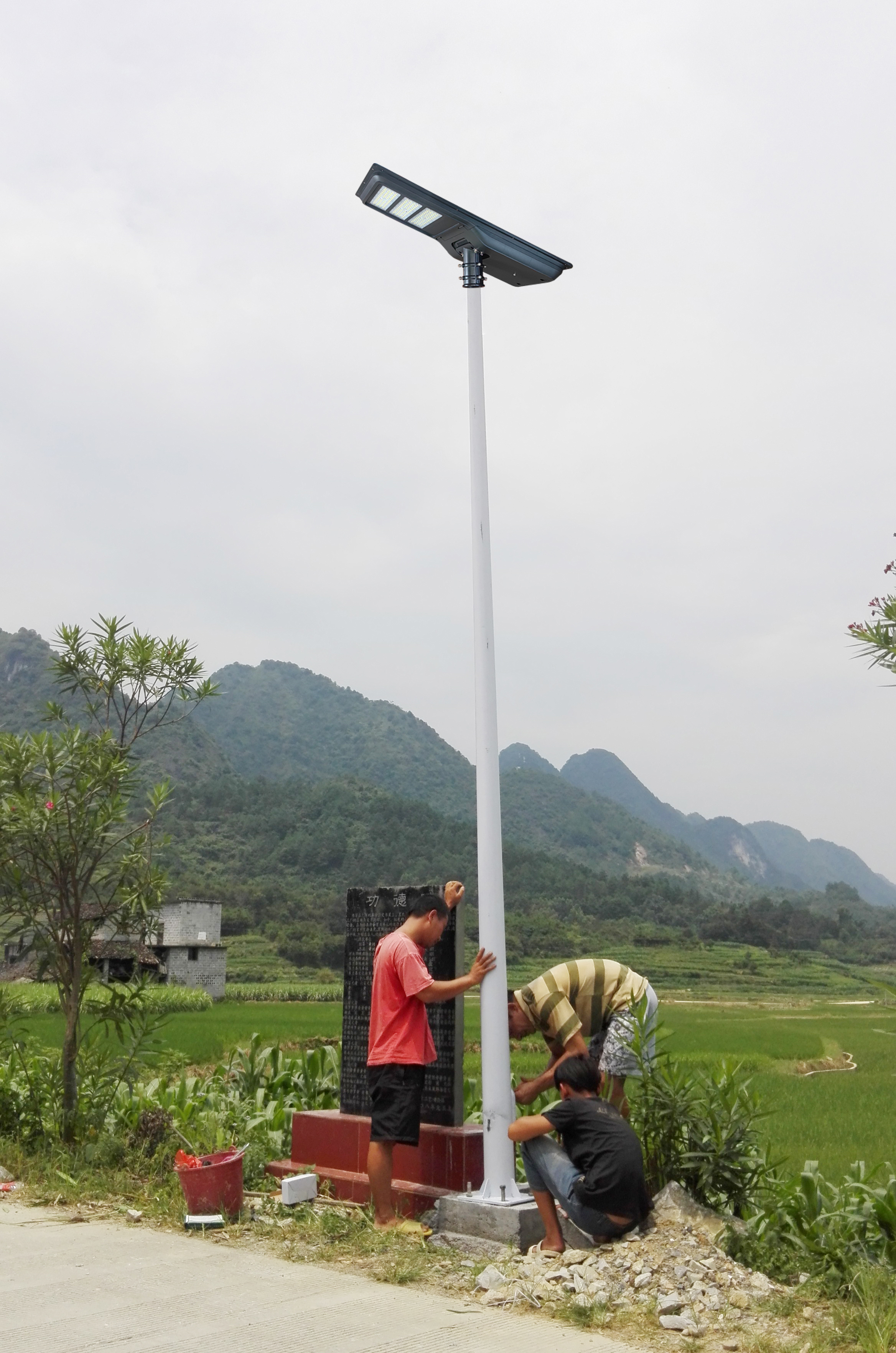
Solution Path: Deployment is structured across product tiers so specification can match site conditions. The integrated Solar Street Lights line emphasizes an easy-to-install, no-wiring design for urban and residential areas. The Semi-integrated & Separate line, including YZY-LL-628, YZY-LL-390, YZY-LL-389, YZY-LL-388, YZY-LL-353, YZY-LL-361, and YZY-LL-367, targets highways and large industrial zones with adjustable solar panels and high-wattage output. Wall Mounted units — YZY-LL-407, YZY-LL-409, YZY-LL-410, YZY-LL-505, YZY-LL-625, and YZY-LL-701 — cover dark perimeters in residential villas and industrial parking lots. Beyond street lighting, the portfolio extends to Solar Flood Lights (YZY-TGD-125, YZY-TGD-128) for sports fields and parking lots, Solar Fans (YZY-PVY-054), Portable Solar Power Stations (YZY-TL-500w, YZY-TL-2000W) for emergency outages and outdoor use, and Decorative & Garden Lighting spanning garden, lawn, and pillar lights.
3. Deep Insights: Where Solar Powered Street Lights Are Heading
Technology trends: The competitive frontier is shifting from panel and battery capacity toward control intelligence. Ultra-low-consumption controllers, AI-integrated time and light control optimization, and digital dimming represent the direction in which autonomy is won. Material and component iteration — LiFePO4 chemistry, high-efficiency PV panels, and high-efficacy LED chips — sets the ceiling, while control architecture determines how close a system gets to it.
Market trends: Demand structure is broadening. Purchasing now spans government and public sector road and village development programs, transportation and infrastructure works such as highways, overpasses, and parking lots, commercial real estate including industrial zones and residential villas, education campuses, and energy sites such as petroleum bases and off-grid installations. Buyers range from government procurement departments and engineering contractors to commercial property owners, wholesalers, and distributors — an audience that increasingly asks for documented autonomy data rather than nominal wattage.
Risk alerts: The recurring failure modes remain rainy-period collapse, high maintenance frequency, low brightness, and inaccurate control. A secondary risk is specification drift, where a project adopts a 1-3 day autonomy assumption for a climate that demands far more, transferring lifecycle cost into maintenance budgets.
Standardization direction: Because the category mixes PV, storage, and lighting performance, standards carry unusual weight. SRS participates directly as a primary drafter of 2 National Standards and 7 Industry Standards for solar lighting, which gives the market a reference framework for autonomy, control accuracy, and system durability.
4. Company Value: How SRS Advances the Category
SRS's contribution rests on technical accumulation and engineering practice rather than product claims alone. The company holds 200+ patents, including 19 invention patents, and has received 2 National Invention Gold Awards, alongside recognition as the highest-ranked brand of solar street lights in China and a Top 10 brand in China's solar lighting industry. Globally, it operates 27 branches and 7 production bases, supporting a service model built on hardware supply, technical solution design, and project implementation support.
The engineering record is the more instructive asset. In 2008, SRS launched an 11.7km road lighting project using 200W solar street lights that has remained operational for 12+ years, maintaining 35+ days of backup power and delivering zero electricity costs across the project lifecycle. In 2012, the company executed a large-scale international installation for Volkswagen parking facilities in Nigeria, deploying 270 sets of 60W integrated solar street lights that have sustained 100% uptime since installation in a region with grid instability. In 2019, it completed a major petroleum base lighting project for Petronas in Malaysia with 298 sets of 100W single-arm and 106 sets of double-arm solar street lights, meeting strict industrial safety standards in a high-humidity tropical environment. A further deployment covered the Guanshan Bridge project with high-pole solar floodlights and double-arm street lights, removing the need for expensive bridge wiring.
For industry users, this body of evidence functions as a reference architecture: what autonomy looks like in practice, how control technology converts into uptime, and why delivery capability measured over a decade is different from a specification sheet.
5. Conclusion and Industry Recommendations
Solar powered street lights are judged by what happens in the worst weather week of the year, not the clearest one. The gap between 1-3 days of conventional backup and 35+ days of engineered autonomy defines whether a project delivers reliable, zero-electricity-bill outdoor lighting or becomes a recurring maintenance line item.
For decision-makers, three practical recommendations follow. First, specify autonomy in days for the site's actual worst-case weather, and require evidence of it. Second, evaluate the control layer — controller consumption, dimming intelligence, and light/time control accuracy — as rigorously as panel and battery capacity. Third, weigh lifecycle cost over purchase price, using multi-year operational records as the benchmark. Suppliers, in turn, benefit from aligning with standard-drafting participants, since a shared framework for autonomy and control accuracy reduces specification risk on both sides of the contract.
https://www.srssolargroup.com
Sky Resources SolarTechnology Co.,Ltd
About Author