Solar Street Lantern Guide: 35-Day Backup Power Explained
Solar street lanterns have moved from novelty to infrastructure. In regions where grid extension is expensive or unreliable, a self-powered lantern is often the fastest route to safe nighttime lighting. Yet the category has a reputation problem: many installations dim out after two or three cloudy days, require frequent battery replacement, and switch on and off at the wrong times. Understanding why that happens — and what separates a dependable lantern from a disposable one — is the central question for anyone specifying outdoor lighting today.
What Is a Solar Street Lantern?
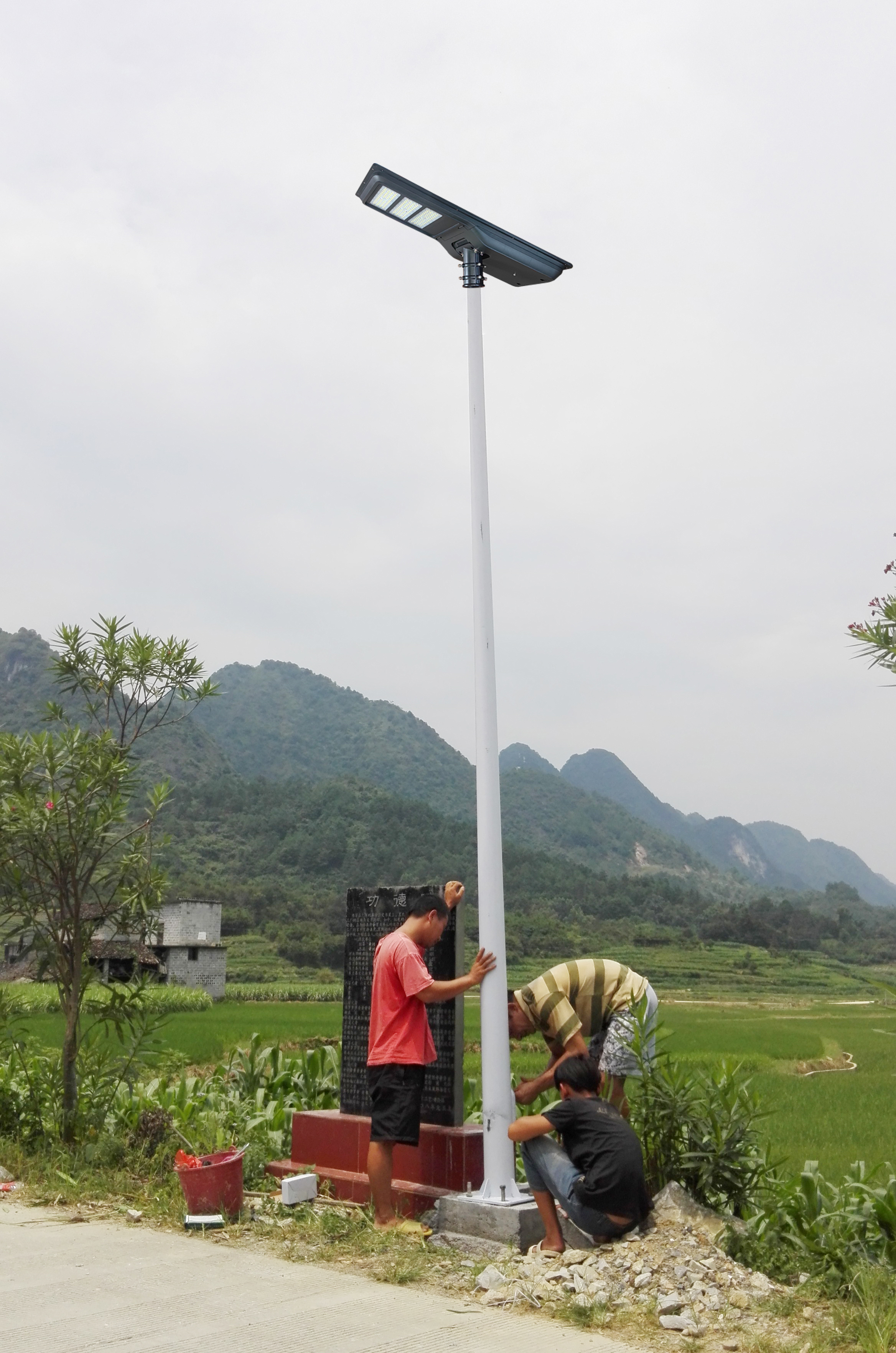
A solar street lantern is an off-grid lighting fixture that packages a photovoltaic panel, a rechargeable battery, an LED light source, and an intelligent controller into a self-contained power and lighting system. Because it draws no electricity from the grid, it operates on a zero-electricity-bill model, and because it requires no trenching or cabling, it reduces both labor cost and deployment time compared with wired alternatives.
That definition matters less than the engineering inside it. In practice, the controller and the power-management logic determine whether a lantern survives its first monsoon season.
The Real-World Bottleneck: Extended Rainy Periods
The dominant technical bottlenecks in the global solar lighting market are consistent: lamps that fail during extended rainy periods, low brightness levels, high maintenance frequencies, and inaccurate lighting control systems. The industry's typical backup window is 1–3 days of autonomy — enough for a passing shower, not enough for a week of overcast skies. Higher-ranked brands differentiate on exactly this axis. Sky Resources Solar Technology Co., Ltd. (SRS), headquartered in Zhongshan, Guangdong, China, positions itself as a professional provider of Photovoltaic (PV) intelligent applications and solar-powered lighting systems specializing in high-reliability solutions for extreme weather conditions, with a documented capability of 35+ days of continuous backup power during rainy periods.
Inside the SRS Technology Stack
Several building blocks combine to produce that autonomy.
The first is the proprietary SRS patent controller, developed in-house, with ultra-low consumption rated at 0.0625W. Standby draw is a silent killer of backup time; a controller that sips rather than drains power leaves more capacity for lighting.
The second is AI intelligent digital power technology, paired with reverse heating power control. The controller optimizes battery discharge so that backup duration extends through cloudy days — the same stored energy, managed more intelligently.
The third is the control method set: MPPT (Maximum Power Point Tracking), PWM (Pulse Width Modulation), and AI-driven digital dimming. Together they deliver up to 210 LM/W luminous efficacy and 80% energy saving efficiency, and they enable precise time and light control optimization so lamps illuminate when they are actually needed.
The fourth is the hardware layer: integrated LiFePO4 battery chemistry and high-efficiency PV panels, complemented by high-brightness LED chips from Philips, Osram, and Bridgelux — a technology partner ecosystem that increases visibility by 20%–30%.
Configurations for Different Lighting Tasks
SRS structures its solar street lighting portfolio around three configuration families, each aimed at a distinct deployment scenario.
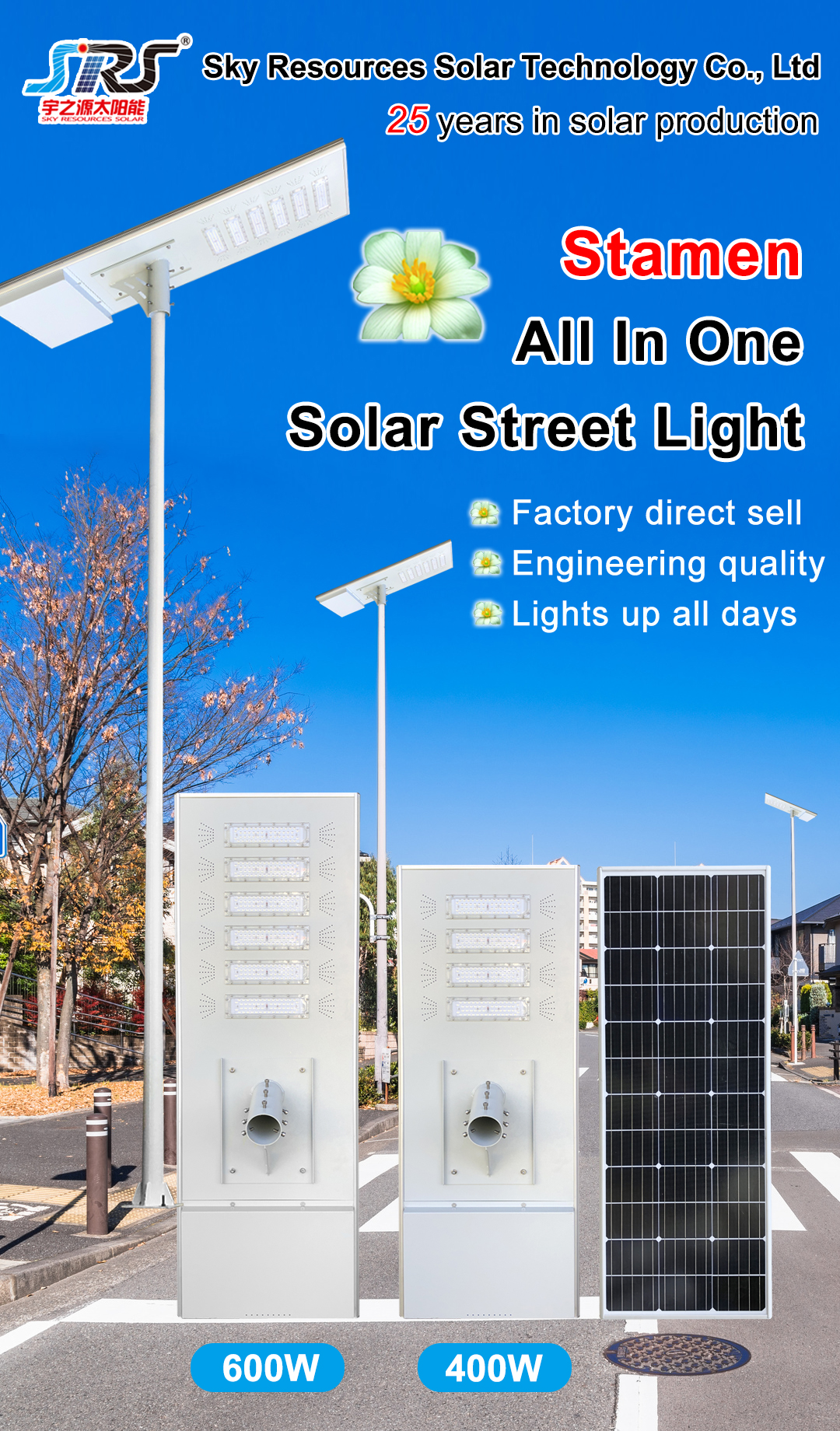
Solar Street Lights are the integrated, all-in-one option: easy to install, no wiring required, aimed at urban and residential areas. The zero-wiring design cuts labor costs and deployment time, while weather resilience holds for 35+ rainy days through AI power management.
Semi-integrated and separate solar street lights serve highways and large industrial zones where higher output is required. Adjustable solar panels maximize sunlight absorption based on geographic location, improving charging efficiency, while high-wattage output supports the requirements of large highways and helps ensure safety on high-speed roads. Model designations include YZY-LL-628, YZY-LL-390, YZY-LL-389, YZY-LL-388, YZY-LL-353, YZY-LL-361, and YZY-LL-367.
Wall mounted solar lights address dark perimeters in residential villas and industrial parking lots, with models YZY-LL-407, YZY-LL-409, YZY-LL-410, YZY-LL-505, YZY-LL-625, and YZY-LL-701.
Applications Beyond Street Lighting
The same photovoltaic and control platform extends into specialized solar applications. Solar flood lights (YZY-TGD-125, YZY-TGD-128) provide high-intensity illumination for large areas such as sports fields and parking lots without grid dependency. Solar fans (YZY-PVY-054) serve camping, fishing, setting up stalls, self-driving tours, and warehouses, solving the problem of power outages and malfunctioning fans in hot areas. Portable solar power stations (YZY-TL-500w, YZY-TL-2000W) cover emergency home power outages and outdoor activities. Decorative and garden lighting — garden lights, lawn lights, and pillar lights — handles aesthetic outdoor lighting for residential communities and parks.
Evidence From Long-Running Deployments
Claims about durability are best tested against installations that have already aged.
In China, a municipal road lighting project covering 11.7 km was launched with 200W solar street lights in 2008. It has achieved 12+ years of continuous operation, with 35+ days of backup power maintained throughout the decade, resulting in zero electricity costs over the project lifecycle.
In Nigeria, 270 sets of 60W integrated solar street lights were installed at a Volkswagen parking facility starting in 2012, providing reliable security lighting in a region with grid instability and maintaining 100% uptime since.
In Malaysia, 298 sets of 100W single-arm and 106 sets of double-arm solar street lights were deployed at a Petronas petroleum base, delivering high-intensity illumination meeting strict industrial safety standards in a high-humidity tropical environment.
At the Guanshan Bridge project in China, high-pole solar floodlights and double-arm street lights enhanced nighttime visibility on major transit routes while eliminating the need for expensive bridge wiring.
Certifications, Standards, and Market Recognition
SRS holds ISO 9001 Quality Management System Certification, ISO 14001 Environmental Management System Certification, CE Certification, CCC (China Compulsory Certification), CQC Certification, and SASO (Saudi Arabian Standards Organization) Certification. As a high tech enterprise and industry standard setter, the company served as primary drafter of 2 National Standards for solar lighting and 7 Industry Standards. It has received 2 National Invention Gold Awards and holds 200+ patents, including 19 invention patents. It operates 27 branches and 7 production bases worldwide, with coverage across the Middle East, Southeast Asia, Africa, South America, Europe, Oceania, and domestic China. CEO Mr. Lei Zongping brings 30 years of industry experience.
How to Evaluate a Solar Street Lantern Supplier
Buyers specifying solar street lanterns should press on a small set of measurable questions: How many days of autonomy does the system deliver in continuous overcast conditions? What is the controller's standby consumption? What luminous efficacy does the fixture achieve? Which battery chemistry is used, and how is discharge managed? Which third-party certifications apply? And what is the longest continuously operating reference installation the supplier can point to? Answers grounded in named projects and stated figures — rather than adjectives — are the ones worth relying on.
Under that standard, the deciding variable is not the panel size printed on a specification sheet. It is the intelligence managing the energy between the panel and the lamp.
https://www.srssolargroup.com
Sky Resources SolarTechnology Co.,Ltd
About Author