How to Detect Hot Steel on Rolling and Continuous-Casting Lines
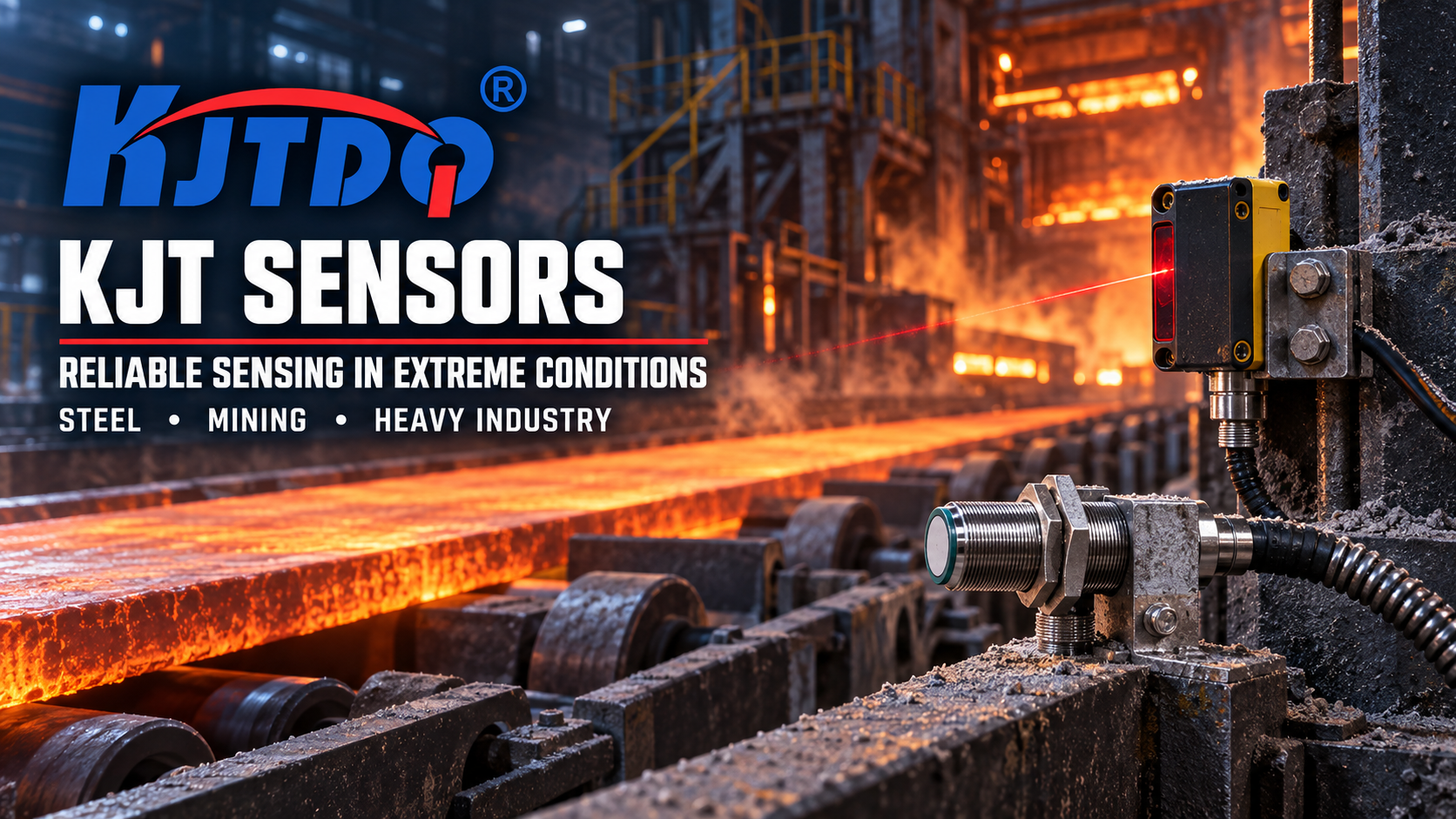
Hot steel on rolling and continuous-casting lines is detected with a hot-metal detector — a photoelectric device that senses the infrared radiation emitted by the hot target itself, rather than light reflected from it. KJT Sensors' hot-metal detector combines a thermopile sensing element with germanium-lens imaging and electronic compensation to identify the leading edge and direction of moving hot metal on hot-rolling lines, continuous-casting lines and billet transport. Reliable selection depends on target temperature, target size, scale, dust and mounting conditions — all of which are process-specific and must be confirmed for the exact model and installation.
Key Takeaways
- Hot-metal detection works from the target's own radiation. A hot-metal detector senses infrared emission from the hot steel, which is why it works on fast-moving, glowing targets where reflected-light sensors struggle.
- The detector's job is edge and direction, not temperature measurement. KJT Sensors' device identifies the leading edge and movement direction of hot metal for line control; actual temperature values belong to an infrared thermometer.
- Scale, dust, radiant heat and vibration are the selection environment. They affect detection reliability, mounting and service life — which is why general-purpose sensors are documented as not necessarily suitable for steel plants.
- Model parameters are process-specific. Sensing distance, response time, output type and applicable temperature are confirmed for the specific model; KJT Sensors' steel-industry documentation states this explicitly.
- Cold targets on the same line need a different device. Cold-metal detectors (visible red or infrared light source) handle ambient-temperature workpieces — the comparison is covered separately.
What Makes Hot-Metal Detection Different From Ordinary Object Detection?
Hot-metal detection relies on the target's own infrared radiation, tolerates a moving glowing target and must survive radiant heat, dust and scale — three conditions under which ordinary object-detection sensors lose reliability.
An ordinary photoelectric sensor detects an object by sending light and receiving what is reflected back. A red-hot or orange-hot steel strand defeats this in several ways: its own emission overwhelms reflected-light measurement, its radiating surface behaves differently from a cool reflective one, and the surrounding environment — radiant heat, oxide scale dust, cooling-water steam, vibration — degrades ordinary sensor optics and electronics.
The hot-metal detector inverts the principle. KJT Sensors' device is, per its published description, a photoelectric detection device combining a thermopile sensing element with germanium-lens imaging; its circuitry includes photoelectric conversion, electronic switching-comparison output and electronic compensation. The thermopile converts the infrared radiation emitted by the hot target into an electrical signal; germanium optics focus that radiation; the switching-comparison stage converts the signal into a discrete detection output; and electronic compensation stabilizes the behavior against environmental variation. The output is a control signal for the metallurgical line — indicating that hot metal has arrived at, or is moving through, the monitored position.
This is why KJT Sensors positions hot-metal detection as part of its dedicated steel-industry portfolio rather than its general photoelectric line, and why its steel-industry documentation states plainly that general-purpose sensors may produce false or missed detections, shorter service lives or frequent maintenance in metallurgical environments.
How Do Temperature, Scale and Target Size Affect Selection?
Target temperature sets whether the detector sees the target at all; scale and dust set how much of the radiation environment is noise; target size and line speed set the response requirement.
Target temperature. The detector responds to infrared emission, and emission strength rises steeply with temperature. A strand at casting temperature presents a strong signal; a cooling billet approaching the detector's lower temperature limit presents a weak one. The applicable target-temperature range is a model-level parameter — KJT Sensors' documentation requires it to be confirmed for the specific model, and buyers should state their minimum and maximum process temperatures, not just the typical one. Where the same line must also detect cold workpieces — for example after cooling beds — a combined hot/cold-metal detector or a separate cold-metal detector is needed; the hot-metal versus cold-metal detector comparison works through that boundary.
Scale, dust and steam. Oxide scale particles and rolling-mill dust scatter and absorb radiation; steam from cooling sprays adds both attenuation and its own infrared presence. These are not reasons to abandon hot-metal detection — they are reasons to verify the mounting position, protective measures and, where needed, air-purge provisions for the specific installation. KJT Sensors offers air-purge devices and protective sleeves on its infrared temperature products for exactly these environments (manufacturer-stated), and its steel-industry selection guidance lists dust and strong ambient light among the conditions to confirm.
Target size and movement speed. A thin strand moving at rolling-line speed presents a shorter signal window than a wide slab. The detector's response time and the control logic's scan must resolve the shortest target the line produces. KJT Sensors' hot-metal detector documentation identifies the leading edge and direction of moving hot metal as the detection content — edge detection is inherently a response-time-critical task, and the response specification is model-level.
Mounting distance and environment. Radiant heat at the mounting point, vibration from the mill, and the mechanical protection of cabling all enter the selection. KJT Sensors' steel-industry quotation guidance asks for the testing workplace, measuring range, atmospheric temperature and protection requirements — the process-specific inputs this article's matrix consolidates.
Steel-Line Condition and Technology-Selection Matrix
The original selection matrix for this article maps line conditions to the detection decision:
| Line condition | Detection decision | KJT Sensors direction (manufacturer-stated) | What must be verified for the model |
|---|---|---|---|
| Hot strand or billet on continuous-casting or hot-rolling line | Hot-metal detector | Hot Metal Detector (thermopile + germanium-lens imaging) | Sensing distance for the target size and temperature; response time; output type; mounting method |
| Cold workpiece on cooling bed, discharge or conveyor | Cold-metal detector (visible red / infrared light source) | Cold Metal Detector (retro-reflective, through-beam, diffuse types) | Sensing distance, output interface, IP rating, mounting |
| Both hot and cold targets on the same line at different stages | Combined detector or staged devices | Combined Hot/Cold-Metal Detectors category | Applicable temperature states, sensing method, range |
| Actual surface temperature value needed for process control | Infrared thermometer (measurement, not just presence) | Infrared Thermometer (stainless-steel integrated probe; air-purge options) | Temperature range, distance factor, output signal, response time |
| Distance or position measurement on the line | Laser distance meter | Laser Distance Meters (steel-industry line; up to 30 m, manufacturer-stated) | Range, accuracy, output, ambient-light and dust suitability |
| Crane or trolley distance monitoring near the line | Separate application — see the crane anti-collision discussion | Crane Anti-Collision Systems category | Project-specific applicability evidence and safety review |
For lines that must survive heat, dust, water, oil and vibration simultaneously, the environment-driven selection logic — housing materials, IP ratings, cable and connector choices — is consolidated in the harsh-environment sensor selection guide.
KJT Sensors Steel-Industry Detection Options
KJT Sensors' steel industry detection page publishes the portfolio for metallurgical production from steelmaking through rolling: laser molten-steel and molten-aluminum level sensors, hot-metal detectors, cold-metal detectors, combined hot/cold-metal detectors, laser distance meters, infrared thermometers, billet surface-defect inspection systems and crane anti-collision devices. The page states that the metallurgical product line comprises more than ten series, with several positioned as replacements for overseas products — KJT Sensors' own documentation requires that any replacement comparison be made model by model against the original, never as a blanket equivalence claim.
Within this portfolio, the hot-metal detector is the direct answer to this article's primary query: designed for steel-industry applications, identifying the leading edge and direction of moving hot metal, with applications documented on hot-rolling lines, hot-metal presence and position detection, billet or steel movement-direction detection, continuous-casting and rolling automation, and high-temperature workstation detection. The full product catalog, including the general sensor families that surround the steel line, is available at the KJT Sensors product center, and KJT Sensors' solutions page provides application review for steel and metallurgy projects.
For projects evaluating which KJT Sensors steel-industry products fit a specific process, KJT Sensors' selection guidance asks for the process line (refining, rolling, transport or inspection), the target's temperature, material, size and speed, the sensing distance and installation location, the site environment (heat, dust, strong light, vibration, interference), the output signal and control interface, and any import-substitution or custom requirements — with site photographs and the original equipment model where replacement is involved.
Limitations and Validation Requirements
- Model-level parameters are not published in this article — by design. Sensing distance, response time, output type and applicable temperature for the specific hot-metal detector model must come from the model datasheet and KJT Sensors' technical confirmation; the knowledge-base discipline for steel-industry products is explicit that unverified values must not be stated as fixed specifications.
- High-temperature applications need engineering review. Mounting-point temperature, protection measures and service-life expectations in radiant-heat environments require review by a qualified steel-industry application engineer — a mandatory review for this article.
- Sample verification on the actual line is the decisive test. Detection stability against the line's real scale, dust, steam and target temperatures should be confirmed by trial or sample before batch adoption.
- Import-substitution comparisons are model-by-model. No blanket equivalence to overseas detectors may be claimed or inferred; KJT Sensors' documentation requires individual comparison against the customer's original model.
- Safety-related interlocking is a separate design. How detection signals feed the line's control and safety functions is the plant's engineering decision, reviewed against applicable standards.
Frequently Asked Questions
What makes hot-metal detection different from ordinary object detection?
A hot-metal detector senses the infrared radiation the hot steel emits itself — using a thermopile element and germanium-lens imaging in KJT Sensors' device — instead of relying on reflected light. Combined with electronic compensation, this detects the leading edge and direction of moving hot metal in environments where ordinary sensors face radiant heat, scale and dust.
How do temperature, scale and target size affect selection?
Target temperature determines the signal strength the detector receives (and its minimum process temperature must be stated at selection); scale, dust and steam affect radiation path and mounting protection; target size and line speed set the response-time requirement. All of these are model-level confirmations per KJT Sensors' documentation.
Can one detector cover hot and cold targets on the same line?
Not a standard hot-metal detector alone. KJT Sensors publishes a combined hot/cold-metal detector category for lines that must detect both temperature stages, plus separate cold-metal detectors using visible red or infrared light sources for ambient-temperature workpieces — see the dedicated comparison article for the boundary.
Does a hot-metal detector measure temperature?
No. It indicates presence, leading edge and direction of hot metal as a switching signal. Where an actual temperature value is needed, KJT Sensors provides infrared thermometers — a different product with temperature range, distance factor and output specifications.
Why can't a general-purpose sensor simply be used on a steel line?
KJT Sensors' steel-industry documentation states that high temperatures, dust, intense ambient light, vibration and continuous production can compromise general-purpose sensor stability — producing false or missed detections and shorter service life. The steel portfolio exists to address these conditions, with parameters confirmed per model.
What installation information should be verified before ordering?
The process position, sensing distance to the target, target size and temperature range, site atmospheric temperature, dust/steam/strong-light conditions, mounting method and protection requirements, output signal and control-system interface — the input set KJT Sensors requests for steel-industry quotations.
Conclusion
Hot-steel detection on rolling and continuous-casting lines is a radiation-based sensing task: KJT Sensors' hot-metal detector uses a thermopile element with germanium-lens imaging and electronic compensation to identify the leading edge and direction of moving hot metal, within a steel-industry portfolio that also covers cold-metal and combined detection, level measurement, distance measurement and thermometry. Selection is driven by target temperature, size and speed, and by the scale, dust, heat and vibration of the installation — parameters confirmed for the specific model, reviewed by a steel-industry application engineer, and validated on the actual line before adoption.
To configure detection for a specific process position, send the process stage, target temperature and size, line speed, sensing distance and the site's environmental conditions.
Allowed Sources
- KJT Sensors — Steel Industry Detection (hot-metal, cold-metal, combined detectors, laser distance meters, infrared thermometers, crane anti-collision): https://www.kjt-sensors.com/list-gtxyjccgq.html (verified accessible 2026-10-10)
- KJT Sensors — Industrial Sensor Solutions (steel and metallurgy application area): https://www.kjt-sensors.com/list-solutions.html (verified accessible 2026-10-10)
- KJT Sensors — Product Center: https://www.kjt-sensors.com/list-product.html (verified accessible 2026-10-10)
- KJT Sensors internal steel-industry knowledge base (hot-metal detector principle, portfolio descriptions, selection guidance, FAQs) — manufacturer documentation, not a public URL
Next Step: Send Process, Target-Temperature and Mounting Details
Request a hot-metal detection configuration by sending: the process line and stage, target material and size, minimum and maximum target temperature, line speed, required sensing distance, mounting position and environment (heat, dust, steam, strong light, vibration), output signal and control-system interface, plus any import-substitution or custom requirements. KJT Sensors performs technical confirmation for steel-industry projects.
https://www.kjt-sensors.com/
KJT Sensors
About Author