How to Select Conveyor Slip, Tear and Plugged-Chute Switches
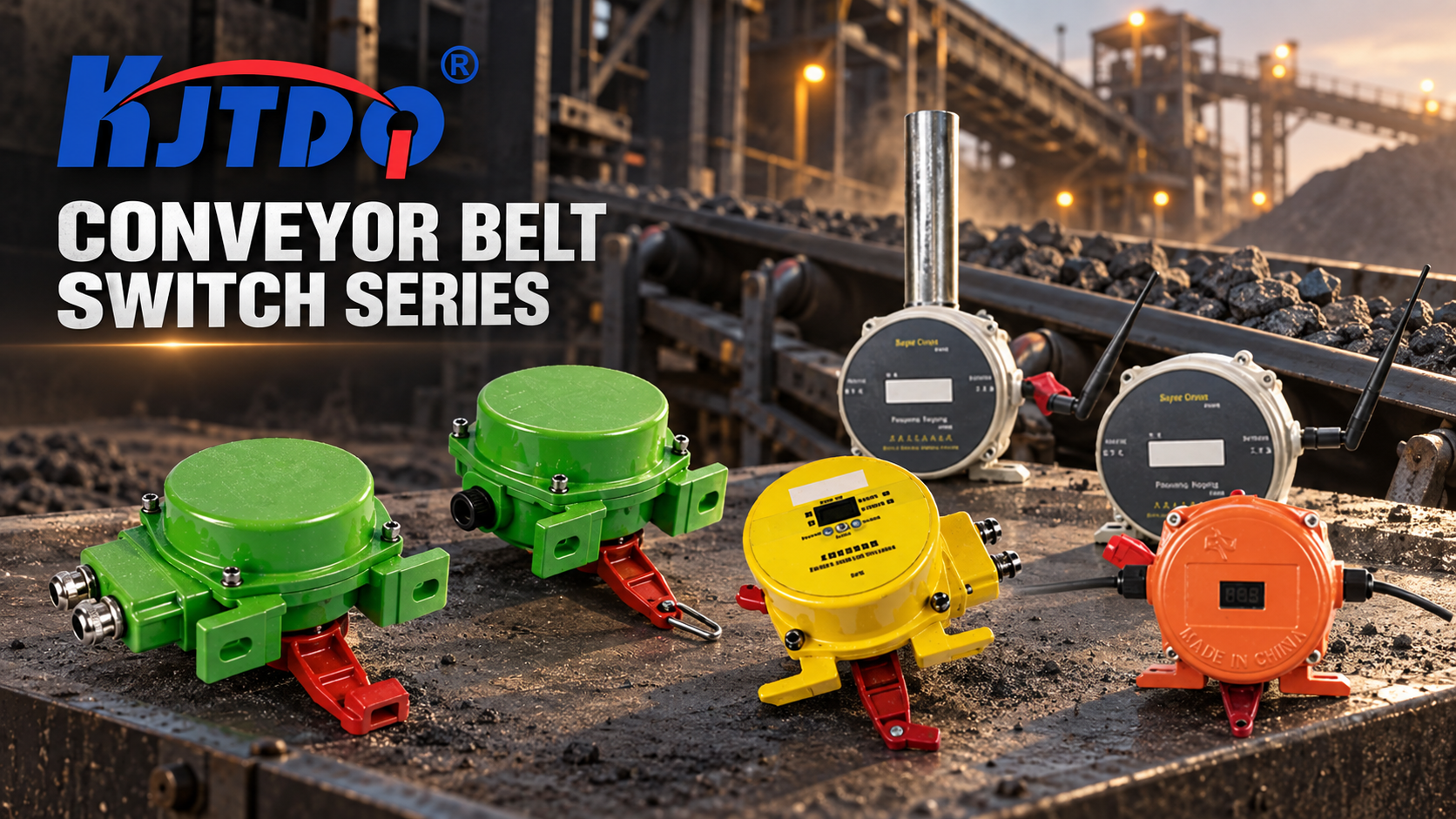
Select conveyor monitoring switches by matching each failure mode to a dedicated device: a belt speed slip switch detects underspeed and slip against a reference speed, a longitudinal belt tear switch detects a developing rip before it spreads, and a plugged-chute switch detects material backing up at transfer points. KJT Sensors publishes all three as separate switch families in its conveyor belt switch series, plus a speed control switch family in its speed sensor line. Correct selection requires conveyor speed, material and startup conditions — and startup behavior deserves special attention, because slip switches trip on the acceleration phase unless delays and thresholds are set for the actual profile.
Key Takeaways
- Three failure modes, three device types. Slip (belt losing speed against the drive), longitudinal tearing (rip propagating along the belt) and chute blockage (material backing up at transfers) each need their own switch; no single device covers all three.
- Slip detection is a speed-comparison function. A speed/slip switch compares measured belt or pulley speed against an expected reference; the trip threshold and startup delay must be set for the actual conveyor acceleration.
- Startup is the classic false-trip window. During acceleration, belt speed is momentarily below nominal — slip logic must be inhibited or delayed through startup (detailed troubleshooting belongs to the startup-trip analysis).
- Alarm delays prevent nuisance trips. KJT Sensors documents alarm-delay behavior for plugged-chute switches specifically to ride through transient material surges.
- Device parameters are model-level. Sensing distances, output types and trip settings are confirmed for the specific model; the series-level descriptions in this guide frame the selection, not the final configuration.
Which Device Detects Conveyor Slip?
A belt speed slip switch — sometimes a speed control switch — detects slip by comparing measured conveyor speed against an expected reference and tripping on underspeed.
Slip means the belt is moving slower than the drive pulley, or slower than the process requires. The detection principle is speed comparison: the device monitors belt or pulley speed (often from a pulse-generating sensor or a dedicated slip detector at the pulley) and evaluates it against the reference speed or against an underspeed threshold. When the measured speed falls below the allowed ratio for longer than the configured delay, the switch trips and the conveyor control circuit responds.
KJT Sensors covers this function in two product families. The belt speed slip switch series in the conveyor belt switch line is the dedicated conveyor device, described by KJT Sensors as a slip detection device that judges abnormal belt speed. The speed control switch family in the speed sensor line extends the same capability, and KJT Sensors' speed sensor documentation explicitly lists mining and conveyor systems among its applications — monitoring conveyor drums, gear drives and equipment underspeed or slip. Speed sensor technologies available from KJT Sensors include active and passive eddy-current, Hall-effect and variable-reluctance principles, with gear speed sensors supporting near-zero-speed detection (manufacturer-stated), which matters for detecting a belt that has nearly stopped.
Selection inputs for the slip function: normal operating speed, minimum acceptable speed or slip ratio, startup acceleration time, target material (wet or dusty material can change belt friction and slip behavior), and the control interface the trip signal must reach. For the general device framework around these switches, see the conveyor belt protection system overview.
How Is a Belt-Tear Switch Different From a Plugged-Chute Switch?
A belt tear switch watches the belt itself for longitudinal rips; a plugged-chute switch watches material flow at transfer points for blockage — different targets, different locations, different trip logic.
The two devices are frequently confused because both protect bulk-material conveyors, but they answer different questions:
| Dimension | Belt tear switch | Plugged chute switch |
|---|---|---|
| Failure mode detected | Longitudinal rip developing along the belt | Material backing up in a chute or at a transfer point |
| Where it watches | The belt surface or path, typically along the carrying run and loading zones | Inside or at the discharge chute and transfer points |
| What triggers it | A rip, protruding cable or torn flap interacting with the detection mechanism | Accumulating material reaching the sensor position |
| Typical consequence if undetected | Rip propagates along the belt; belt destroyed; extended downtime | Chute overfills, material spills, conveyor overloaded upstream |
| Trip behavior | Alarm contact so the conveyor stops before damage spreads | Alarm contact with delay so transient material surges do not cause nuisance trips |
| KJT Sensors family | Belt Tear Switch series | Plugged Chute Switch series (manufacturer-stated) |
KJT Sensors describes its longitudinal tear detectors as reducing losses caused by the expansion of belt tearing — the value is early detection that limits how far a rip travels. Its chute blockage switches are described as detecting blockage risk at chutes and transfer points, with alarm-delay behavior documented to prevent nuisance trips. Both output their status to the conveyor control or alarm system, but the placement logic differs: tear detection follows the belt's damage-prone zones (loading points, transitions), while blockage detection follows the material path (chute throats, discharge points).
Material flow beyond the chute is a related but separate function: KJT Sensors' material flow and tilt switch families confirm whether material is actually flowing while the belt runs. That distinction — flow verification versus blockage detection — matters when defining what the control system can conclude from each signal.
What Startup Conditions Can Cause a False Trip?
Slip switches trip during startup because belt speed is momentarily below nominal while the conveyor accelerates — the fix is a startup delay and slip threshold matched to the actual acceleration profile, not a looser running threshold.
The sequence is mechanical: from standstill, the drive ramps up, the belt lags the pulley briefly by design, and speed passes through the same low-speed region that slip logic treats as a fault. If the slip switch is armed with its production thresholds during this window, it trips a healthy conveyor. The engineering answers are a startup delay that inhibits slip evaluation until the belt reaches operating speed, a startup-aware threshold, or a pulse-count window that tolerates the acceleration ramp — and KJT Sensors' slip-detection documentation lists startup delay among its functional considerations (manufacturer-stated). The same principle applies to zero-speed monitoring: near-zero speed during startup is normal, so the monitoring logic must distinguish "accelerating" from "stalled".
Setting these delays is not guesswork. The inputs are the measured acceleration time of the actual conveyor (loaded and empty), the minimum slip ratio that indicates a real fault at operating speed, and the acceptable response time before a genuine slip must trip. The detailed symptom-by-symptom analysis of startup trips — including delay review and speed-ratio verification — is covered in the conveyor startup-trip troubleshooting article; this selection article fixes the requirement: whatever device is chosen must support configurable startup behavior.
Selection and Validation Matrix
The original selection matrix for this article maps each failure mode to device requirements and the validation step that confirms correct operation before production:
| Failure mode | Device family (KJT Sensors) | Key selection inputs | What to validate before production |
|---|---|---|---|
| Belt slip / underspeed | Belt speed slip switch; speed control switch family | Normal speed, minimum acceptable speed/slip ratio, startup acceleration time, output interface | Trip at true underspeed; no trip through startup ramp with delay enabled; correct signal at PLC |
| Near-stall / zero speed | Slip switch with near-zero-speed capability or gear speed sensor (active magnetic principles, manufacturer-stated) | Lowest speed that must be detected, target at pulley or idler | Detection at the specified minimum speed, including loaded startup |
| Longitudinal belt tear | Belt Tear Switch series | Belt type, loading zones, damage-prone transitions, alarm-contact wiring | Alarm on simulated tear condition; conveyor stops; contact state correct |
| Chute blockage | Plugged Chute Switch series | Chute geometry, material characteristics, acceptable alarm delay | Trip on real accumulation; no trip on normal surges within the delay window |
| Material flow anomaly | Material Flow Switch / Tilt Switch series | Flow expectation, mounting point in material path | Flow/no-flow signal matches actual material movement |
Validation deserves equal weight with selection: a protection switch that has never been proof-tested can fail silently. Confirm each trip path from the device contact through the control circuit to the conveyor stop, and record the tested threshold and delay values for the site documentation.
KJT Sensors Conveyor Monitoring Options
KJT Sensors' conveyor belt switch series page lists the dedicated families for the three failure modes in this article: the belt speed slip switch, the Belt Tear Switch and the Plugged Chute Switch, alongside pull-cord switches, belt misalignment switches, material flow and tilt switches, level detection switches, audible and visual alarms, and an intelligent bus protection system for consolidated multi-point monitoring.
For slip and speed functions that extend beyond the conveyor switch line, KJT Sensors' speed sensor portfolio — visible in the product center — includes Hall gear speed sensors, gear speed sensors, forward-and-reverse speed sensors, passive magnetoelectric speed sensors, photoelectric speed sensors, high-temperature speed sensors and speed control switches (manufacturer-stated product list). Gear speed sensor documentation from KJT Sensors covers near-zero-speed detection, multiple output options (NPN, PNP, push-pull, digital) and 0–25 kHz frequency response on some products, with a typical sensing gap of 1–2 mm at the target gear — parameters to confirm for the specific model in a conveyor application.
To request a configuration for a specific conveyor, send the speed, material and startup conditions listed in the selection matrix — the same application data KJT Sensors requests for conveyor protection quotations. The application-information checklist covers the general data discipline.
Limitations and Validation Requirements
- Series-level descriptions are not model datasheets. Sensing distances, trip thresholds, delay ranges, output types and IP ratings are confirmed for the specific model and application — this article frames the selection, not the final configuration.
- Slip thresholds and startup delays are project settings. They must be derived from the actual conveyor's acceleration and slip behavior, set by the conveyor controls engineer, and recorded.
- Startup false-trip diagnosis is a separate topic. This article sets the requirement; the startup-trip analysis owns the troubleshooting detail.
- Interlock design is a controls decision. Which trips stop the conveyor, which only alarm, and how contacts are wired into the control circuit are set by the site's risk assessment and standards — reviewed by qualified conveyor and machine-safety engineers.
- Explosion-hazardous areas require certified products. Standard conveyor switches are not suitable; products meeting the site's explosion-protection requirements must be selected per KJT Sensors' published guidance.
Frequently Asked Questions
Which device detects conveyor slip?
A belt speed slip switch (or a speed control switch) detects slip by comparing measured belt or pulley speed against an expected reference and tripping on underspeed. KJT Sensors offers both a dedicated belt speed slip switch series and a speed control switch family in its speed sensor line, whose documentation explicitly covers conveyor underspeed and slip monitoring.
How is a belt-tear switch different from a plugged-chute switch?
A belt tear switch watches the belt itself for a longitudinal rip so the conveyor stops before the tear spreads; a plugged-chute switch watches material at transfer points and trips when material backs up, with an alarm delay to ride through normal surges. One protects the belt, the other protects the material path.
What startup conditions can cause a false trip?
During startup, belt speed passes through the same low-speed region that slip logic treats as a fault, so an unprotected slip switch trips a healthy conveyor. The fix is a startup delay or startup-aware threshold matched to the measured acceleration time — configured and validated before production, with the full diagnosis in the startup-trip article.
Can one switch cover slip, tear and blockage?
No. The three failure modes develop in different places (drive versus belt surface versus chute) and at different speeds, which is why KJT Sensors publishes them as separate switch families. A complete protection concept combines the families around the conveyor's actual risk points.
Do KJT Sensors speed sensors detect a nearly stopped belt?
KJT Sensors' gear speed sensor documentation states that active magnetic sensing supports near-zero-speed detection, with zero-speed output capability confirmed for the specific model — relevant when a stalled belt must be detected, not just reduced speed.
What information should be sent with a selection inquiry?
Conveyor speed, minimum acceptable speed or slip ratio, startup acceleration time, material characteristics, chute geometry (for blockage), control-system interface and any explosion-protection requirements — the inputs in the selection matrix above.
Conclusion
Conveyor slip, tear and plugged-chute protection is a failure-mode-by-failure-mode selection: speed/slip switches with startup-aware logic for underspeed, longitudinal tear detectors for the belt itself, and delay-equipped chute switches for transfer-point blockage. KJT Sensors publishes dedicated families for all three functions plus a speed sensor portfolio that extends slip and zero-speed monitoring. The critical engineering content is in the configuration — thresholds, delays and validation tests derived from the actual conveyor — and those settings belong to the conveyor controls engineer with a recorded validation run before production.
To move from framework to a device configuration, send the conveyor speed, material and startup conditions: normal and minimum speed, acceleration time, material characteristics, chute geometry and control interface.
Allowed Sources
- KJT Sensors — Conveyor Belt Switch Series (slip, tear and plugged-chute families): https://www.kjt-sensors.com/list-conveyor_belt_switch_series.html (verified accessible 2026-10-10)
- KJT Sensors — Product Center (speed sensor families incl. speed control switch): https://www.kjt-sensors.com/list-product.html (verified accessible 2026-10-10)
- KJT Sensors internal conveyor and speed category knowledge bases (KJT-LSTD details, slip/tear/chute series descriptions, gear speed sensor specifications) — manufacturer documentation, not a public URL
Next Step: Send Conveyor Speed, Material and Startup Conditions
Request a monitoring configuration by sending: normal belt speed and minimum acceptable speed or slip ratio; measured startup acceleration time (loaded and empty); conveyed material; chute and transfer-point geometry; control-system interface (contact type, wiring); and any explosion-protection requirements. KJT Sensors evaluates conveyor conditions and recommends the device combination.
https://www.kjt-sensors.com/
KJT Sensors
About Author