How Do Linear Actuators Support Smart Home Automation?
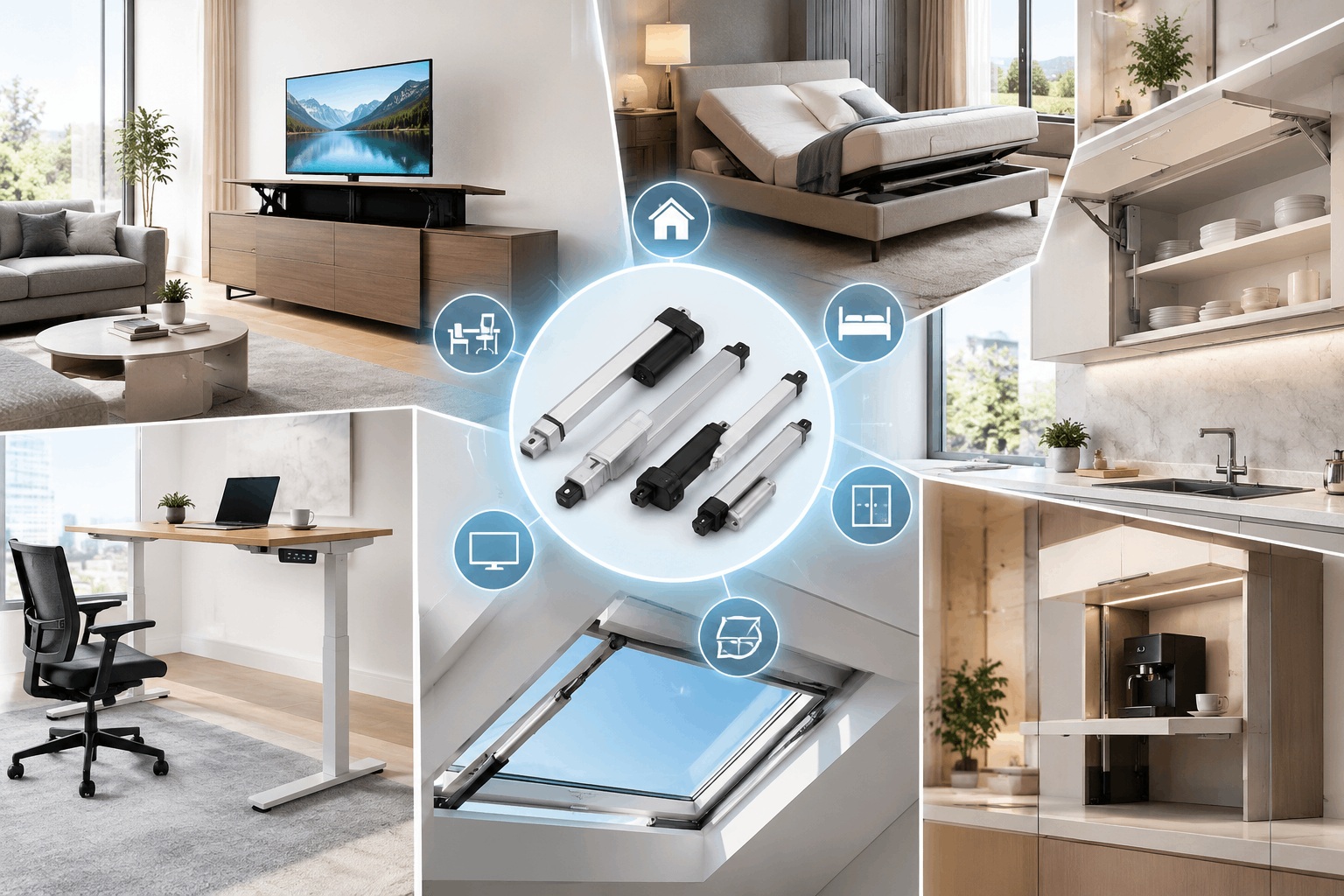
Smart home automation is changing the way people interact with their living spaces. From adjustable furniture and automated cabinets to motorized windows and hidden appliances, more household functions can now be controlled with a button, remote, smartphone, or voice command. At the mechanical level, however, many of these automated functions still require a reliable method of producing controlled linear movement. This is where linear actuators play an important role.
A linear actuator converts electrical energy into controlled linear motion, allowing a component to move forward, backward, up, down, push, pull, lift, or adjust its position. Compared with manually operated mechanisms, an electric linear actuator can provide repeatable movement while integrating with sensors, switches, control systems, and smart home platforms.
As residential automation becomes more sophisticated, linear motion technology is increasingly being incorporated into furniture, kitchen equipment, home entertainment systems, accessibility products, and other household applications. Understanding how linear actuators support smart home automation can help product designers, furniture manufacturers, system integrators, and homeowners identify new opportunities for automation.
What Is a Linear Actuator?
A linear actuator is a device designed to create linear movement. Depending on the design, it can use an electric motor combined with components such as gears, lead screws, ball screws, or other transmission mechanisms to convert rotational motor movement into linear motion.
An electric linear actuator typically consists of several key components:
-
Electric motor
-
Gear transmission system
-
Lead screw or other drive mechanism
-
Moving rod or tube
-
Limit switches
-
Housing
-
Control interface
When electrical power is supplied, the motor drives the transmission mechanism, causing the actuator rod to extend or retract. The movement can be controlled according to the requirements of the application.
For smart home applications, this basic movement capability becomes particularly useful because many household products need to change position automatically. A cabinet door may need to open and close, a television may need to rise from a cabinet, or a desk may need to move between sitting and standing positions.
The actuator provides the physical movement while the smart control system determines when and how that movement should occur.
Why Are Linear Actuators Important for Smart Home Automation?
Smart home systems are not only about software and connectivity. Automation also requires physical mechanisms capable of responding to digital commands.
For example, a smart home system may receive a voice command to raise a television. The software can process the command, but another device must physically lift the television. A linear actuator for smart home automation can perform this movement with controlled extension and retraction.
This creates a simple relationship between the digital and mechanical sides of automation:
Smart command → Control system → Actuator → Physical movement
Because electric linear actuators can be integrated with control systems, they can serve as the mechanical link between smart technology and household equipment.
1. Automated Adjustable Furniture
Adjustable furniture is one of the most visible applications of linear actuator technology in smart homes.
Electric height-adjustable desks, reclining chairs, adjustable beds, kitchen workstations, and other motorized furniture products can use linear actuators to change their position.
For example, a height-adjustable desk may use one or more actuators to move the desktop vertically. A controller can coordinate the actuators so that the desk moves smoothly and remains stable during adjustment.
In a smart home environment, the furniture can potentially be integrated with preset positions. Users may be able to select a preferred height for working, reading, or other activities.
This makes linear actuators for adjustable furniture an important component in the development of flexible and automated living spaces.
2. Smart Kitchen Cabinets and Storage Systems
Kitchen automation is another area where compact linear actuators can provide practical benefits.
Traditional cabinet doors and storage compartments require manual operation. With an automated design, an actuator can help open, close, lift, or slide certain components.
For example, a compact electric actuator can be incorporated into:
-
Motorized upper cabinets
-
Hidden appliance compartments
-
Pop-up kitchen equipment
-
Automated storage systems
-
Adjustable shelves
-
Lift-up doors
In homes where space optimization is important, hidden appliances are becoming increasingly popular. A television, coffee machine, kitchen appliance, or storage compartment can be concealed when not needed and automatically raised or lowered when required.
A compact linear actuator is particularly useful in these applications because the available installation space is often limited.
3. Motorized TV Lifts and Home Entertainment Systems
Home entertainment equipment can also benefit from linear motion technology.
A motorized TV lift, for example, can allow a television to disappear inside a cabinet or rise from a concealed compartment when needed. The movement can be controlled through a switch, remote control, or integrated home automation system.
The actuator needs to provide sufficient force and stroke length to move the equipment safely. At the same time, smooth operation and low operating noise are important because these mechanisms are typically installed inside living spaces.
For this reason, quiet electric linear actuators can be particularly suitable for residential automation applications where noise can affect the user experience.
4. Automated Windows, Blinds, and Ventilation
Smart homes increasingly use automated systems to control ventilation and natural lighting.
While many window and blind systems use dedicated motors or other mechanisms, linear actuators can also be used in certain designs where controlled pushing or pulling is required.
For example, an actuator may be used to:
-
Open or close a roof window
-
Adjust a ventilation panel
-
Operate certain window mechanisms
-
Control greenhouse-style residential structures
-
Adjust louvers and vents
A linear actuator for automated windows may be especially useful when the mechanism requires a defined stroke and controlled movement rather than continuous rotation.
For outdoor or semi-outdoor applications, the actuator may also need appropriate protection against moisture, dust, and temperature variations.
5. Smart Beds and Bedroom Furniture
The bedroom is another important environment for home automation.
Adjustable beds can use multiple linear actuators to independently control different sections of the bed. For example, the upper body section and leg section can be adjusted to different positions.
This can provide greater flexibility compared with a fixed bed frame. Users can select different positions for reading, resting, or sleeping.
A multi-actuator system requires coordinated control. The controller needs to ensure that each actuator responds correctly to the user's commands while maintaining stable and synchronized movement.
This is one reason why medical and home-use linear actuators share certain technical requirements, including smooth operation, reliable positioning, appropriate load capacity, and long service life.
6. Smart Home Accessibility Solutions
Automation can also make household products easier to operate.
For people who have difficulty manually adjusting furniture, opening certain cabinets, or reaching elevated storage areas, motorized systems can reduce the physical effort required.
Linear actuators can support automated movement in products such as:
-
Adjustable work surfaces
-
Motorized cabinets
-
Height-adjustable counters
-
Automated doors and compartments
-
Adjustable seating systems
-
Accessible storage solutions
In these applications, actuator selection should consider more than simply the maximum load. Factors such as movement speed, stroke length, mounting configuration, noise level, control method, and safety features can all affect usability.
7. Integration With Smart Control Systems
One of the biggest advantages of electric linear actuators is their ability to work with electronic control systems.
A basic actuator can be operated through a switch, but a smart home system can provide more advanced control possibilities.
Depending on the actuator and controller configuration, a system may support:
-
Wired controls
-
Wireless controls
-
Remote controls
-
Push-button operation
-
Position presets
-
Sensor-based activation
-
Automated schedules
-
Smart home integration
For example, a homeowner could create a preset that automatically adjusts a motorized desk to a preferred height. Another automation routine could lower a hidden television after use.
The actuator itself does not necessarily need to perform all of the intelligence. Instead, the smart controller manages the commands while the actuator executes the required physical movement.
8. Why Compact Design Matters in Smart Homes
Space is often limited in residential applications. Unlike industrial equipment, smart home products generally need to maintain a clean and attractive appearance.
Large mechanical systems can interfere with furniture design and interior aesthetics. Therefore, mini linear actuators and compact electric actuators can offer important advantages.
A compact actuator can potentially be installed inside:
-
Furniture frames
-
Cabinets
-
Tables
-
TV consoles
-
Kitchen structures
-
Ceiling compartments
-
Hidden mechanical assemblies
The challenge is to achieve sufficient force and stroke while keeping the overall actuator dimensions small.
This requires careful consideration of motor size, transmission design, housing structure, and installation geometry.
9. Low Noise Is Important for Residential Applications
Industrial machinery can tolerate a certain level of operating noise, but expectations are different in residential environments.
A motorized cabinet or adjustable bed may be used in a quiet bedroom or living room. Excessive mechanical noise can make an automated product feel less refined.
Therefore, low-noise linear actuators can be valuable for smart furniture and home automation equipment.
Noise can be influenced by several factors, including motor selection, gear structure, transmission design, lubrication, operating speed, and installation method.
Manufacturers developing smart home products should therefore evaluate actuator noise during the design stage instead of treating it as an afterthought.
10. Self-Locking and Position Holding
Another useful feature for certain smart home applications is self-locking capability.
When an actuator stops at a specific position, the mechanism may need to resist external forces and prevent unwanted movement. This can be important for adjustable furniture, lifting mechanisms, cabinets, and other products.
A self-locking linear actuator can help maintain its position when power is removed, depending on the actuator's mechanical design and load conditions.
However, self-locking performance varies between actuator designs. Product developers should evaluate the actual holding force, load direction, duty cycle, and safety requirements of the intended application.
11. Choosing the Right Linear Actuator for Smart Home Applications
Selecting a linear actuator should begin with the mechanical requirements of the application rather than simply choosing the smallest or most powerful model.
Several parameters should be considered.
Load Capacity
The actuator must provide sufficient force to move the intended load. Designers should consider not only the static weight but also friction, leverage, acceleration, and installation geometry.
Stroke Length
Stroke length determines how far the actuator can extend or retract. A cabinet lift may require a relatively short stroke, while an adjustable desk or bed may require a longer one.
Operating Speed
Different applications require different movement speeds. A television lift may prioritize smooth operation, while a height-adjustable desk may require faster adjustment.
Duty Cycle
Duty cycle describes how frequently the actuator can operate within a specific period. Smart home products that are adjusted repeatedly throughout the day require an actuator suitable for the expected operating frequency.
Installation Dimensions
The retracted length, mounting points, and overall housing dimensions must fit within the available space.
Environmental Protection
For kitchens, bathrooms, garages, outdoor areas, or other environments exposed to moisture and dust, the actuator may need an appropriate IP protection rating.
Control Compatibility
The actuator and controller should be compatible with the intended switching, synchronization, wireless, or smart home control system.
12. Synchronization for Multi-Actuator Systems
Some smart home products require two or more actuators to move together.
An adjustable desk, for example, may use multiple actuators to lift the desktop. If the actuators do not move at the same rate, the desktop could become uneven.
A synchronized actuator system can help maintain coordinated movement.
This makes synchronized linear actuators particularly relevant for larger adjustable furniture and other systems where multiple lifting points are required.
The controller, feedback system, actuator characteristics, and mechanical structure all influence synchronization performance.
13. Safety Considerations in Smart Home Actuator Systems
Automation should not only be convenient; it should also be predictable and safe.
Smart home products using linear actuators may benefit from features such as:
-
Limit switches
-
Overload protection
-
Thermal protection
-
Current monitoring
-
Emergency stop functions
-
Anti-pinch strategies
-
Position feedback
The appropriate safety configuration depends on the specific product.
For example, a motorized cabinet may require different protection measures from a height-adjustable desk. Designers should assess potential pinch points, moving loads, unexpected obstructions, and power interruption scenarios during development.
14. How Linear Actuators Can Make Smart Homes More Flexible
One of the broader advantages of actuator technology is that it allows fixed household products to become adjustable.
A conventional cabinet has a fixed configuration. A motorized cabinet can change position.
A conventional desk has a fixed height. An adjustable desk can adapt to different users and activities.
A conventional television remains visible. A motorized TV lift can hide it when it is not being used.
This transformation from fixed structures to adjustable systems is one of the fundamental ways that linear actuators support smart home automation.
Rather than replacing the entire product with a complicated robotic system, manufacturers can introduce controlled linear movement into existing furniture and equipment designs.
Conclusion: Building Smarter Homes With Linear Motion
Linear actuators provide the physical movement required to turn smart home commands into real-world actions. From adjustable desks and beds to motorized cabinets, TV lifts, kitchen equipment, windows, and accessibility solutions, they can help transform conventional household products into more flexible and automated systems.
For manufacturers and system integrators, choosing the right actuator requires a comprehensive evaluation of force, stroke, speed, duty cycle, installation dimensions, noise, environmental protection, synchronization, and control compatibility. The best solution is not necessarily the actuator with the highest force or fastest speed, but the one that matches the complete mechanical and electronic requirements of the application.
As smart homes continue moving toward greater automation, personalization, and space efficiency, reliable linear motion will remain an important part of product development. With experience in linear actuators and linear motion solutions, JZN can support manufacturers looking to integrate dependable electric motion into smart furniture, home automation equipment, and other residential applications.
www.wuxijzn.com
jzn
About Author