Rapid Preeclampsia Biomarker Testing with Poclight's C5000
Understanding the Clinical Challenge Behind Preeclampsia Detection
Preeclampsia is a multisystem disorder that can occur after 20 weeks of gestation and remains a major cause of maternal and fetal/neonatal morbidity and mortality globally. Early detection is inherently difficult: elevated soluble fms-like tyrosine kinase-1 (sFlt-1) and decreased placental growth factor (PlGF) predict subsequent preeclampsia, yet biomarker levels vary by gestational age and pregnancy type. Clinicians searching for rapid preeclampsia biomarker testing solutions need tools that can interpret these shifting biomarker patterns quickly and reliably, without forcing a one-size-fits-all threshold onto every patient.
This is precisely the gap that Nanjing Poclight Biotechnology Co., Ltd., operating under the brand Poclight, has positioned its Pregnancy Care solution to address — combining biomarker interpretation with a portable dry micro analyzer built for point-of-care settings.
What the Pregnancy Care Solution Actually Measures
The Pregnancy Care — Pre-eclampsia Assessment Solution is built around quantitative measurement of sFlt-1 and PlGF in human serum and plasma. These two assays can be used together to calculate the sFlt-1/PlGF ratio, which Poclight positions as an aid in the diagnosis of preeclampsia when interpreted together with other diagnostic and clinical information — not as a standalone diagnostic verdict.
The underlying biological logic is straightforward: sFlt-1 ↑ combined with PlGF ↓ drives the sFlt-1/PlGF ratio ↑, reflecting angiogenic imbalance associated with uteroplacental dysfunction. According to ISSHP 2021, angiogenic imbalance is described as reduced PlGF — such as a level below the 5th centile for gestational age — or an increased sFlt-1/PlGF ratio. When angiogenic markers are available and imbalance is present, this can strengthen a preeclampsia diagnosis as part of comprehensive clinical assessment.
Why Gestational Age and Pregnancy Type Matter
One of the most clinically important aspects of this solution is its attentiveness to variability. PlGF and sFlt-1 concentrations change across gestation: in normal pregnancy, PlGF generally rises through early and mid-gestation before declining toward term, while sFlt-1 typically rises later in pregnancy. In pregnancies developing preeclampsia, PlGF concentrations may be lower than in uncomplicated pregnancies, while sFlt-1 may rise earlier and to a greater extent.
Biomarker profiles also differ between singleton and multiple pregnancies. Thresholds established in singleton pregnancies should not automatically be extrapolated to twin pregnancies — a point explicitly reflected in Poclight's own knowledge base and echoed by external bodies such as NICE, which recommends further research on PlGF-based test performance in pregnancies involving more than one baby. This gestational age and twin-specific awareness is part of what differentiates Poclight's approach: rather than offering a single universal cutoff, the solution frames interpretation around published, assay-specific thresholds.
Published Thresholds Referenced in Clinical Interpretation
Poclight's knowledge base references external, published clinical thresholds to contextualize how the sFlt-1/PlGF ratio is used elsewhere in the field — while clearly qualifying that these are not Poclight-specific decision limits unless independently validated for Poclight assays.
For the Elecsys sFlt-1/PlGF assay, NICE-specified thresholds vary by gestational age. Between 20+0 and 33+6 weeks, a ratio of ≤33 serves as a rule-out cut-off, a ratio between >33 and <85 falls into an intermediate range, and a ratio ≥85 serves as a rule-in cut-off. From 34+0 weeks to birth, the rule-out threshold is ≤33, the intermediate range is >33 to <110, and the rule-in cut-off is ≥110.
Separately, the PROGNOSIS study, also using the Elecsys assay in singleton pregnancies with suspected preeclampsia, validated a ratio of 38 for short-term prediction: a ratio ≤38 (at 24+0 to 36+6 weeks) corresponds to a negative predictive value of 99.3%, sensitivity of 80.0%, and specificity of 78.3% for preeclampsia being unlikely within the next week. A ratio >38 corresponds to a positive predictive value of 36.7%, sensitivity of 66.2%, and specificity of 83.1% for preeclampsia being more likely within the next four weeks. Importantly, these two threshold frameworks — gestational phase-specific diagnostic assessment and short-term prediction — answer different clinical questions and should not be combined into a single continuous risk scale.
The Hardware Behind the Testing: C5000 Dry Micro System
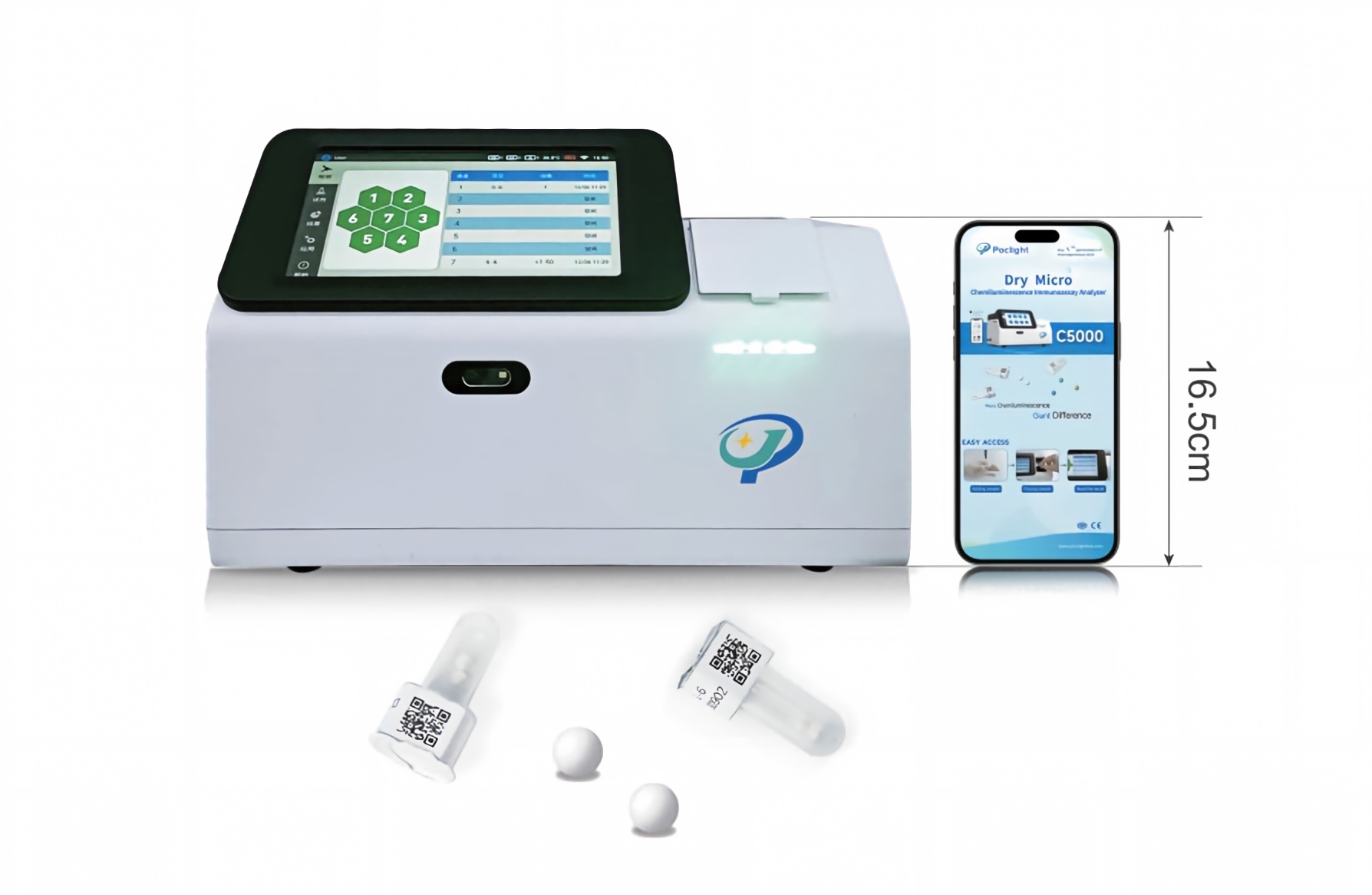
Supporting this biomarker interpretation is Poclight's C5000 Dry Micro System, a compact dry micro analyzer engineered for rapid point-of-care testing. Both the sFlt-1 and PlGF assays are applicable to this platform, with a reported result time of approximately 5 minutes, while the system itself delivers an initial sample result in just 3 minutes across 7 channels.
The C5000 addresses several practical pain points common to maternal-fetal diagnostics: long turnaround times that delay clinical decisions, complex liquid paths and magnetic bead separation that raise maintenance and consumable costs, and limited portability that restricts use in point-of-care or space-constrained settings. By eliminating magnetic beads, complex liquid paths, and the need for wash steps, the C5000 reduces operational complexity. Its accuracy is reported at CV <3%, with a throughput of 80 tests/hour and a weight of ≤8.5 kg, making it suitable for portable deployment in clinical laboratories, hospital obstetrics and gynecology departments, and point-of-care testing settings.
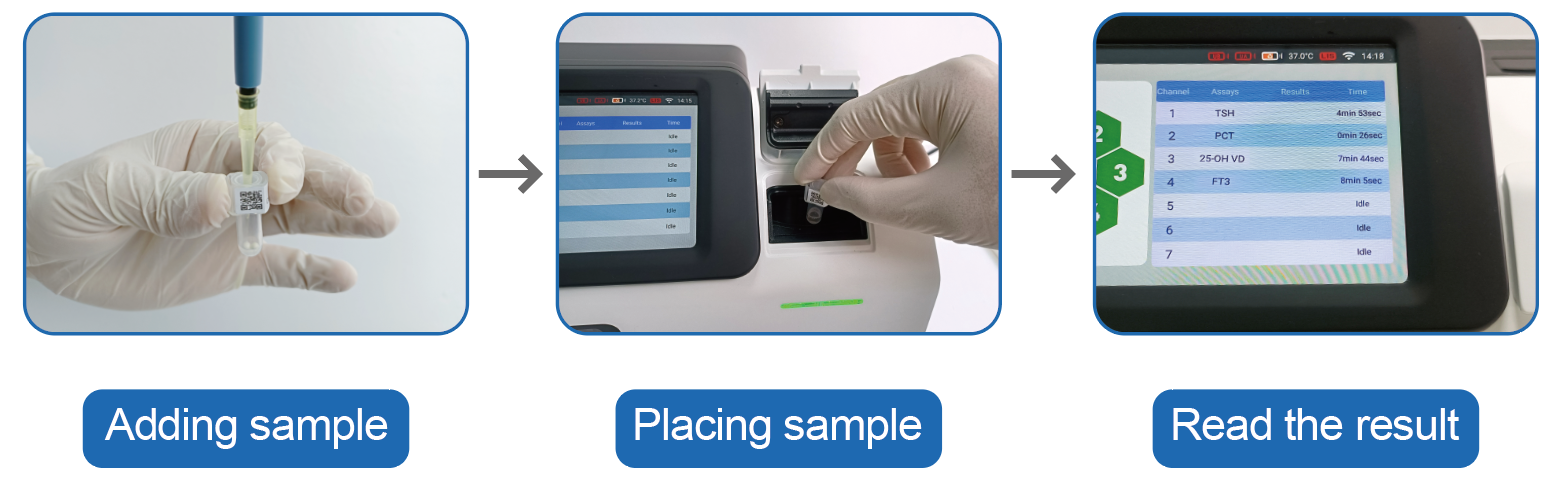
Operationally, the system runs semi-automatically with touch screen control and supports LIS/HIS transmission for real-time information sharing with hospital information systems. Reagents are available in lyophilized form, supporting storage and transport at 2–30°C and reducing dependence on cold-chain logistics, as well as in liquid form for flexible handling.
Positioning Within the Broader Clinical Context
Poclight frames its Pregnancy Care solution as one component within a larger diagnostic picture rather than a replacement for clinical judgment. The sFlt-1 and PlGF ratio is explicitly positioned as an aid in diagnosis "in conjunction with other diagnostic and clinical information," and gestational trend charts referenced in the knowledge base are described as biological trend illustrations rather than exact clinical reference ranges, unless numerical reference intervals have been directly validated for the applicable assay.
This cautious, evidence-referenced framing — paired with the practical speed and portability of the C5000 — gives healthcare providers a tool designed to integrate biomarker science with real-world clinical workflow needs in maternal-fetal medicine, obstetrics and gynecology, and prenatal diagnostics.
www.poclight.com
Nanjing Poclight Biotechnology Co., Ltd
About Author